Friday, July 23, 2010
"Always - Love Over Gold" - WHY DID YOU MAKE ME HUMAN? cassette compilation (Mississippi Records)
The continuing saga of a modest little record store in Portland, Oregon and the consistent stream of audio goodness that bears their imprint/mark of quality is one of the best and least expected fruits of being a music fan in the here and now. WHY DID YOU MAKE ME HUMAN? is volume 43 in Mississippi Records’ homemade compilation tape series, and it presents a fine selection of “Doo-Wop, R & B and early Rock” (as scrawled on the packaging), much of it (at least to these ears) sweetly obscure. The ultimate objective of these cassettes (and the MP3s of their contents that are currently traversing the internet’s reliable circuitry) is quality and not rarity however, so the track-list does include some well known names: Bo Diddley’s riotous and celebratory call and response groove-mining (“Africa Speaks”), Ike & Tina Turner’s molten hip-swinging ferocity (“I Idolize You”), The Shirelles’ tough and sweet gal-group largeness (“Doomsday”), The Coasters’ typically zonked and wise-assed R & B (“Little Egypt”) and Sam Cooke’s eternally gorgeous soul rendering (“Nobody Knows the Trouble I’ve Seen”) all make superb appearances. There are also a slew of names that are noteworthy if far less canonical, and that’s where some of this comp’s finest tracks are located. Garnet Mimms and the Enchanters are best known for the formidable hit “Cry Baby” (later covered by Janis Joplin), but “A Quiet Place” should’ve been just as big. It lands squarely between late period vocal group richness and the then (1964) burgeoning Cooke-inspired soul construction, and it contrasts well with the blunt gush of The Falcons’ (who hit big with “You’re So Fine” in 1959) “I Got a Feeling”, which uses a roughly similar blueprint toward a goal that’s far more concerned with raw stomping and shouting. The Ad-libs are best known for “The Boy From New York City”, but their non-hit 1966 A-side “Human” (which queries this compilation’s title) is an amazing piece of A cappella Doo-Wop that’s cumulative effect is just jaw-dropping. The Edsels’ of “Rama Lama Ding Dong” fame conjure a nice bit of vocal group loopiness with “I Was Born in Mexico”, and Barbara George, best known for “I Know (You Don’t Love Me No More)” (#1 R & B/#3 Pop in ’61) fronts a slightly eccentric but inviting slice of vintage New Orleans junk. Considering the quality of all of the above, it’s still the obscurities that carry this gem up the stairs to the level of exceptional. The Twistin’ Kings were actually Motown’s legendary house band aka The Funk Brothers, and “Congo Twist (Part 2)” is a very curious and uncommonly inspired attempt at dance craze cash in, radiating very much like a piano led soul-jazz session that’s mutinied by a rogue gang of hired percussionists, the scalawags derailing and rerouting the atmosphere into territory very much about strong coffee and lush exotica. Quite beyond Chubby Checker, baby. But The Delcos’ might just steal this whole show with “Arabia”, which is a whole lot like a rougher, less streamlined version of The Four Seasons contractually obliging a cameo in some nameless rough and tumble exploito-teen cinema. I kind of imagine the scene a little like this: A bunch of absconding harem girls stow away on a cruise ship and accidentally drink copious amounts of a kooky scientists’ powerful love-elixir. They proceed to invade the ships swinging and unsuspecting discotheque, where Valli and Co are holding court with a particularly smoking band. Rhythmic mayhem ensues. If “Arabia” is destined to be my personal tiptop of the cuts offered here, there is still plenty more fine quality stuff located amongst the 23 tracks, and while most of it leans toward vocal group eloquence either A cappella (The Casanovas, The Hudsons) or with accompaniment (The Jive Bombers, The Revells), it also has a nice helping of additional R & B in store (Tarheel Slim & Little Ann, Pearl Jones). But it’s the two truly spiffy Rockabilly excursions that really stand out (but make total sense) in this milieu. The Musical Linn Twins “Indian Rock” is dripping with that spastic hiccupping frenzy as perfected by crazy Caucasians in the second half of the ‘50s and Benny Joy’s warped excursion into sauced lounge weirdness is a direct antecedent to one of Tav Falco’s many facets. The entirety of this cassette is an ideal example of wise, inspired assemblage, and as such is so much more than just cool. It’s loaded from end to end and back again with pure life affirmation, the stuff that serves like a hand-me-down hickory stick to beat off the bugaboos, scourges and downers of modern life. And while the actual cassette copies of this have probably all found loving homes, I’ll again stress that MP3s are out there for the finding. Playing them might lead you to momentarily mistake yr IPod for a transistor radio, and cool THAT most certainly is.
Labels:
Doo-Wop,
Mississippi Records,
rhythm and blues,
soul
Monday, July 12, 2010
Ten from the '90s Part Six (1995): The Blue Humans- INCANDESCENCE CD (Shock)
INCANDESCENCE was released in 1995 on writer and Skullflower guitarist Stefan Jaworzyn’s Shock label, and it documents a particularly noteworthy and vital trio formation of guitarist Rudolph Grey’s post-No Wave/improv-rock outfit, featuring legendary and late jazz drummer Beaver Harris and longstanding skronk-noise-agitator Jim Sauter from New York’s notorious behemoth sax/guitar trio Borbetomagus, recorded live at CBGB in an opening slot for Sonic Youth in 1988. Music recorded in the ‘80s and released in the ‘90s to be (hopefully) savored until the end of all time. Blue Humans (along with Grey’s solo work) has been generally uncelebrated within the wide-open range of the post-’77 underground, even though he’s collaborated with a bunch of major names, outsider jazz giant Arthur Doyle and top-notch experimentalist Alan Licht among them. If Grey’s name rings a bell for many it’s in relation to his exceptional oral biography of sui generis American filmmaker Edward D. Wood Jr. And yeah, that’s one whopper of a book. Grey’s strength as a purveyor of molten improvisational scorch is a whole other basket of steaming bagels, though. Without explicit debts, Blue Humans launch from the same pad that hosted the ecstatic eruptions of late era-John Coltrane. But where lots of artists more deeply connected to jazz tradition became (maybe at times too) concerned with relating /continuing the spiritual element of ‘Tranes’ late sound, Pharaoh Sanders springing to mind first and foremost, Grey’s various groups start with the glorious sonic extremity inherent to LIVE IN SEATTLE or OM and jump with calibrated intensity into a new territory that falls between out-(noise) rock and unapologetically full-on improvisational scorch without ever feeling like a studied attempt at fusion style grafting, ultimately registering as far more organic and intuitive than either Last Exit or the unjustly neglected SST act Universal Congress Of (as great as both of those bands certainly were, and more on UCO later). Of course, Grey’s No Wave roots are a big part of the picture. His late ‘70s band Red Transistor is one of the key lost groups of the genre (one essential 7” posthumously released on Thurston Moore’s Ecstatic Peace! label), and Blue Humans can be looked upon as the template for the sort of aggressive and extended non-commercialism that No Wave really should have developed into. This very brief CD is evidence of the quite frequent gestures toward unbridled creativity that occurred during this era of supposed horrid conformity (the ‘80s only sucked for people who didn’t look or couldn’t find hep sounds), and I feel safe in surmising that at least one person that unknowingly stumbled in front of the exquisite explosiveness of this trio had their life permanently altered for the better. Sauter’s delivery here is looser and more identifiably jazz-like than his deliberately pummeling attack in Borbetomagus and Harris’ drumming throws aside any explicit ties to jazz tradition, instead opting for an explosive and rock-aligned forward motion (still abstract as all hell) that shows how deeply simpatico he is with Grey’s sensibility. That sensibility, in something close to a nutshell, is a free flowing yet thick and abrasive mass of sound surely influenced by but ultimately not classifiable as jazz. The music here, even with its roots in Coltrane (and Albert Ayler), owes far more to Jimi Hendrix at his most sonically extreme. Most casual listeners might miss this since Hendrix was nearly always somehow connected to song forms and Grey most assuredly is stridently the opposite, his work often feeling instead like one of Jimi’s typically great solos turned inside out and reshaped into something seemingly new yet secretly familiar, or possibly like a brief segment of The Experience at their most outré being looped, examined and expanded like a mind-bendingly beautiful Technicolor balloon. There are certainly still ties to the assaultive core sensibility of No Wave and also to free jazz, but Blue Humans were simply born of the former and borrowed from the latter. And just like it would be a huge fallacy to categorize AXIS: BOLD AS LOVE as a blues record, to call INCANDESCENCE late period No Wave or contempo free jazz is just as largely off the mark. Instead, this document is a core example of one of the rarest of forms: Free Rock. Now, one thing INCANDESCENCE does share with free jazz is the harsh fact that it is best experienced in the live context. To quote the great master Eric Dolphy: “When you hear music, after it's over, it's gone, in the air. You can never capture it again”. The recordings of improvisational, cathartically abstract expression have always been attempts to capture the incendiary essence of this wide-ranging and inexhaustible form, and even the greatest examples have ultimately failed to grasp the sheer life-altering power of witnessing the sweat roll from the brow of a player while standing in the midst of a cloud of collective creative abandon. INCANDESCENCE does a damn fine job trying to harness the force of the fervor, though. It’ll never match being there, but it can make being wherever the hell you are infinitely more interesting. And that’s the whole point, I think.
Grey with sax master Arthur Doyle and Beaver Harris
Wordy, unruly and dissonant: Saccharine Trust- PAGAN ICONS LP (SST 006)
Saccharine Trust’s first album is probably destined to be ever-slept on. It’s certainly identifiable as punk rock circa 1981, though there are either too many or not enough odd, quirky, arty elements integrated into the brief running time of PAGAN ICONS (I consider it an LP, some call it an EP, I think we’re both right) to work up the posthumous froth of a fan base. For many, they will be considered too weird to fit the now codified definition of what punk rock is supposed to sound like. But for others, the Trust will be too committed to the rock tradition, even at this early point, to really qualify under their terms as groundbreaking or vital. They weren’t an “anti”-group like Flipper in form or The Nig-Heist in content, and while assuredly lyrically thought provoking also lacked the aggressive antagonism inherent to many of their peers (label mates Black Flag for one example). Folks could and have called Jack Brewer’s words pretentious and his voice obnoxious, but rest assured I’d never be that uncouth. Brewer’s real function at this early stage is to serve as an effective vocal counterweight to guitarist Joe Baiza’s already distinctive style. Syllables and chords intertwine into a heaving, throttling atonalistic mass that when aided by the functional but worthy rhythm section of Earl Liberty (bass) and Bob Holtzman (drums) forms a vicious and dark whole. Brewer’s throat is so loose and slippery that it essentially eschews the sorta big group sing-alongs that have aided a lot of now canonical punk action, plus the lyrics avoid the kind of chanting brevity or blatant sloganeering that was quite frequent by this point. “I Am Right” is a tightly wound and well executed exception (while subversively serving as a smart taunt toward self-righteousness, punk and otherwise), featuring a group-growled chorus melded to some tightly coiled chug and clang (it was later covered very well by Sonic Youth), and “We Don’t Need Freedom” does edge up against the caustic protest punk that was starting to gain traction in the dawn of the hardcore era, though the thorny ponderousness of the subject matter is much larger and interesting than the so often simplistic political platitudes expressed by a stinky busload of punk “radicals”. This true non-conformist quality is quite an important aspect of their sound and identifies Saccharine Trust not as outsiders searching for the safety of a marginalized peer group (which is what much of the punk movement [any movement for that matter] actually was, and there is not a bit of shame in that) but instead as committed iconoclasts stoked by the thrilling tension and release (i.e. the power) of musical expression. Of course the Trust did find their hail fellows in the SST/New Alliance scene, where they became an integral piece of that network’s puzzling jigsaw. This fine record zips by in a flash of amped up density, with the five minutes of its closing cut “A Human Certainty” making it quite clear that Baiza and Brewer were heading outward from any kind of orthodoxy. Joe wails through a snarling mess of string mulch while simultaneously presiding over a stressed groove, and Jack steps up and matches him with the bruised and bombastic testifying of a wounded soul. This is the track that appeared on THE BLASTING CONCEPT compilation LP and served as my introduction to Saccharine Trust. ICONS fell into my lap almost immediately after that, and at first “A Human Certainty” stuck out like an aching digit from the other seven tracks on the record. 1-7 were hyper-spazzy out-punk, ragged and surly and comely, but 8 felt to me like a sweaty and unstable deconstruction of something I was much more familiar with at my then young age, that being blues based hard rock. This was in no way a boneheaded punk-era piss take, however. It was instead a signifier of deeper rock knowledge that lined these guys up with not only their SST label mates Minutemen and St. Vitus, but also Cali-contemporaries like Dream Syndicate, X and Flesheaters. This sense of history helped Saccharine Trust avoid even a fleeting flirt with faceless generics, and they continued to evolve, underappreciated but unbowed. These days, PAGAN ICONS truly feels like a well formed whole. Its energy and intelligence are undiminished, and if you’re at all interested in the SST saga, this isn’t a footnote, it’s an essential component.
Ten from the '90s Part Five (1993): Unrest- PERFECT TEETH CD (Teen Beat/4AD)
Unrest’s development from smart and arty ‘80s post-HC upstarts into arguably the best guitar-pop trio of the ‘90s was a fascinating thing to hear as it happened. I can’t brag that I was there from the very beginning mind you, but I wasn’t that far behind, doing mail-order from Mark E. Robinson’s Teen Beat label when a large portion of that imprint’s discography was homemade cassette releases. And in my opinion there is a plurality of approaches into the vast worthiness of the band’s legacy: maybe the easiest way is to engage with their existence in two parts. The first found Robinson and drummer Phil Krauth interacting with a progression of third members (Tim Moran, Chris Thomson, Dave Park, Justin Chearno) in a sustained attempt at romancing a mind-bogglingly diverse assemblage of influences into something roughly approximating a focused aesthetic. That they were so successful at this unruly endeavor gets more impressive as time slouches forward. UK prog, Kiss covers, Kenneth Anger, shards of DC-post hardcore, choppy acoustic wrangling, unusual but surefooted instrumental passages, sincere post-punk appropriation and flashes of unadulterated pop brilliance all combined to somehow sound downright logical. Any of the band’s early recordings showcase this sonic coup to fine effect, though MALCOLM X PARK is probably the best example. The culmination of this first part saw the band undergo a subtle refinement that avoided downplaying their wide ranging nature, with KUSTOM KARNAL BLAXPLOITATION evidencing this shift. And that was cool, but where do you go from there? In Unrest’s case, you move on to the second part of their lifespan, often called the “Bridget Cross-era”. Cross had already made some serious waves as a member of Velocity Girl, contributing in a very key manner to that DC-area group’s outstanding debut 7” before bailing and hooking up with Robinson and Krauth in 1990. Her contribution to Unrest was immediately felt as they kicked out a couple of classic short players, “Yes She Is My Skinhead Girl” and “Cherry Cherry”. Listening to both it was plainly clear that further refinement was taking place. Specifically, deep attention was now being paid to the post-punk and guitar pop elements in the band’s arsenal, and they quickly attained an overt yet non-slavish Anglo-ist minimalism that was equal parts arty and catchy. At times insanely catchy. IMPERIAL F.F.R.R. is often thought of as the go-to release for this era of the band, since it solidified them as a main attraction of the ‘90s indie heyday (Spin Magazine articles and all that). And it is a masterful record, but as much as I’m smitten with that one (and smitten I most assuredly am) I rank their final album PERFECT TEETH as both my sentimental favorite (by a nose) and this incarnation of Unrest’s qualitative high note. It’s the release that hits the perfect synthesis of their late fixations and is also a monument to how deep study of musical precedent can meld with imaginative inspiration to reward the listener with a profoundly personal collective voice. It opens with a nice passage of guitar and vocal fragility from Bridget and Mark (“Angel I’ll Walk You Home”) before exploding into the precise pop heaviness of “Cath Carroll”. You may recognize that name as belonging to a certain Factory Records artist of notable cult renown (she was in Miaow, one of the best late ‘80s Factory groups). Deliberate hommage was a major element in the Unrest (and Teen Beat) attack, often visually (that’s Cath’s striking image gracing PERFECT TEETH’s cover above). They titled another tune “Winona Ryder”, penned “Isabel” in tribute to painter Isabel Bishop and named an early cassette LISA CAROL FREMONT (identify the reference and make this middle-aged auteurist happy). This practice surely gives off a nice post-Godardian whiff, something they share with fellow DC resident Ian Svenonius. The song celebrating this particular Brit-pop muse is just brimming with elements that basically define late-period Unrest; guitars hyperactive and chiming (with occasional helpings of judicious distortion), vocals soaring and joyous (when they weren’t magnetically melancholic), drumming complex and forceful (yet wildly, indefatigably direct in a manner that’s kinda post-Motorik). The tune gallops, it freefalls, it explodes, it repeats. And repeats. Sweet and glorious. From there the record moves into Mark’s mid-tempo jangle comfort zone (“So Sick”), finds Bridget conjuring a very UK rainy day-ish spirited mopery (“Light Command”), lands on one of Mark’s alternate-universe karaoke belters (“Soon It Is Going To Rain”), and sees Phil sing (and drum) a pretty and picturesque love ditty, the kind of tune that’d sound flat-out euphoric on headphones from an airplane seat while traveling to reengage the warm embrace of a lover long missed (“West Coast Love Affair”). Yeah, there is also some Tommy Tutone if he recorded for Sarah Records tomfoolery from Mark (“Six Layer Cake”), and Bridget’s closer has the sort of bold bass playing and airy downtrodden vox that screams out Rough Trade circa 1980 (“Stylistic Ampersand”). The centerpiece of the whole disc though is “Make Out Club”, which sounds like some dastardly rouge cooked down the choppy jangle-rifics of the early Wedding Present, sucked it up in a big-assed cartoon syringe and shot it into a throbbing mainline that leads to a furiously beating heart muscle energized not by blood (no way) but by the myriad and eternal beauties of love (sorry Scientists). If you’ve ever passionately kissed someone in a field on a blanket in late spring until it felt like you had just exchanged tongues, you’ll understand the greatness of this song. If you haven’t, it’ll make you want to. Please proceed.
Labels:
4AD,
indie rock,
Teen Beat,
Ten From the '90s,
Unrest
Sunday, June 20, 2010
Two sides of a valuable coin: Classicism and innovation in mid-20th Century jazz Pt. 1- Don Byas- A NIGHT IN TUNISIA (Black Lion)
Don Byas is essentially the original expat horn man, and his decision to blow off racist USA in 1946 for the more attractive territory of Europe still affects his standing as one of the major swing to bop blowers. He deserves mention in the same breath as Coleman Hawkins, Lester Young and Ben Webster, forming a holy quartet of forward thinking tenors that helped to subtly modernize jazz in the big-band era while influencing the post-WWII revolution of Parker/Gillespie/Gordon/Navarro/etc in the bargain, but sadly his name persists in being spoken of only in serious jazz terms. Compounding this neglect is the fact that Byas didn’t start recording as a leader until two years before skipping to The Continent, while his post-Euro period slowly became focused more on live performance at the expense of a studio legacy. Some of those club dates were taped, however. Black Lion’s A NIGHT IN TUNISIA was captured at the Montmartre in Copenhagen Denmark early in 1963, and it shows how his playing continued to be spirited and inventive long past any sort of real or imagined shelf life. Byas commanded a lush, insistent, gruff tone that was equally suited for ballads and faster tempos, and this meant he could hold down a long night on the bandstand as the sole horn, playing with advanced, dynamic versatility. “I’ll Remember April” will dispel any doubts over Byas’ lasting prowess on the sax, with its spirited and somewhat agitated soloing proving that his ears had remained open to the sounds of the period. This up-to-date quality is only amplified on a slower number like “Lover Man”, where the raw force of his improvising breathes life into standard material in a manner roughly equivalent to a tack often employed by John Coltrane during the same era, though that’s not to infer any explicitly avant-garde qualities on the playing. On the other hand, while Byas’ sound is straight-ahead, it’s also directly linked to the booming lung-power of Peter Brötzmann, particularly the German free-master’s fairly recent work in small groups, and this connection speaks directly to the elder’s lasting relevance and vitality while providing yet another example of the relationship between tradition and experimentation in jazz history. The seemingly unending avenues and alleyways of that history get sharpened at least a small bit by hearing this sax giant simply pour it on from the bandstand with a crack team of Nordic support: pianist Bent Axen first crossed my consciousness by playing on the Prestige label’s three posthumous volumes of Eric Dolphy’s IN EUROPE, and he really shines here, particularly on “Yesterdays”, his assertive playing essentially anchoring the proceedings while Byas goes on some extended and very choice solo flights. Drummer William Schiopffe might lack the finesse of Max Roach or Kenny Clarke, but this deficiency is easily compensated for with poise, energy and communicative skill, and he excels at faster tempos, throwing off sparks mildly reminiscent of both Elvin Jones and Pete LaRoca. Bassist Niels-Henning Ørsted Pedersen is the true Euro-veteran in Byas’ band, however. His credits from the ‘60s alone are massive, with two of my favorites from that long list being Roland Kirk’s KIRK IN COPENHAGEN and Dexter Gordon’s ONE FLIGHT UP. He really excelled at the expressive support that so many travelling masters deserved and often didn’t receive, so it’s no wonder the guy’s discography spans into the hundreds. And it was live dates such as this one that helped secure NHØP’s (as he’s often referred) reputation, with a sizeable portion of his recorded work deriving from bandstands and festival stages. There’s a great moment on this disc’s “Lady Bird” where Byas drops out and Axen navigates through a very fine solo with Schiopffe and the bassist swinging into a masterful groove beneath him, and when Byas jumps back in to instigate the tune’s climax there is a palpable sense of everyday, workmanlike brilliance. Just another night/There will be no other nights like this. The song choices here form a fine geography and it’s likely the peaks and valleys of their presentation are a non-tampered with slice of vérité, just one inspired live set from this quartet captured on tape and sent to the pressing plant for immortalization. The disc culminates with a fiery and loose knockabout on Dizzy Gillespie’s titular warhorse, and if you’re a Byas newbie I guess this release is as good a point of entry as any. There are a couple of indispensible collections in the Gitanes/Universal JAZZ IN PARIS series, LAURA and EN CE TEMPS-LÀ, both documenting his early European recordings, and certainly his ‘30s-‘40s stuff is substantially more than necessary; the work with Count Basie’s band (which really put him on the radar, “Harvard Jam Blues” especially), the ’41 jam session MIDNIGHT AT MINTON’S (a key moment in the bop chronology, featuring early work from Monk and Kenny Clark) and the SAVOY JAM PARTY comp in particular (try and find the 2LP original, not the shitty CD reissue that’s seven tracks light and shrinks the liner notes down so small you’ll need a high-powered monocle to read ‘em). What makes A NIGHT IN TUNISIA an acceptable introduction to the man, in addition to the high musical quality described above, lies in how it flouts the oft-heard and truly bogus textbook wisdom that by 1961 pre-bop artists like Byas were, with a few exceptions (Duke and Coleman Hawkins, most notably), past their prime. The booming bigness of NIGHT might temporarily throw a cover of surface datedness over the earlier recordings (nearly all of which were touched by commercial constraints of the period such as song length and sound quality), but the inherent goodness of the older stuff will swipe off that cloak of quaintness tout de suite. Anybody interested in the transition of jazz from lively pop/dance/social music into the vital and interactive modernism of bop and beyond really needs to spend some quality time with Don Byas. He trod over Europe like Gulliver did Lilliput, and the hugeness of his playing still shatters any attempts to place it under glass.
Friday, June 11, 2010
Ten From the '90s Part Four (1993 [sort of]): KMD- BLACK BASTARDS CD (Sub Verse)
Lots of folks like to fetishize the ‘80s as the classic locus of hip-hop grandiosity, “old school” authenticity and all that, and I’ll certainly agree that there was a surplus of major creativity and rapid fire evolution in hip-hop during that era, but I tend to think of the ‘90s as an epoch of constant rap innovation, the decade where it no longer had to answer questions of musical validity and also produced records at a high frequency that could stand toe to toe qualitatively with the best from any contemporaneous genre. It was also the period where underground hip-hop really began to exert itself as a deep, sustained counterpoint to the more commercial manifestations of its form. In 1993, this writer was neck deep in the assorted permutations of the indie-rock scene, and when I wanted a momentary respite from that environment, I almost always turned to two things: jazz and rap. Gang Starr, Souls Of Mischief, Beatnuts, Del the Funky Homosapien and numerous others formed a powerful, diverse, and still relevant sonic labyrinth that is/was secure from ever running dry. Much of this movement was in fact many different smaller and often geographical scenes, with quite a few reacting to and extending the funky intellectualism of the A Tribe Called Quest/De La Soul/Jungle Brothers/3rd Bass axis, so in turn it was indirectly related to earlier heavies from the ‘80s like Boogie Down Productions and the Ultramagnetic MCs and the Def Jam scientists. It was an extremely fertile stream of sound, a landscape that eventually sent both Outkast and Nas into the larger public consciousness. So, am I going to enthuse on any of the abovementioned names that happened to release a record in 1993? Nah, how ‘bout we talk about BLACK BASTARDS by KMD, a record slated for public consumption in that year only to hit a stumbling block (brick wall, more like it), not becoming legitimately available until 2001, and if you drink in the cover above, I’ll doubt you’ll have any difficulty gleaning why. KMD’s first record, MR. HOOD from ’91, is an outstanding mixture of De La Soul’s deceptive surface lightness and a deeper, well pronounced black consciousness that was just beginning to really articulate itself, largely due to Public Enemy’s righteous clamor. Many people today recognize the name KMD, if at all, as the place from whence came MF Doom, but back in the day (as they say) MF Doom was known as Zev Love X, and KMD were just one group amongst many populating a culture that was dedicated to promoting hip-hop as something other than a string of one-hit wonders and flashes in the pan. If BLACK BASTARDS had actually seen release at the time of its completion (which means that Elektra would’ve momentarily had to act as something other than an ass-sucking corporation), I have no doubt it would now be recognized as the equal of any rap disc released in the first half of the ‘90s. But reality stinks in this case (Elektra unable to be anything but what it was), so this amazing record now needs as much posthumous advocacy as it can get. Where MR. HOOD was the kind of fun-flowing jam, full of good humor and Sesame St. samples, that you could play while yr Mom grilled shish kabobs and you played chess with yr Uncle, this follow up was a noticeably darker affair, at times bordering on angry, though it is always coherent and in firm command of its intentions. In some ways this progression is comparable to the big jump Public Enemy made from YO! BUM RUSH THE SHOW to the gargantuan follow up IT TAKES A NATION OF MILLIONS (I’m sure you know the rest), but KMD weren’t militant in delivery (while being tight with Brand Nubian). Instead, on their second record, KMD were concocting an extremely varied sound. Some of it sounds like a pissed off Tribe (and can you ever recall Q-Tip sounding pissed off?), other parts examine cyclical loops of acoustic bass that boom large without any self-congratulatory back-patting, and there are additional passages that present a sustained dexterous elasticity full of ragged intensity that sits in contrast to the deliriously smooth sonic flow promoted by DJ Premier on records by Gang Starr, Jeru the Damaja etc. I’m notoriously a guy far more concerned with the creativity of DJ’s and producers in the hip-hop scheme of things, quite often caring less about the constant stream of verbiage that spouts from the mouth of an MC, indeed not connecting so much with what the words are saying (the content), instead absorbing the sound and unbroken extendedness of the vocalization (the form). All that explained, both Zev Love X and Rodan excel at being fully formed rappers; I’m quite confident they’d sound fantastic if I didn’t understand a word of English, though their command of the language is admirable. And the late DJ Subroc (Zev Love/Doom’s younger bro, felled by a reckless New York motorist) integrated a raw, sample heavy density that never once feels like it’s recycling itself. His astute ability at weaving a funky progression of cleanly picked guitar samples is the sort of thing that’s been almost entirely left behind in hip-hop’s current more technocratic state. BLACK BASTARDS might have been temporarily sidelined by the bottom-line assholes at Elektra, but its subsequent release establishes a deep corrective to that bad major-label mojo, so do please search it out if it sounds like yr sort of rafter shaking ruckus. It’ll blast grand between STEP INTO THE ARENA and I WISH MY BROTHER GEORGE WAS HERE. It also sounds sweet three times in succession, and that’s a sure sign of a truly great record.
Wednesday, May 26, 2010
Ten From the '90s Part Three (1992): The Dead C- HARSH 70S REALITY (Siltbreeze)
Some adjectives that apply to the aura that surrounded The Dead C’s subterranean existence at the dawn of the ‘90s: mysterious, dark, foreboding, shambolic. At this current time the band are justifiably legendary (if still underappreciated) in u-ground music circles, but in their earlier days as a very left field New Zealand low-fi noise-rock trio they flew under the radar of all but the most discerning listeners. Previous to The Dead C’s tenure on U.S. label Siltbreeze, if you came across a review of one of their releases in the fanzine press it was almost certain to be a glowing notice of admiration, not due to any sort of consensus from the field but instead because the only scribes actually writing about them were the few people who simply couldn’t resist searching for the band’s output, of which many were cassette releases that frankly felt quite indifferent toward the idea of self promotion (in contrast to the deliberate purposefulness of documentation): releases dribbled into the States and could be procured with a little luck through mail order channels or from the racks of clued in shops, and along with a distinct and raw visual aesthetic that often drew upon guitarist Michael Morley’s woodcut artwork came the lingering aura of a reversal in the modern consumerist norm. The Dead C didn’t come to you hoping for acceptance; instead, if you were intrigued by their existence, finding them required some searching, a little effort. And joining up with Siltbreeze increased the band’s visibility only somewhat. HARSH 70’S REALITY was issued as a double-LP in ’92, and didn’t get a truncated CD release until around five years later. While it is tempting to say that hard line adherence to the varied qualities of format limited their popularity, with some consideration I feel that line of thinking is folly. The marriage of Siltbreeze founder Tom Lax’s defiantly and pleasantly screwed vibe and The Dead C’s uncompromisingly abstract free-rock was a shrewd intertwining of sensibilities. It would’ve done nobody any favors to have used CD bins clogged with the fallout of the overzealous promotion of their music to an always unpredictable indie marketplace. And the stature of this record slowly rose to masterpiece levels in the annals of noise-rock anyway, indeed becoming a cornerstone of the sort of organic, flowing formlessness that’s been a major component in much of the new millennium’s noisy goings-on. There is probably no better bathe-in-it-or-reject-it statement of purpose than the opening side long excursion of “Driver UFO”. Sounds drift in like storm clouds, threatening and unpredictable, with both feedback and distortion asserting and retreating, rising and falling, fading away or abruptly stopping, creating a loose and fascinating tapestry where the rain ultimately never bursts forth but a strange fog rises instead and envelops the surroundings, becoming incredibly dense before eventually dissipating into the ether. What a grandly twisted twenty-two and one-half minutes. Not everything included here is that shapeless and huge, though. Side two begins with “Sky”, and ragged bit of rocking that could be mistaken for some lost demo track from ‘80s subterranean Cleveland. “Love” basically lands between the two extremes, with string damage and brittle drumming slowly cohering into an almost groove, and it’s here that the occasionally cited comparisons to early Fall border on the explicit. The 2nd LP begins with “Sea Is Violet”, where the levels of guitar overload reach mind-melting highs and the drums attain a stunted, staggering momentum, and based on the primal thrust of this track if the agreement with Siltbreeze hadn’t happened, The Dead C could’ve just as easily fit on the Massachusetts label Twisted Village (who also released an LP by Gate, another of Michael Morley’s bands, so maybe I’m just stating the obvious). “Baseheart”, the middle of Side D’s three tracks, opens with a guitar riff so ominous it begins to feel like the soundtrack to the climax of an ultra low-budget action movie flickering on the backside of my eyelids: slow motion like Peckinpah, but tight, direct, energetic and sleazy ala early Ferrara, you know? Along the way it adds some wickedly broken Jandek-ian vocals, spectacular bursts of knotted and frayed guitar splatter, and a splendid slow build from the drums. This leads into “Hope”, where the music continues in a Corwood-like vein, combining the bent vision of outer-Texas with a hazy slumbering gait that, to me at least, approaches the far-left end of the early ‘80s UK DIY spectrum in its strung-out bedroomy density. The attention to texture is severe, though thoroughly appropriate, and is a well-considered conclusion to a lasting, uncompromising work. This is probably my favorite release by The Dead C, though the various editions of DR503 and TRAPDOOR FUCKING EXIT aren’t far behind, and those unfamiliar with the expanse of their maw that are attracted to the untiring candle flame of Sonic Youth’s experimental side should step right up to the plate and swing. Free-rock doesn’t get any more major than HARSH 70S REALITY, and as time hurtles forward and more bands shake off a slavish reverence to structure, the status of this masterwork has nowhere to go but up.
The Dead C live at Johnny Brenda's Philadelphia, PA October 12 2008
Labels:
noise rock,
Siltbreeze,
Ten From the '90s,
The Dead C,
Xpressway
Fighting a war we can't win: Black Flag's DAMAGED (SST 007)
If I had a buck for every time Black Flag's DAMAGED was used as the soundtrack for some sort of hedonistic gathering or unhealthy activity, I'd never need to work again. And if I could gain a dollar for each time this same record was played by a single individual, angry and confused and plagued by solitude, staring at the walls or down at a blank sheet of paper that's purpose is to document thoughts expressed through words that somehow can't get through the haze or distortion of emotional desperation, I'd double my money. Easily. I'm sure there are people who own this record that have never punched a brick wall out of sheer frustration or looked at themselves in a mirror in disgust or stood amongst a group of individuals and felt light years away in temperament. Those people may even "like" this record. But they don't really know its power, what it's expressing so succinctly about the failure to fit into a world that shuns and shames those who can't or won't internalize or deny the sheer causticity of which daily life is capable. A whole lot of ballyhoo has been made about the legal bullshit that this record inspired, but the aspect of the whole situation that sticks out to me is what started it all, specifically MCA's refusal to release it, using the jargon "anti-parent". It's a nice tidy term that holds the messier reality that DAMAGED is like the aural essence of the quintessential "problem child". It's a seething rant to every mom and dad who'd half-assed reared offspring that didn't ask to be brought onto this planet, and also a balm to those same kids, informing each one that they were part of a multitude of fucked-up and scrawny and fat and acne-riddled teens who were teetering on the brink of implosion. It's easy to picture some well tanned asshole record executive hearing this music and being assaulted by exactly what it was/is, and immediately fearing that it could spread like a virus from pressing plant to record store to bedroom through speakers and headphones and into ear canals and oh, shit: the gig is up. Molly no longer hates the fact that she's overweight or feels inferior to the cheerleading squad. Nah, she's bought a leather jacket, cut her hair short, and doesn't hide that she's attracted to girls. Of course I'm romanticizing somewhat, but after taking in the bitter yet lovely pill that is this album, all that romantic jive slowly transforms into well earned tribute. The fact that the band plays with such feral atonal fury while always keeping a loose grip on the song's focus is still startling. The phrase "an untamed sense of control" was coined by Bob Dylan to describe the early country/pre-bluegrass Kentucky mountain music of Roscoe Holcomb. I'd like to momentarily hi-jack the compliment and apply it to this LP, because it fits like a pair of long johns. Only after a few decades of bands’ copping its moves does DAMAGED really reveal itself as the goddamned structural behemoth that it is. The rhythm hits with a deliciously pummeling elasticity, and Greg Ginn's guitar grinds, burns, and squalls all over the proceedings, reaching for twisted sounds that ring out with a "wrongness" that's just gripping. If you haven't heard the record, my description may lead you to think that its greatness is tied to a certain inspired monochromatic sensibility, ala certain first generation hardcore bands. If so, let me correct that impression. It's certainly not all over the map stylistically, but as the grooves lead to the label it displays a commendable variety, particularly on the second side: "Padded Cell" is just one example of the spastic perfection that this specific version of the band could cook up.
Black Flag live at Wilson Center, Washington DC with Chicago's Effigies and some of harDCore's finest
(almost too much of a good thing)
The record ends with a ranting Rollins presiding over a tweaked sub-bluesy lurch that points Black Flag to one of their subsequent directions. For many, the majority of songs contained herein were almost golden oldies, and it wasn't hard to see the appeal to the band of truly throwing them down one more time before moving on. Rollins-era Flag was a rapidly evolving beast, at times not even including the vocalist that for a large group of listeners is the first thing they think of when this group's name comes up. Unlike The Minutemen or even underappreciated yet championed SST groups like Saccharine Trust or Slovenly, opinions about Black Flag differ wildly. Each vocalist has their partisans, some love the pre-Rollins period and disdain the DC transplant's contribution ("Rollins ruined Black Flag"), others dig this record but think that the focus was lost with the later stuff, for a few the two live albums of the Rollins-era are where it's at, with the studio stuff falling short. The instrumental work is hated and loved by many for roughly the same reasons. This is only a few of the opinions held about Flag's discography (if I had a buck for every debate/argument this group inspired at parties or bars…..ah, you know the rest). In some ways this is unavoidable and part of the band's lasting appeal: I know I listen to MY WAR more than LOOSE NUT, and when I want a charge of primal punk rock the early stuff satisfies the need, not THE PROCESS OF WEEDING OUT. But DAMAGED stands apart (not entirely though; I've met a few stodgy Flag fans who say they don't like it) as the one document of the band that comes close to summing up what they were all "about". It has definite links to the early sound, the gunky two guitar mania (which Spot apparently hated), and includes enough off-kilter tics and weird flashes to show that they were so much more than just some ordinary punk band who happened to have a really great day in the studio. This is the sound of ‘80s style urban desperation boiled down to a science and fired like a shot from a bazooka to send the façade of normalcy falling down like the house of cards it most certainly is. It's a stone classic and one of the finest and most extreme examples of the sonic depth charge of which rock music is capable. I can only hope you're young and fucked enough to know just how special it is.
The Auteur Files #6: Gerd Oswald's SCREAMING MIMI (1958)
A few years ago, before cancelling my cable, I caught this 1958 film on Turner Classic Movies channel. Its director Gerd Oswald is a not particularly renowned figure who holds a special place for fans of classic TV (he directed a bunch of OUTER LIMITS episodes) and a certain small pocket of directorially focused and historically inclined film-nuts, most of them probably guided by the great Andrew Sarris, who wrote a wonderful tribute to him in his book THE AMERICAN CINEMA: DIRECTORS AND DIRECTIONS 1929-1968. That resource, which was pretty much ground-zero for English language auteurist film writing as well as a guide-source for movie-buff directors like Scorsese and Tarantino, was broken down into themed sections where Oswald fell under the group labeled as "Expressive Esoterica", and it was this corral to which I was attracted like a moth to an uncovered light bulb. Roughly half of this bunch toiled in the thankless landscape of the B-movie, a constant thread in the history of American film that wasn't really killed off until episodic television thoroughly entrenched itself as the way most people entertained themselves (the Grindhouse-era is the sometimes berserk and often sordid icing on this decades long cake), only to be resurrected in an inferior fashion with the largely undistinguished shelf-filling straight-to-video crap that appeared in the '80s "home-theatre"-period. Oswald was certainly a B director (the two exceptions to this were a film that featured Bob fucking Hope and a later '60s cash-in on the Bond craze called AGENT FOR H.A.R.M., two movies that Sarris calls "pre-doomed"), having to consistently deal with five to seven day shooting schedules and not particularly inspiring materials.
One of the great works of film scholarship
One of the first detectable qualities of MIMI is that its script is no great shakes. It's not "bad" (at least not in a groan or guffaw inspiring sense), but it is rather undistinguished in how it services the story. Oh yeah, the story. It's about a hubba-hubba blonde dancer named Virginia and as the film opens she gets attacked by a knife wielding psycho while taking an outdoor shower. The killer gets subdued by her shotgun toting relative (importantly, a sculptor) but Virginia is understadably traumatized and ends up in a sanitarium. While there, her doctor develops an attraction to her and his feelings take a left turn on the way to love and land smack dab in the territory of unhealthy and controlling obsession. Next thing we know, she's out of the hospital and working in a night club under the name Yolanda. A newspaper reporter falls into the story, and he's curious about this dancer's aloof personality and her possessive manager (yes, the doctor mentioned above). Then Yolanda finds herself attacked by another unknown manic with a knife, gets out of the hospital, engages in a brief tryst with the reporter, and starts acting more and more strange. Add in to the story these small sculptures of a stressed-out woman with flailing arms (I'll stop here for the spoiler averse), and you've got the basics for a no-reputation '50s-era suspense flick with some serious potential. The opening scene shows that at least some of that potential is going to be cashed in. It has a suitably rugged sensibility that's appropriate for a movie where the female lead gets attacked in the first few minutes by a man with a knife covered with the fresh blood of her dog (killed off-screen, natch). Additionally, this set up is also conceived with the dual intention of hooking the audience and withholding the fact that the pivotal character is played by a woman who wasn't cast for her acting abilities. Anita Ekberg was a European looker who is probably best remembered for appearing in Fellini's LA DOLCE VITA, but to be frank, she wasn't cast in that art-house staple for her thespian qualities, either.
It's in this movie's next scenes, which are full of crisp visuals and tight cutting, that Ekberg's deficiencies are gradually exposed. To expand and be fair, most of the acting is pretty bland, though Philip Carey as the reporter is solid and Harry Towne does achieve a mild level of Peter Lorre-ish strangeness. The movie's economy seems designed to create enough momentum to fend off viewers dwelling upon a flatly delivered line or a bland dialogue exchange. BAM, she sure is traumatized. BAM, that doctor sure likes her. BAM, she's getting better. BAM, Dr. Green is kind of a strange cat, and he's breaking at least one professional oath by messing around with his patient. BAM, she's out of the hospital, and dancing in a burlesque house under a different name. What's up with that? I didn't have my stopwatch handy, but all of this felt like it went down in under ten minutes. Along the way we get some nice camera movement and one notable little moment of Ekberg swaying around barefoot to some music that serves to establish that she's approaching some semblance of surface normalcy while simply upping the sexy quotient (sexy barefoot chicks being a staple of movies made under the production code. I find this to be one of the quirkier little elements of hommage in the cinema of obvious foot-man Quentin Tarantino). Next up was one of the more fractured scenes in the film, the extended establishment of the night-club where Virginia/Yolanda has landed a job. There are some seriously conflicting things going on: the club's band is played by Red Norvo's trio, and they lay down some nice '50s-era mainstream (not a putdown) jazz. It sounds cool, yet it feels a little off the mark to have a jazz group led by a double-mallet vibe player as the house band at an exotic dance club. Not exactly bump and grind material. But this really seems to feed into the atmosphere of this mythical joint. It's like a battle between shots that play up the "risqué" attributes of the place, and others that possess a blunt corniness (goofy dancing waiters, joke’s stale as a decade old bag of croutons).
It appears the intended effect is to land squarely between hipness and hokum. In the process, it becomes sort of an "unreal" location, not concerned with any kind of accuracy (at least to my perceived experience of what a dive like this, where scantily clad women dance "artfully" for the almost exclusive enjoyment of men [men who nearly all wear hats], circa 1950s America, should "really" "be"), instead existing as a motley mixture of elements that don't seem very compatible (the production code certainly played a part in this, and it could’ve also been designed by Oswald himself as a way to not offend some of the potentially fragile mindsets that could hypothetically inhabit theatre seats). I'm no stickler for realism, so I haven't the slightest beef with what's detailed above. Others might resort to mocking laughter or derision. Our personal mileage may vary, as they say.
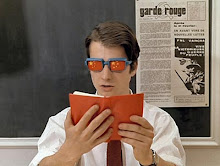
As the scene unspools, the character of club owner and MC played by Gypsy Rose Lee is introduced. She delivers a not at all funny routine for the customers, and is obviously intended to add spice to the story, existing as a hard-as-nails, tough talking bird who just so happens to share her apartment with a young brunette with overt qualities of bohemianism, a pure hominahominahomina hottie who never utters a line but is almost always at Gypsy's side (even sitting beside her during a card game with the boys). I can't help but think that this girl exists to clue in the "knowing" to Gypsy's sexual preferences. There is one "red-herring" moment with this boho missy where she gives a meaningful head-turn as if she knows something to be revealed later, but all that adds up to is a hill of beans.
Dressed in black and digs records: My kind of gal
Shortly after Gypsy's introduction, we learn that Ekberg can't dance any better than she can act, which doesn't really seem so odd for an exotic dancer, but does create some dissonance when characters deliver subsequent lines about how great she is. Through this whole scene, the camerawork is rather nice, reinforcing the efficient assurance of the film up to this juncture. From a visual/thematic standpoint, things just get better in the next scene, which takes place in Yolanda's dressing room. In a word: mirrors. Characters have the opportunity to really see themselves, but nobody uses it. This theme is amplified by subsequent developments in the movie. We also get introduced to Devil, Yolanda's annoying as shit Great Dane. There is this wonderfully oddball reverse shot of a barking Devil that seems like it’s coming from another room entirely; it doesn't "fit" in the smooth manner that is the nearly all-encompassing standard for film's last few decades or so. Most will think this a positive development, but I for one love these brief flashes of shoe-string eccentrics. They’re like utilitarian hiccups, the tangible flare-ups that are sparked by the use of a more meager pallet.
But the true test of strong direction with little or no money is how complicated scenes are executed. The crowd scene here, the moment in the story where Yolanda gets stabbed by a mysterious, unseen serial killer, is certainly complex. It's set up to withhold essential information; we never see her get stabbed, the scene opens after the fact. When this is done, the complexities move away from showing the act convincingly, and head in a thornier direction, an area that's the opposite of the natural "less-is-more" tendencies of low-budget filmmakers. For a crowd scene that essentially functions to inform the viewer of what they've missed, you need to add characters, in this case bystanders and emergency personnel, who shape the scene. This means more shots, more continuity and more difficulties. Oswald does a fantastic job with this scene, and includes a bit of what I think is the movie's big underlying theme, for good measure. The ostensible good guy in the scheme of things is the reporter Bill Sweeney. He's at the scene, flanked by a cop with a pistol, and he's attempting to get the wounded Yolanda from the bottom of a basement stairwell. The only problem is Devil, who's in full protect mode, barking wildly. At one point, Oswald cuts to a close-up of Sweeney's face telling the cop to "shoot him, he's mad!" The look on his mug is an unflattering mix of coldness and menace. They do manage to get her out of the stairwell without offing Devil (he's needed for further story developments), and as the movie proceeds, Dr. Green gets more and more possessive, Yolanda becomes more and more disturbed, and she and Sweeney get down to some lovey-dovey business. The aforementioned underlying theme, delivered with a tasty ambiguity that's aided by the detached camera and cutting, is the suffering of Virginia/Yolanda under a group of male characters that inflict her with violence, selfishness, non-physical abusiveness, and a general inability to understand or care that the best thing for this particular woman at this specific time would be to get as far away from this fucked-up and foul group of heels as possible (in a nutshell: MALE OBSESSION. Where would the movies be without it?). Her brief affair with Sweeney is the icing on the cake. After a magnificently shot apartment scene that utilizes darkness and bursts of blinking light from outside the window, it becomes clear that Sweeney wants her to run off with him, even though her life is a borderline shambles that she can't remember large portions of. Oh, she was easy to convince. This is, until Dr. Green did some convincing of his own. From here the film heads with due speed to a tidy but in no way happy ending (nobody gets the girl). The story takes some far-fetched turns, but the unlikelihood is preferable to triteness.
My overall impression was that Oswald took the uninspiring materials he was handed and really made something worthwhile from it. The theme outlined above is penciled in (or "smuggled in", as Scorsese likes to say) so that some foggy nogoodnik in a wrinkled raincoat taking in a ten cent double bill in '58 could simply watch in obliviousness (a.k.a. what the studio wanted). Meanwhile, the no-flash mise-en-scene breathes life into the proceedings in much the same fashion.
The blunt delivery of movies like this, short sweet and self-effacing little "entertainments", at least from a surface glance, is a big part of their value. They are almost never included in the sporadic round-ups of "greatest films" or "best ever" lists, but are just as valuable as many canonical masterpieces. The perspective of the masterpiece is pretty much inappropriate for films like SCREAMING MIMI, anyway. Masterpieces are basically all-encompassing works that so often scream out that they are important and demand attention, that make clear that their existence has had a profound impact on the course of whatever form of art they inhabit (which is not exactly what the word masterpiece means [a piece that shows mastery, basically], but culture has taken this particular term and ran with it in the exact opposite direction from the word genius, which these days gets applied to chefs and football coaches). I'm cool with that: having my ass handed to me by Duchamp in a gallery to the point where I'm unconscious of strangers standing beside me is one hell of a feeling. But I'm just as clued in to a smaller scale scene, where I'm looking at (or hearing, or reading) a succession of less weighty productivity, all the while getting a little bit of impact from each example until at some point I'm just clobbered with the reality that a whole lot of so-called modest work has added up to a sum of something quietly unique and powerful. This is the domain of the pulp novelist, the minor poet, the garage band, and certainly the lowly "action-film" director circa 1958. That's where Gerd Oswald is at, plugging away in anonymity in a genre of his art form that got no respect while it was happening, only to find himself retroactively assessed as a small but significant part of a real golden age.
Gerd Oswald
Credit where it's due: most of the above screenshots were taken from the nifty beatniky-inspired blog Like...Dreamsville. Check it out: http://likedreamsville.blogspot.com/
Labels:
Andrew Sarris,
film,
Gerd Oswald,
The Auteur Files
Thursday, May 20, 2010
3 quick ones

The wealth of post-war electric blues can at times be a bit much to fathom. That’s why some folks elect to stay with the established classics, such as the stuff on the Chess, Trumpet and Aladdin labels, for just three instances. And that’s not an unwise attitude to take if yr tastes are diverse and yr time is valuable. But it doesn’t paint the whole picture. The compilation COOL PLAYING BLUES CHACAGO STYLE does indeed shed light upon and deepen the pool that casts the refection of ‘50s amplified blues, consisting of sides cut for the Parrot label in the middle portion of that decade. Most of this disc was unissued at the time of recording, but I suspect that had more to with the economics involved and not the quality of the sounds. However, if you’re rigid in yr disdain of horn sections as an unnecessary intrusion into the wild transference of energy that was the electrification of the blues, you might want to skip this one. That’s not my bag, but I do tend to prefer my blues raw and unfettered from the tendencies of streamlining, so this disc wasn’t a personal mindblower. It does go down well enough though, the best of the bunch belonging to Curtis Jones, whose use of horns feels natural (possibly the result of a working band) and not grafted on in an attempt to increase commercial appeal. Jody Williams has a nice uptown B.B. King-ish feel, L.C. McKinley’s tracks seem to hearken back to the booming echo-laden sound of the Chess Brothers’ Aristocrat releases (where guitars, pianos and horns often blended in a nicely rudimentary fashion), and on one tune tenor sax player Nature Boy Brown’s Muddy Water’s-like vocals create an appealing clash with his band’s favored blend of jazzy-R & B (his other two tracks are instrumentals). But yes, this is still a very hornified affair. And as such it lacks the impact of being slapped on the pate by the primal scorch of say, early Elmore James. But that’s alright. And the Jo Jo Adams’ cuts apparently feature arrangements by Sonny Blount, aka Sun Ra. WHOA!!!
Because I am what some consider a stick in the mud, I prefer early Cure to almost any other type of Cure. SEVENTEEN SECONDS isn’t the band’s oldest stuff, but it is the beginning of what I (and others) consider the group’s most fertile period. Never as doomy and depressing as some folks made them out to be (particularly in contrast with any ‘80s Swans, for just one example), they were staking out territory that combined pop, post-punk, and studied atmospherics in a stridently non-smiling way that was markedly different from the more late-night horror-movie infused aesthetic of fellow U.K.-ers Bauhaus. Oh well, the press still tagged The Cure as gothic. But that’s because they were fucking lazy. I’ll confess that I never started really listening to this band in earnest until my late 20s (though they were in semi-constant rotation in my high school years at parties and during car rides); before that, they always seemed too refined for me, especially in contrast to the brilliance of Joy Division, who nailed me to the wall the first time I heard them. I can intuit a lot of Joy Div in this record (particularly in the placement of the bass guitar in the schema of the band’s sound), more so than on any post-MOVEMENT New Order release in fact, but I can also hear a band attempting to bring its own collective identity to the table. And yes, refinement. The Cure were surely post-punk, but they weren’t raw or antagonistic. Accessibility was part of the band’s M.O. from the start (I mean seriously, give me an example of a more catchy woe-is-me mope-fest than “Boys Don’t Cry”), and this album commences a trio of records that combine that approachable sensibility with a seriousness of intent that refutes their reputation as just college radio hit-makers. This is a fine LP that at its best finds them proffering a catchy, multi-layered and deceptively edgy plod. Play this between Siouxsie and the Banshees’ ONCE UPON A TIME: THE SINGLES and Bauhaus’ IN A FLAT FIELD (a couple of classics, in retrospect) and you’ll have the soundtrack to at least a half dozen nights of my late teenage life. Nice to know I can appreciate it more now than I did then.
SUN ARK, Sun Araw’s newish 7’’ on the Not Not Fun label is a fine spectacle. “Bump Up (High Step)” is an extended tour of a blissed-out zone that feels equally indebted to low-fi bubblegum dub and tinny, street corner psychedelia. It’s a sweet blend of expansiveness and repetition, fuzzy and druggy, but with an irresistible (some might say nagging) pulse that never deviates from start to finish. Layers of gonky organ junk proliferate as the track motivates into the eternal consciousness, insuring that the sonic whole builds in intensity, but the track never really shakes its feel as hypothetical soundtrack music for a video game that’s object is to save the world while simultaneously getting thoroughly and unapologetically stoned. Sound(s) like fun(?) If this reads to you like some sort of retro trip - on one hand kinda, but on the other most emphatically NO. Grace Slick will hate it, but Phil Lesh will likely understand. Side two, “Live Mind”, is much more heavily drenched in dub syrup, but there is just as much wheedling and woozy organ, substantial levels of blunted boom-chacka guitar progressions and a slick fabric of cyclical rhythmic bursts. Vocal textures arrive, though they wisely avoid the limitations of language. It’s no surprise that a flute momentarily emerges from the mix. Like much of the current underground, Sun Araw is fairly prolific, and it’s clear that the man behind the title (Magic Lantern member Cameron Stallones) is quite welcoming of what many perceive as archaic technology in both the overall aural whoosh of his project and also in the manner of documentation, since a sizable portion of that output has been released on cassette. Mighty keen, I say. This baby is a vinyl single however, a limited edition of 500, and most likely already sold out. MP3s do exist, and if you are well stroked by the sounds of Panda Bear, High Places or label-mates Ducktails, you should seek Sun Araw out, bask in the rewards, and then tip yr cap in the vicinity of Augustus Pablo and Albert Hoffman for helping to set this delicious mess into motion.
Saturday, May 8, 2010
Ten from the '90s Part Two (1991): Love Child- OKAY? CD (Homestead)

It’s interesting to consider the bands/artists that get anointed with immortality and those that suffer the fate of being forgotten (if they were indeed ever known). To wit, 1991. Of all the bands in my personal heavy rotation that year, it was Pavement that has most impacted history. And that’s cool. PERFECT SOUND FOREVER was/is a flat out beauty of a 10 inch EP. The “Summer Babe” 7" was a stone gas as well. But two groups that were beating out Stockton's finest in my personal sweepstakes of the constant spin were Thinking Fellers Union Local 282, a bent and comely post-avant-garage group from San Fran that will no doubt eventually get their own post in this space, and Love Child, a complex New York indie-trio that I felt at the time were poised to rise to the top of a bursting bullpen of bands (though I probably played SEBADOH III more than any other record that year, but everybody loves that one, right? Right?). Thinking Fellers have a deep discography and are pretty entrenched in the lore of post ’77 US art-damage, but Love Child has been sorta kicked to the curb of history, or more to the point they are a footnote in the twisted geography of Alan Licht’s snaky list of recordings. In this regard, they suffer next to Run On, a Matador act that were kinda looked upon (by me, anyway) as an indie-supergroup (for the record, Rick Brown ex-Fish & Roses and Les Batteries, Sue Garner of the Shams and Licht of, well, Love Child, and also very fine solo releases and his shit-hot participation in Ed Wood-biographer Rudolph Grey’s mammoth no wave/free jazz project Blue Humans). One reason I thought Love Child were all set to conquer the scene (so to speak) was due to the way they were such a swell collusion of seemingly irreconcilable influences, convulsed in a specifically Noo Yawk way. Let’s run down the list: an approach to stripped-down sonics that was similar to the at-that-point very much in vogue K records’ sound, which was justly amplified by the bands’ multi-instrumental attitude (Never mind that Licht titled a solo release CALVIN JOHNSON HAS RUINED ROCK FOR AN ENTIRE GENERATION). Male sung lyrics that at times come off like a passive aggressive Jonathan Richman and at other moments lash out from the hypothetical psyche of a love-wounded schmeedle. Much of the proceedings are related to post-power pop happenings to varying degrees. Female vocals courtesy of the much missed Rebecca Odes generally detail lovey-dovey goings on in a grandly smart and detached manner (Oh so sweet). Licht’s guitar playing (soloing) depicts an alternate universe where Eddie Van Halen is actually Thurston Moore. I even hear echoes of post-Ubu Cleveland and a Frankensteinian sewing job of early Television and early Feelies. How east coast. In a sense Love Child was a perfect band for 1991, a period where the indie scene had reached a boiling point, Nirvana and to a lesser extent Pavement tearing the roof off the sucker. But Love Child was in no way a schizophrenic band. Nah, they seemed totally simpatico, with the necessary frictions and individualistic tendencies. They were riding a blazed trail into wide open territory, just one piece of a nationwide under-the-radar grid. Another reason I thought Love Child would succeed in contrast to (for example) the great but quite obscure Royal Trux (who inexplicably [to me] ended up on a major label and lasted into the 21st century) related to the trio’s pop sensibility, which at this point was more explicit then that of Unrest or for that matter Pavement. Ultimately, you never know how things are going to shake out. OKAY? really shook the peaches from my proverbial tree for a few years and has been in semi-frequent rotation over the last twelve months or so since I copped a download to replace my beat-to-shit vinyl. I never located the follow up LP WITCHCRAFT, though I’d love to hear it since it’s rumored to be in a more Yo La Tengo direction (It featured new member Brendan O’Malley replacing Will Baum, who left to head out west. He formed the band 9 Iron. Never heard them). I do own the debut 7” on Trash Flow and the Moondog covers 7” on Forced Exposure. Both are dandy. But I’ll let you in on a secret. If some enterprising and cutting edge label (say Merge, who’re getting a rep for righteous indie collections/reissues, Honor Role and Dino Jr. and Volcano Suns and Destroyer to name four) decided to compile the entire output of Love Child into a jam packed 2CD set, I don’t think I could resist picking it up, largely because they were such an aesthetically solid and purely rewarding band. They are always at the top of my coulda-shoulda been contenders list, a group that was clearly tailor made for my mindset (then and now), so any motion in the contemporary marketplace toward justifying their too brief existence would seem to require a reciprocal gesture on my part. The least I could do, essentially. What’s that? My favorite tracks? I’ll type this slowly, so nobody misses the point. Every fucking one. OKAY?’s landscape ranges wildly from start to finish, but every second is essential. Until somebody with the wherewithal to make waves wakes up and smells the caffeinated breeze, I guess it’s up to me to light a candle for these three. If you stumble upon them and find yrself similarly impacted, perhaps you might do the same.
Alan Licht playing No Fun Fest NYC
(any idea how hard it is to find a pic of Love Child online?)
Labels:
Homestead,
indie rock,
Love Child,
Ten From the '90s
Subscribe to:
Posts (Atom)