These six pieces were my first group of picks for Winchester, VA vinyl shop Chester Records, completed for the store's blog before I started sensibly linking them each each week in this space. Naturally I want them here, so below you shall find....

The growth of producer/musician James Murphy as documented by his activities via the DFA label has been impressive. Initially, his group LCD Soundsystem was just one of a hot handful of names under the DFA umbrella dedicated to combining dance music aesthetics with a punk/experimental edge. All that worked out surprisingly well, with Murphy and partner Tim Goldsworthy becoming in demand remix specialists, tackling tunes from sources diverse as The Blues Explosion, The Chemical Brothers and Justin Timberlake. Along the way, LCD slowly kept gathering momentum, getting nominated for Grammys while expanding the scale of the group’s sound. I use the word group loosely; Murphy is the creative force behind the LCD moniker, and the Top Ten charting THIS IS HAPPENING finds him attaining a consistently high standard. Utilizing a smart set of influences is a huge part of his success, but songwriting has also come to play an increasingly important role. THIS IS features a handful of cuts that display a maturing pop sensibility married to Murphy’s sonic attack. “All I Want” features the sort of anthemic melancholia that’s reminiscent of and a worthy successor to Bowie’s “Heroes”, and “I Can Change” feels like what might’ve happened had Vince Clarke replaced Gary Numan in The Tubeway Army. Lotsa soaring high notes and boing-boing robotics, ya dig? Other parts of the record fuse this popishness to Murphy’s now well-established off-the-cuff quirk with fine results. Album opener “Dance Yrself Clean” is the best example of this savvy combination, feeling like an early version of Depeche Mode that honed their chops not in England but in the dank New York clubs of the early ‘80s. And those who love the making it all up as he goes along mouthy quality from the earlier records have nothing to worry about. “You Wanted a Hit” and “Pow Pow” continue the development of LCD’s more extemporaneous side, with the later displaying sonic touches of the youngish New Order until the arrival of a down and dirty bass-line seamlessly shifts the focus to percolating techno-funk throb, and all the while Murphy’s talking and talking. While it’s nice to name check the influences (amongst other elements, Eno is a major implicit presence, there are touches of Kraftwerk’s techno-pop period, and the cover photo is obviously inspired by artist Robert Longo), what’s more important is how these reference points are assembled. As a 40-year old dude, Murphy heard a whole lot of his inspiration as it happened, and he’s had a whole lot of time to reflect on just how to integrate those elements. The punkish vibe of LCD (and DFA in general) has nothing to do with snarly snotty posing and everything to do with reverence for a period in the punk chronology where Suicide were considered as legitimate an example of the form as The Ramones. Experimentation as one part of a well-balanced diet. Another major factor in the success of the sound lies in the avoidance of the use of computer software. Murphy has a stated preference for analog sound (the synths he uses are the kind you play, not program), and that really makes a difference, since a longstanding aspect of LCD’s success is the sort of clinical iciness that has inspired black-clad pale-skinned boys and girls to mope around for roughly three decades. Underneath that icy quality however is warmth provided by the instrumentation. This mix of cold/hot goes all the way back to Cabaret Voltaire and The Normal’s “TVOD”/”Warm Leatherette”, and it’s a big reason why Depeche Mode and New Order still resonate with people born after those band’s formative years. On THIS IS HAPPENING James Murphy has set his personal bar extremely high, with nary a dud or a tangible dip in quality, and it’ll be interesting to see if he continues to mine this fertile territory or lights out in a different direction.

James Murphy

Lucky for us, since the dawn of recorded sound, history has handed us a steadily growing resource of music that can reasonably be described with the admittedly somewhat overused term “great”. Additionally, there exist a much smaller number of aural documents that sit at the highest level of esteem, what some would call essential listening and others might bestow as the absolute crème de la crème. The previous two sentences are a loquacious way of saying that there are records and then THERE ARE RECORDS: James Brown’s LIVE AT THE APOLLO is an example of the caps font variety. I’ll state the case and make it plain. This 1962 LP is almost certainly the greatest live recording of all time. Now, to expand a bit- the music found on this brief slab of vinyl is a rare glimpse of raw artistry distilled into a perfectly calibrated performance, where Brown, then at an early peak in his long career as a groundbreaking R&B bandleader par excellence, engaged in a glorious give-and-take/tug-of-war with his crack band The Famous Flames, their collective effort inspiring a feverish dialogue with a theater filled to capacity with passionate fans. It’s the personification of hard soul, and the ability of the band to navigate a varied terrain of raucous crowd movers/slow burners honed down to their very essence has lost none of its brilliance. Naturally, Brown presides over this dynamic showcase with faultless urgency and precision. Never is there any doubt that James is the crucial element of the show, and it’s his relentlessness, his joy, his anguish, his pleading that truly elevates the recording of this performance (just one of a weeklong engagement) to legendary status. The centerpiece of the record is “Lost Someone”, which takes up over a third of the album’s running time. Brown swings into a mode of extended gospel testifying before gradually shifting into a bout of call and response with the increasingly overwrought audience as the band sagely simmers and accents the proceedings, and then quickly, with an emphatic shout out of “Please Please Please”, the direction shifts into a medley of tunes that instead of feeling underwhelming or cheap (as medleys so often do), actually attains an aura of sensible grandeur. It’s almost as if playing the songs in their entirety would’ve caused The Apollo to spin into orbit from sheer euphoria. In the annals of soul music, there are two guys who basically invented it, Ray Charles and Sam Cooke, and then two other guys who took that impetus and ran with it full steam into the 1960s, Otis Redding and James Brown (we’ll discuss the girls another time). All four of these names deserve a monument at least the size of Rushmore. But it was Brown who seized upon the essence of this most communicative of pop music forms and boiled it down to a simple equation. Lungs + sweat + groove x (crowd) = Star Time. Are you ready for Star Time?

Mr. JB

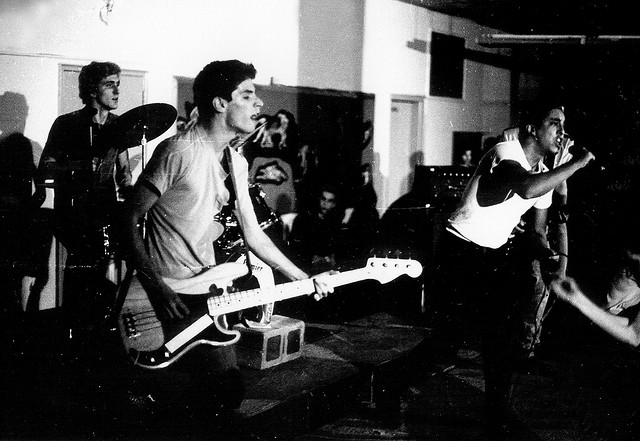
Post-hardcore was a vague catchall term used in the late-‘80s to describe various advancements being made in the underground scene by aging punks looking for new kicks. Some of the noisier/artier bands that once fell under this description are now categorized as indie-rock, Dinosaur Jr. being a fine example. But many post-HC units were distinct from their peers in that instead of subverting or moving beyond the rudiments of hardcore punk they actively sought to expand the genre into something less rigid or predictable. Probably the two biggest locales for post-HC were Chicago and the Nation’s Capital, and this makes total sense. The Windy City’s geographical position made it less likely to fall victim to faddism or to develop niche scenes that were in direct opposition to the punk/hardcore impulse, and DC’s function as the nerve center of the Federal Government played a large role in shaping how many in the District elected to transform hardcore, which was quite often a very political genre, instead of abandon it. Dag Nasty were part of the initial wave of DC post-HC bands, and until the emergence of Fugazi, they were likely the most popular. Featuring Brian Baker (ex-of Minor Threat), Dag Nasty made a huge impression with the 1986 release of CAN I SAY, presenting a fresh sonic recipe--retain the heaviness, increase the melody and eschew rage and didacticism in favor of angst and introspection. I first heard CAN I SAY roughly a year after it hit the racks, and while it did play a big part in my personal growth away from standard punk and hardcore, I must confess it didn’t affect me the way their artier, wordier DC contemporaries Rites Of Spring did. The members of Dag Nasty were all veterans of other bands, and it’s obvious from listening to their debut that the shared goal was to play more accessibly and connect with a wider audience. In this case, that’s cool. By 1985, the standard hardcore scene had stagnated considerably. And at this point, their music retained much from Minor Threat circa OUT OF STEP and held flashes of influence from such worthy melodic trailblazers as Descendents and Hüsker Dü. However, there was an earlier, tougher period in Dag Nasty’s genealogy which featured powerhouse vocalist Shawn Brown (later of Swiz). The recordings of that lineup have been floating around for almost two decades, but I’d never made the effort to check ‘em out until now. My mistake. DAG WITH SHAWN, Dischord Records’ archival release of the Brown-era tapes shows how different the initial version was in both texture and velocity. The raw-throated sing-shout of Brown essentially necessitates that the band respond with something approximately as heavy, and in so doing the entire session falls much closer to the wilder, more abrasive end of the post-HC spectrum. The whole sweet mess is coated with the sturdy chug/throttle that became very common (and welcome) as the better hardcore bands learned how to stretch beyond the limitations of the form’s standard beats and riffs. This tightly wound release really hits a qualitative peak with the jackhammer delivery of the song “Can I Say”, which raises the bar on an already classic tune. To my ears, Brown’s brawny, vein bulging roar is preferable to subsequent vocalist Dave Smalley’s streamlined approach, though it must be stressed how that more well-mannered style fit his version of the band like a pair of stretchy bike shorts. To wit: CAN I SAY’s “What Now?” combines a tuneful, almost popish dynamic with earnest lyrical vulnerability, resulting in a sound that helped inspire legions of alienated teen punks to scribble endlessly into battered composition notebooks all across the land. I know, ‘cause I was one of ‘em. Due to these palpable differences DAG WITH SHAWN doesn’t serve as a replacement for CAN I SAY, but instead stands as its own entity, falling in with the bolder, more workmanlike DC bands such as Marginal Man, later-period Scream and Ignition. Listening loudly is like a passport back to a sweaty “3 bands for 3 bucks” gig in the cramped confines of the old 9:30 Club. If my memory of those days sounds like a good time I can assure you they definitely were, and by extension this record most certainly is.

Shawn Brown

The Stanley Brothers weren’t the originators of bluegrass, but they do stand as one of the earliest and finest exponents of the style, helping to expand the possibilities of this still quite popular genre in its formative period shortly after the Second World War, and anybody who wants a thorough picture of the movement away from old timey string band traditions toward the development of a more progressive and modern sound simply must contend with this pair. While it’s generally acknowledged that they really hit their stride with the 22 tracks recorded for the Columbia label starting right at the cusp of the 1950s, the material collected on EARLIEST RECORDINGS: THE COMPLETE RICH-R-TONE 78S (1947-1952) is still fascinating and in my estimation essential for numerous reasons. Foremost, it catches the Stanleys at a crucial moment where their style did more than just hint at the influence of their predecessors. I find it impossible to listen to this record’s opening cut “Little Maggie” and not hear the resonant style of Appalachian giant Clarence “Tom” Ashley, for just one instance. Also, it’s quite apparent that the expressive melancholy that forms a huge part of the stylistic makeup of bluegrass, a feel the form's progenitor Bill Monroe called the “high lonesome sound” (a term also used to describe the art of another old time master Roscoe Holcomb), was an inextricable part of the Brothers’ work from the very start. To elaborate, their vocal harmonies possessed a chilly gripping beauty that many later bluegrass players and groups sacrificed in favor of flurries of technical flash and modest slickness. The Stanley Brothers’ music at this point is emotionally direct and strikingly pure in form, though at this early date any purist notions are still a long ways away. They easily attain a natural ache and a well balanced instrumental vision while essentially responding to other’s advancements in this newfound roots style (Monroe’s “Molly and Tenbrook” is covered here, much to Bill’s then disdain). And those brotherly harmonies fall into an estimable progression of sibling country acts that include the Delmores, the Louvins and the Everlys. One only need listen to “Death Is Only a Dream” to understand just how vital this pair was not only to bluegrass but to the intricate and often undervalued fabric of country music as a whole. Anybody with an interest in the weave of that tapestry needs this collection pure and simple. And please note that only the first ten tracks here truly qualify as the Stanley’s earliest recordings. The last four were actually done in the short interim between their Columbia and Mercury contracts. So this is a real gap-filler for budding musicologists as well as an indispensible slab of gorgeous rural science. Getting familiar with the earliest work of an artist or group can sometimes be just a completist gesture. And that’s alright. I’ve gestured in a completist manner many times, and am far the better for it. But completism is not the case here. Ralph and Carter Stanley were great from the get-go, and it’s wonderful to see their early sides collected and readily available.

Ralph & Carter Stanley

It’s becoming clear that Deerhunter, like their indie homefrys Liars and Dan Deacon (for just two vaguely analogous examples), are in it for the long haul. Flash-in-the-pans come and go, and the overhyped have a tendency to betray the true magnitude of their nature, but long haul bands and artists share the knack for cutting through all the extraneous distractions and temptations to get down to the brass tacks of making quality records. It can be a romantic notion to surmise that the long haulers are the true lovers of music and the hypers and panners are merely self-serving or careerist in purpose. Attributing qualities to those we don’t know is a dangerous activity however, and just because a record from a flavor-of-the-month is shallow or uninspiring doesn’t mean the intentions of those who made it weren’t pure. But in Deerhunter’s case, designating them as music lovers is quite appropriate, since their latest release HALCYON DIGEST is explicitly about being inspired by the lovely (and sometimes lonely) tumultuousness of musical passion and fandom. There are many facets to the terminal need for sound, and where Sonic Youth’s string of Geffen releases often attained an aura of hipster erudition, or You La Tengo’s continuing Matador run feels like the crystallization of the greatest used record store ever opened, Deerhunter’s new one pleasantly reeks for much of its duration like a very well programmed set of late-night college radio (remember college radio?) or an expertly crafted mix-tape handed down from an older sibling. There is tangible disparity from track to track, but also a considered thread of similarity, a connective tissue that erases any threat of facile genre hopping. No, the quality of the songs here is striking, and Deerhunter’s continued movement away from their more noisesome roots is frankly not the trajectory I would have predicted and also not the slightest bit disappointing. While they never really gave Wolf Eyes or Merzbow a run for the cacophonous money, Bradford Cox and Co certainly began more as experimenters/manipulators/disrupters of rock-based sound rather than subverters/extenders of essentially pop-oriented song form. This type of streamlining progression often results in diminishing returns, but happily not in this case, since it’s become obvious that Deerhunter couldn’t make a “normal” album if they tried. Again, they have been heading in this direction for some time, but never has the migration sounded this advanced and surefooted. What once felt like dabbling and growth has moved past the point of no turning back. And maybe it’s just the label switch to 4AD, but I’m detecting a hazy anglophile vibe on HALCYON DIGEST that if traced all the way to its origins would likely lead us into a walk-in closet full of Bowie’s high-heeled boots. What a clothes horse! Additionally there are flashes of ‘60s-inspired transistor radio guitar jangle mildly reminiscent of San Fran’s Girls, hints of the new-new-new-psychedelia (possibly due to producer Ben H. Allen) that continues to place these guys in the general proximity of Animal Collective and an overall commitment to quality that’s heartening in these days of shoddy or underdeveloped product. Closing with a very fine tribute/dedication to the late, much missed Jay Reatard, HALCYON DIGEST is a very necessary proposition, and any survey of the contemporary music scene is incomplete without giving ample time to these considerable cats. Deerhunter’s been at it now for over half a decade, which in contemporary indie scene terms is a real long time, and it seems like they’re just getting warmed up.

Deerhunter on a couch

Muddy Waters’ deserved reputation as one of the greatest of all bluesmen basically rests on his steadily evolving flow of exceptional material from the 1950s. By the middle of that decade, he’d essentially perfected the groundbreaking ensemble sound that would pretty much define the following twenty years of Chicago Blues (Buddy Guy, Junior Wells, Magic Sam, Charlie Musselwhite etc) and would additionally play a pivotal role in rock music’s fitful growth (ever hear of the Rolling Stones? How about Eric Clapton?). The sparks and grease of Muddy’s innovation actually transpired on the bandstands of clubs and joints, and when the Brothers Chess finally relented and let his working band unleash their stuff in the studio the results were pure, thick gravy. While amplification of the blues had been a practical maneuver, allowing the music to be heard over the din of clamorous nightlife, Waters’ band took it a vital step further by synching themselves into one huge, rhythmically pulsating entity that’s effectiveness was only enhanced by their growing facility with the elements inherent to electrification. Brilliantly combining density with agility, they also deftly mixed varying degrees of smooth, suave urbanity with the tough rural Delta roots that made up the core of Muddy’s sound. The boldness of tone remains astounding. SINGING THE BLUES 1954-1959 is twenty-four tracks spread across two LPs that successfully provide a deep immersion into the still vibrant power of this estimable man’s grand repertoire. It combines a sprinkling of well known ringers like “I’m Ready”, “Mannish Boy” and “I Got My Mojo Working” with a strong helping of less bandied but just as worthy numbers such as “Evil”, “Diamonds At Your Feet” and a cover of his rival Howlin’ Wolf’s “Smokestack Lightnin’”. Muddy’s guitar and vocals sustain a uniformly high level throughout, and the players surrounding him are in the top tier of post-war blues artists. The set extensively features the majestic walking bass of Willie Dixon, mouth harp by sublime blowers Little Walter Jacobs and James Cotton, the faultless piano of Otis Spann, sturdy second guitar from either Jimmy Rogers or Pat Hare, and the crucially unfussy drumming of Francis Clay. As the music’s power accumulates, nary is a note laid wrong. The majority of the songwriting is roughly split between Waters and Chess house maestro Dixon, who in addition to bass duties served as a songwriter, producer, and general all purpose conduit between the brothers Phil and Leonard Chess and the constant flow of talent they captured. The difference between Muddy’s Delta-descended stuff and Willie’s considerably more pop oriented material is complimentary, with Waters’ splendid delivery tying the strands together, and the sheer range on display means this sets’ listenability across four sides of vinyl is quite a rare achievement. Even the greatest blues artists can become a bit or a lot monochromatic as separately released sides are compiled and presented as a single entity, but by this point Waters was swinging so hard and wide that 1954-1959 solidifies and gains momentum as strongly as any long-playing release in the genre. “Good News” and “Evil” include some unexpected and not overdone tenor sax, and “She’s Into Something” finds the group finessing a wickedly shifting dynamic that’s about as progressively urban as Muddy ever got. Add in three cuts from the rather unheralded MUDDY WATERS SINGS BIG BILL BROONZY LP and the breadth of this mighty baby should be readily apparent. The man’s track record up to around ’65 or so is unimpeachable, and I’ll always have a serious soft spot for the diamond-tough extremity of the early material, but 1954-1959 is simply the stuff of legends. By this point Waters had the sure-footed swagger of a Mississippi man transplanted to Gotham and made good. And instead of slacking off, he just kept turning up the heat. What a benevolent mastermind he was.

Mr. McKinley Morganfield