Saturday, October 9, 2010

These books, they mean quite a lot to me.

And of course the list is far from complete. No Coover, no Hawkes, no Moody, no Woolf, no Ishmael Reed, no Stein, no Vollman, no F. Scott, no Delillo, no Jones/Baraka, no Hawthorne. That's just for starters. Plus, I left out those tomes that present a beautiful unwieldiness which push them toward being perpetually unfinished: Proust, Jan Potocki, Robert Burton (though unlike everything else below, THE ANATOMY OF MELANCHOLY ain't fiction). And where's Borges? You get the point. But one thrilling aspect of literature is how great books are never really finished anyway, since their greatness always encourages the desire to start again for a deeper understanding and appreciation. So that being the case, this list will remain unfinished as well.


1- William Gaddis THE RECOGNITIONS- a novel that examines human kind's propensity/need for fakery. It's sprawling, dense, frustrating, exhilarating and painfully, wonderfully human. And also very funny.


2-     Thomas Pynchon GRAVITY'S RAINBOW- epic and surreal, with uncompromising flowing language, outlandish characters, and talking dogs. Labyrinthine and acidic, weird and dark. What might seem like an elephantine mix of indulgence and lack of discipline is really just the blunt reality that the author’s smarter than you. Smarter than me, too. My advice? Just lay back and soak it all up. I’m trying to decide what sounds better: comically bleak or bleakly comic


3-     James Joyce ULYSSES- the heavyweight champion of modernism; once the code is broken, his characters and situations are drenched in truth and beauty. As rewarding as it is complex.


4-     William Faulkner AS I LAY DYING- much like Joyce,
he's unconcerned with making it easy (though this one is easier to swallow than THE SOUND AND THE FURY, which I also adore), and his situations can build to gut-wrenching levels, but that's part of what makes it so powerful and lasting, along with his lack of sentimentality and the prickly dimension that he brings to his characters and subjects.


5- Herman Melville MOBY DICK- really the beginning of modernism in America. It has a very agreeable poetic sensibility that is actually far more at home in the middle of the 20th century than at the time of its writing, and Herm is as relevant now (as is Nat Hawthorne, for that matter) as he’s ever been. To love Melville is to love language.


6-     Flannery O'Conner WISE BLOOD- what a freak-show. Southern Gothic on bad acid. Oh, the strychnine. Some of the most compelling bleakness I've read. There exists a very credible film version of this work, but if you haven’t seen it, please do yrself a favor and read the book first. The difference in quality is palpable.                                                                                                                                        

7- William H. Gass THE TUNNEL- sometimes I'm a bit hesitant to tell people that I'm drawn to novels where the characters are so bitter, dysfunctional and steeped in failure, not so much out of any concern for what folks will think of me personally, but simply because it potentially amplifies the inadequacy of the phrase “reading for enjoyment”. You mean you actually like reading a 600+ page doorstop with a main character that’s a gargantuan asshole? Yep, you betcha! This has one of the most unlikable protagonists of any book I've read, but it also presents this character trying to write his way to terms with all his pain (and the pain he's caused others) in a manner that's quite riveting. Oh, that manner: the language!!!

8-     William Gaddis JR- a lengthy expertly rendered critique of capitalism that is maddening, a little bit frightening, and often very humorous. That humor is really the key to Gaddis’ authorial presence, I think, since this book, his second, is markedly different from THE RECOGNITIONS. His first is a huge mixture of classic and modernist influence stuffed to the gills and ready to explode all over yr desk and reading room and consciousness. JR is far more obsessed with an intertwining sprawl of narrative and dialogue. An acquaintance once complained to me that Gaddis’ characters had diarrhea of the mouth, that they rarely listened to each other and that their words didn’t feel “real”. My compound retort was a) I don’t read for “real” and b) regarding the ratio of talking to listening, have you been to a bar lately? When Gaddis’ characters get a few drinks in them they often start spilling out gorgeous verbiage in a way that’s all too familiar to yrs truly. I first read this roughly six years ago and I couldn't believe how contemporary it felt.


9-     James Joyce PORTRAIT OF THE ARTIST AS A YOUNG MAN- Everything I've read by Joyce has left a big impression. Stephen Dedalus is one of the earliest and greatest examples of the downtrodden hero, a phenomenon that became quite common in fiction, some would say too much so, later in the century. Lots of folks dig Holden Caulfield, and yeah I dig him too, but ol’ Stephen Hero appealed to me more as a young man (ahem) due to his old nature, shouldering the weight of history and art with solemnity, profundity and a lack of pretense. Caulfield is surely cool, but Dedalus is complicated and fascinating.


10- Jack Kerouac BIG SUR- can be a big drag for those who are deeply attached to the transcendental gusto of the early novels. This is a book for more mature sensibilities, for people who are familiar with disappointment and disillusionment. He was drinking himself to death while writing this one. I’m tempted to sandwich this baby into a massive re-read with Malcolm Lowry’s UNDER THE VOLCANO and the works of Fred Exley, but Christmas is coming and I’m worried I might succumb to the titanic despondency and suffer a self-inflicted wound to the brainpan. Oh, I jest. Maybe. The power of literature is strong. Whoever finds my decomposing carcass has to take care of my cat, okay?


11- Herman Melville PIERRE, OR THE AMBIGUITIES- a dismal commercial failure while being an estimable and complex artistic endeavor, it's a sustained rumination on folly (both social and artistic) and the problems that arise from human interaction and desire. Ambiguity is constant in Melville's mature work, and this thorny masterpiece is the best example of the author’s need for unresolved situations and unanswered questions.


12- Mark Twain THE ADVENTURES OF HUCKLEBERRY FINN- maybe the best story (if not the best writing, though it should go without saying that his words are also great) in all American fiction.


13- John Barth LOST IN THE FUNHOUSE- short works by one the great postmodernists. The title story is an exquisite commentary on self-doubt and the strain of artistic aspiration (and the dread of failure that often accompanies it). Everything here possesses an estimable knowledge of literature and how to carry its themes into a contemporary framework. Old and new at the same time.


14- William H. Gass OMENSETTER'S LUCK- his first novel. Comes off a bit like Faulkner if he were a part of the post-WWII post-grad scene. When taken in unison with the short story collection IN THE HEART OF THE HEART OF THE COUNTRY and the slim and still brilliant mash-up of structure and visuals and of course (always) language that is WILLIE MASTERS' LONESOME WIFE, it’s damned startling just how explosive this now esteemed man of letters was out of the starting gate. Maybe the most neglected American fictioneer of the second half of the last century. And he’s still going strong.


15- James Joyce DUBLINERS- there have been thousands of short story collections since this pup was published and very few before. But the worth of these stories is far greater than just that of originality and influence; it's also the depth of feeling and the scope of human emotion that's contained within.


16-  Stanley Elkin THE MAGIC KINGDOM- about a busload of terminally ill kids who are taken on a trip to Disneyworld. And it's hilarious. Elkin is the combination of two wonderful things: a Jewish wise-ass and comma addiction.


17-  William S. Burroughs THE NAKED LUNCH- it's been over ten years since I've read this, so it makes the list due to the sheer impact that it had on my developing mind. A book that encompasses sci-fi, experimental lit, beat sensibilities, weird smut, and a thick dose of 20th century pessimism. It only takes a hard cold look at the present tense to understand that Burroughs was far less paranoid than his detractors often claimed and far more prescient than even his biggest boosters thought.


18- Henry James RODERICK HUDSON- I have some major gaps in my knowledge of James, but this is my favorite out of what I've read. The short novel's title character is a sculptor who becomes consumed by an unhealthy attraction to a young princess. But what it's really about, for me, is James' beautiful sentences. He comes up with page after page of words that positively beg to be read aloud. I've discussed James with people who totally dismiss him because he writes slow novels about rich people, but I can't get with that dismissal at all. In my estimation, it's not about what it's about (though this can surely add to the experience). It's about how it's written, how it sounds coming of the (mind’s) tongue.


19-  David Foster Wallace THE BROOM OF THE SYSTEM- out of everything listed here, this book has the most to say to me from a purely generational standpoint. It's a bit like early Pynchon, steeped in post-modern influence and absurd situations that place it in direct opposition to the brigade of realist fiction. Wallace's stuff has a looseness (a punk sensibility, perhaps) that differentiates it from his pomo antecedents: where those books positively, proudly drip with higher-learning, Wallace comes off like a disheveled spiky-haired smart-ass who can (and will) ace the test without even trying, so he just shrugs it off as no big deal. All the while, he's laying dangerous land-mines in his pages that seem to spell certain disaster, only to ultimately prove an essential ingredient in the fabric of the (master)work.


20- William Gaddis A FROLIC OF HIS OWN- Kerouac compared Burroughs to Swift, and yeah, I can see it, DO see it in fact, but the most Swiftian writer (besides Swift) that I (and maybe Sven Birkerts) can think of is Mr. Gaddis. As formidable as his prose can be purely from a standpoint of language construction (and this uncompromising style is what gets him described as simply a difficult writer by hit-and-run magazine blurbists), the emotional heft of his work is caustic satire, and the guy is absolute bulls-eye.

Tuesday, October 5, 2010

The Auteur Files #7: Arthur Penn's NIGHT MOVES (1975)

Arthur Penn died on Sept. 28th, and the fact that I'd not seen NIGHT MOVES or THE MISSOURI BREAKS, both key late works in the filmography of this valuable American filmmaker, felt rather neglectful on my part. So here's the first installment in my attempt to rectify that state of affairs. RIP, man. The beauty of yr artistry will be long missed.


Any chance that NIGHT MOVES had to slowly ooze its way into the film-going consciousness of 1975 and to ultimately metamorphosize into one of that decade’s many “sleeper” hits was soundly destroyed by the runaway success of JAWS, released a week later with a then novel concept: network TV commercial promotion that necessitated concurrent openings nationwide. In the era before the multiplex, when many towns had only one or two theatres with a screen each, you can be certain that substance was squashed by hype. In fact, JAWS joins together with STAR WARS and ROCKY to from a trinity of hype, a triangle of normalcy that essentially derailed the progress made toward a wide-ranging, adult cinema in the years following the end of the Production Code. Of course, freedom often meant undisciplined folly, but NIGHT MOVES was just the opposite, unfolding as an intelligent, mature, and graceful work that subtly plants its seeds of discontent. Arthur Penn’s film stands up to present-day scrutiny with flying colors, and on the basis of one viewing I feel unusually confident in calling it one of the best U.S. movies of its decade and a key “forgotten” film.


From within the well-worn territory of the detective/noir genre, Penn presents a group of characters that flitter between colorful and plain. Gene Hackman’s Harry Moseby is closest to an archetypal standard, inhabiting a role that’s not far from the land of low-rent private-eyes. Decency and vulnerability complicate and deepen this portrayal however, and one of the many joys of this film is that none of its characters register as a cliché.


In addition, Neo-noir often flounders or fails outright when it feels superior to its reference material (something it shares with Neo-westerns) so it comes as a breath of fresh air that NIGHT MOVES never falls into a condescending tone. Instead, Penn and writer Alan Sharpe have seen fit to simply update the malaise and despair of the noir model so that it fits snuggly into the creeping desolation of the mid-1970s with no straining for relevance or bouts of overzealous existential alienation. This works well with the movie’s visual style. Penn’s approach to cinematic form is quiet but strong, and unlike many films from the same era, MOVES never looks fussy, junky, gaudy or washed-out. As content and form expertly intertwine, the story gradually builds in complexity and tension, ultimately culminating in one of the more unexpected and emotionally devastating endings to have entered my filmic experience. Its final shot depicts an aimlessness that is representative of its time, yet still holds resonance and power, since aimlessness can surely curdle into something far more malignant.  Maybe it has.


Penn with Melanie Griffith on the NIGHT MOVES set


Tuesday, August 31, 2010

Some thoughts on The Howlin' Wolf (and a little bit of autobiographical rumination)


Howlin’ Wolf’s early recordings have made the rounds over the years, with my first exposure to them being the swell 12-track collection CADILLAC DADDY: MEMPHIS RECORDINGS 1952, which hit the market from Rounder Records right about the time I graduated high school. I still think that well sequenced disc serves as a fine introduction to the Wolf’s primal pre-Chicago period, but time has seen improvements in the documentation of this essential stuff in completist terms and also that of sound quality. When I first spent time with CADILLAC I was surely pinned against the wall, but also couldn’t help being a bit bummed by the audible damage that time and neglect had inflicted on these sessions. Subsequently, the fine reissue label Ace Records has collected all of the Memphis-era stuff that was released by the Bihari Brothers’ Modern and RPM labels, the latest incarnation of which, HOWLIN’ WOLF SINGS THE BLUES, references in title and cover the 1962 LP on the Bihari’s Crown imprint. That album was the first to compile a portion of those furious sides (and the strange inclusion of two otherwise fine Joe Hill Louis tracks) for consumption by a rough and ready young rock audience. And that updated disc is an indispensible document for understanding the electrification and modernization of the blues, which means that it’s also a vicious vessel of raw grooving. Natch. But brothers and sisters, I’m here to tell you there’s more. The amazing Bear Family label has released two volumes titled MEMPHIS DAYS that assemble all of the unissued material that Sam Phillips and Ike Turner captured in that heady era, documenting a stupendous talent that inspired Phillips to comment "When I heard him, I said, 'This is for me. This is where the soul of man never dies’”. What a sage the guy was. Because yes, there is a certain ineffable eternal energy in these recordings that really bring home the musicological talk of Wolf being a true artistic descendant of Charley Patton. This quality never really left his work, but it did become less pronounced the longer he recorded as one of Chess Records’ blues ambassadors, due in part to the seemingly inevitable streamlining that resulted from commercial success and additionally the quite advanced songwriting and production of Willie Dixon (a contribution that Wolf was often ambivalent about). The Memphis material however can really blindside the unsuspecting listener with its crazed mania, a quality it shares with other Southern electric blues of the period (the Trumpet Records’ material for example), and the wild edge found on these two discs is part of the solid connection to the uncompromising power of the pre-war Delta. But what ultimately makes Wolf the electric heir to Patton isn’t really the rawness of the delivery, it’s the range and depth of his repertoire. Patton is celebrated today in part due to the vastness of his material; he was more than simply a bluesman, existing as a professional live entertainer with the varied songbook that was necessary to keep a crowd of revelers juiced-up into the wee wee hours.


By the time of the MEMPHIS DAYS recordings, Wolf had already understood the importance of diversity. In addition to the hard Delta-core of his stuff, there is also some of the more modern slow moaners that he brought to perfection a few years later (“Getting Old and Grey”), some screwy jump blues inspired material that didn’t seem to survive his transition to Chicago (the fantastic “Oh Red”, with its blunt and loopy horn section), and a whole bunch of what can be described as proto-rock-‘n’-roll. The band that Wolf employed at this point is a big reason why he gets spoken of in the annals of pre-Elvis rock motion. Willie Johnson’s slippery and distorted guitar was effective at any tempo, so the faster numbers on these volumes just drip with the wicked hunching that would inspire explosions all over the continent just a few years hence. Willie Steele’s drum abuse assuredly pops the cork on the bottle labeled insanity, but more importantly he can also hang back when it’s called for (which is quite often), displaying the sort of understated simplicity that’s always been a rare commodity. L.C. Hubert’s piano lands in the fine territory between banging clamor and shrewd finesse, and as such adds much to Wolf’s incredible mixture of old and new. Now, to speak in audiophiliac terms, the sonic upgrade that’s been given to these recordings is a truly wonderful thing. The annoying acetate hiss that seriously marred the opening of “Mr. Highway Man” on CADILLAC is basically imperceptible now. And if you’re worried about high-tech sterilization, don’t be. This digital scrubbing has done nothing to detract from the awesome power of “Moanin’ at Midnight”, a tune I consider to be in the heavy handful of the absolute greatest of electric blues records. If you’re a curious newbie to the Wolf or just aren’t very familiar with his Memphis junk, I’d say grab SINGS THE BLUES first, because that has all the stuff that created the fuss that got this huge dude up the road and swinging from curtains in the Windy City. And if that fires yr coals (and I don’t see why it wouldn’t), you’ll need both volumes of MEMPHIS DAYS like a baby needs a warm nipple. We’re talking serious nourishment here. After that, there are multiple avenues in which to explore the Chess-era, where he had an massive decade-plus streak of artistic quality that only started to run afoul at Marshall Chess’s insistence on “experimenting” and updating his sound in a foolhardy attempt to land a fresh “hip” psychedelic-era audience (a fate that also befell Muddy Waters, although in a less disastrous fashion). The question of which of the Chess Big Two had more of an impact on my teenage life is at this late date impossible to answer. I’d got into Muddy first and then later eased into Wolf, spinning records and having my mind blown in my basement bedroom like the surly outcast I most surely was. By 11th grade I’d found the punk underground; finally I discovered a chunk of contemporaneous youth culture that really spoke to me. In a typically youthful boneheaded move that can only rise from the combination of impatience and poverty, I traded in a truly impressive stack of blues vinyl for a smaller stack of punk stuff, only a couple albums of which I still own. Oh well. By the last month or so before my graduation, I was already quietly regretful over losing my blues stash, and when I stumbled upon a copy of CADILLAC DADDY at my local music shack I impulsively bought the thing even though I didn’t even own a CD player at the time. I then went on a tour of digitally equipped friend’s houses, saying something like “Hey, check out what I have. Wanna hear it?” A few listened and balked, some smiled and taped it and a couple fell right the fuck over. That was a good day, and I’ve had countless good days (and late nights) listening to Chester Burnett since then. The music, like the man himself, is a gigantic presence that transcends the ordinary and continues to display a startling vitality into this young pup of a century. It’s kind of like the guy’s spirit just keeps on keeping on, long after Clapton paid for his tombstone. Damn Sam. You really summed it all up.


Three listens: Lothar and the Hand People, ME WANT BREAKFAST, Medications


It seems that Lothar and the Hand People have been relegated to the dustbin of history. If this is the case, it’s a shame. Perhaps this probable reality is due to the genuine (if at times) subversive pop streak that flows through Lothar’s music and separates them from the more sternly serious (some would say po-faced) and retroactively attractive avant–garde-ish proclivities of Silver Apples, another New York band of the era. That era would be the late ‘60s. This isn’t to infer that L&THP weren’t progressive. They utilized a Theremin and a Moog synthesizer for crying out loud. But it’s also quite obvious that the group had a collective boner for the song-smithing of The Beatles. This is at least part of the reason why they signed to Capitol, The Beatles US label at the time. Their debut album PRESENTING…LOTHAR AND THE HAND PEOPLE is a stone gas, a bit like the Lovin’ Spoonful filtered through those Beatles at their most psychedelic with a predilection for oddball technology thrown in. It bombed commercially, but that didn’t stop it from getting a well deserved CD reissue from Razor & Tie a few years back. I copped a copy of that disc because it included the band’s elusive early singles (I already owned the LP), and I’ve never regretted that purchase. Where tracks like “Machines” lean toward Lothar’s more adventurous side, other cuts such as “This Is It” and the swell cover of the Everly Brothers’ “Bye Bye Love” present a very unlikely faux country-ish influence. “This May Be Goodbye” has the sort of crisp pop-psyche that should’ve dented the singles chart, and “That’s Another Story” features some positive Sebastian-ist vibes. “You Won’t Be Lonely” is high quality garage rock that nods toward Love’s early stuff. “Ha (Ho)” is the most overtly Beatles-like tune on the disc, with an obvious debt to “I Am the Walrus” that’s shrewd enough to avoid feeling like a blatant rip. “Kids Are Little People” actually reminds me of an American-Midwestern version of the very early Pink Floyd that recorded for Smash Records and broke up after releasing four singles. It might be a tad too goofus for some, but I’m okay with it. Their brief celebration of the Woody Woodpecker theme might be a lot too goofus for some, but I’m okay with that, too. And while we’re on the subject of humor, a slight early-Zappa-like atmosphere does emanate from the LP tracks, though it’s less smirky and more nudge/wink. So the goofery also feels sorta knowing. Ya’ know? This aura doesn’t extend to the single tracks however, which all sound fine to differing degrees but also present a band that was still finding its sound. “Have Mercy (Mercy Mercy)” is a more than acceptable white-boy romp-through of the oft-covered Don Covay and the Goodtimers R&B smash, and both “Every Single Word” and “Comic Strip” take on an almost Anglo-bubblegum quality. And that’s fairly cool. But the album is way cool. PRESENTING doesn’t ultimately rise to the rank of lost masterpiece, but it is loaded with great moments that render it a solid keeper. Now, would some label please do a stand-alone reissue of their 2nd LP SPACE HYMN? Vinyl would be nice. I’ve heard seven of that record’s tracks courtesy of a lackluster comp that See For Miles squirted out back in ’86, and I’d love to drink in the whole thing, for these sly gents were/are an important addition to the non-crap wing of late-60’s East Coast rock.


The audio format that’s best suited for the unhyphenated shit and majesty that is punk rock is the 7” single (I may have mentioned this here already. This blog is starting to get a little bulk to it). The so often finite window of opportunity given to these groups intertwines with the unpredictable nature of inspiration, and when you throw in the inevitable frictions, personality conflicts and volatile passions of youth, it should become clear why a couple of sloppily recorded and speedily delivered songs will triumph over full length records by groups whose best days were behind them. Plus, brevity and simplicity are two crucial elements to punk in its pure form. Less is more. There is definitely a very heavy crate or two stuffed full of excellent punk long players, but the attention given to self-released and micro-label 45s and EPs via mp3-blogs over the last five years or so has really exposed just how extensive and intense and global the initial punk explosion really was. The KILLED BY DEATH volumes and the BLOODSTAINS series of LPs (plus the wave of similar comps they inspired) that commenced in the dawn of the ‘90s were really the beginnings of this retroactive reassessment of the punk movement, and this leads me to an adjunct observation regarding the best presentation(s) of this particular genre’s charms: consider, if you will, the compilation. There are different types of comps of course, and early punk is littered with records that serve as essential scene/region/label documentation (I plan on covering at least some of these grand statements in this space as the word count continues to grow). By the later portion of the ‘80s, this type of comp was in serious decline in large part due to creeping musical genericism, but also because of the uninspired and mercantile nature of most label samplers. Add in that these releases multiplied like a hutch full of nymphomaniacal rabbits, and you can see why compilations were scorned by so many. However, this derision didn’t extend to the tastefully/tastelessly assembled and historically crucial addendums that were the DEATH/STAINS bootlegs, the contents of which served as a true revelation for legions of socially awkward record hounds that were afflicted with suburbia and terminally thin wallets. But previous to that, around ’87 or so, materialized a crucial boot LP loaded with Dangerhouse Records’ material titled ME WANT BREAKFAST. Back when this beatific babe first hit the shelves it was not at all easy to cozy up to the output of what was probably the greatest US punk label of all time. That last part may sound like a bold statement, but I’ll counter that Dangerhouse in my estimation never released a record that was less than great. The early incarnations of the Dischord and Touch & Go labels are kinda hard to imagine without the guiding example of this Los Angeles imprint, and that influence extends to the high quality visual aesthetic that helped to set all three of these names apart from the pack.


see a similarity?


Stuff that really stuck out in the racks: if it looks great, it stands to reason it’ll sound great. And it ultimately comes down to the music. BREAKFAST is loaded with some of the finest Cali-punk ever recorded, including three of the greatest punk songs ever waxed anyplace anytime in The Dils’ “Class War”, X’s “We’re Desperate” and The Weirdos “We’ve Got the Neutron Bomb”, with an additional batch that aren’t very far behind. It opens with The Bags’ dismissal of England “We Don’t Need the English” and closes with The Random’s inspired piss-take “Let’s Get Rid Of New York”. It features a couple of classic drug tunes via The Eyes’ “T.A.Q.N.” (that’s short for “take a Quaalude now”) and Rhino 39’s “Prolixin Stomp”. It’s got The Alleycats’ enduring paean to disillusionment “Nothing Means Nothing Anymore”, and it also holds The Deadbeats’ stunner “Kill the Hippies”. On the surface “…Hippies” might seem like an example of the kind of nihilism and intolerance that people saddle onto the punk ethos. Listening to the track however shows that it’s a killer combination of snide humor, retaliation against a staid lifestyle/ideology that had outgrown its shelf-life to become a rather oppressive presence, and savvy punk auto-critique (“Kill them because you need a scapegoat”). And this was 1978 L.A., folks. Every track here qualifies as a top-tier classic. So you ask, why is this illicit bootleg still relevant in the (some would say equally illicit) file-sharing era and after Frontier Records’ two outstanding (and legit [and very necessary]) volumes of Dangerhouse stuff? Well, for many its relevance will be lost to the contemporary ease of access, i.e. the instant digital record collection. But for some, the loving landscape of the song selection will unwind like an indispensible comp tape personally crafted by a raggedy, inspirational mentor. The problematic nature of bootlegs and the kinda shitty sound quality aside, I’ve always felt ME WANT BREAKFAST was elevated above standard (even often exceptional) compilations by the power generated by its tracklist, which reeks like a handmade (and delivered) document that you’d keep in shoebox (or by the stereo) for a lifetime. If you revel in the act of holding something transcendent and everlasting in yr moist mitts, try this LP on for size. Plus, it has a gorgeous Gary Panter cover. Yeah, they probably stole that too. What a bunch of crooks.


Washington DC’s Medications have called Dischord Records their home since they got together around seven years ago. Devin Ocampo and Chad Molter were previously in the majestic and mathy Faraquet, who released a late-period Dischordian classic with THE VIEW FROM THIS TOWER. That record helped to provide a fantastic soundtrack to a rent-a-car road trip back in ’94, so I was curious about Medications from the beginning. On their initial release they really brought the heavy, but mingled it with a more straight-ahead melodic focus that found them shifting away from the angular goings-on of Faraquet. Devin had also played in Smart Went Crazy, one of the more slept on Dischord bands, so the integration of a more trad sensibility wasn’t all that unexpected. They utilized it well, was the main thing. And as time has progressed, Ocampo and Molter have really gravitated toward a new type of pop-ish intricacy, where standard post-post-post-post-hardcore heaviness is primarily used as an accent for a bunch of widely varied and well-conceived songs. COMPLETELY REMOVED is their new one and I find it their best release yet. Medications’ sound now exists as a well-calibrated mix of the complex and the catchy. A more suitable term might be progressively memorable, though they are heading deeper into fine hooky singability as time passes. They really excel at building tight, jazzily rhythmic bedrock for the songs and then heading into a bunch of different directions. The palate of sonic texture is widening as well, with percussion, piano, organ, horns and vibes adding to the state of affairs. There are brief snatches that recall Spoon and Tortoise a bit (and that’s cool), but mostly these deepening elements do a good job of weaving into and evolving the band’s music. Devin’s vocals (and some of the songwriting) are reminding me more and more of Ted Leo if he dug King Crimson as much as Stiff Little Fingers, and that’s an unexpected pleasantry. “Long Day” seems to hint a bit at the very attractive Africa-fusion of Extra Golden, though that might be all in my own head. “Rising To Sleep” has a some hard-rock dynamics that could’ve been absorbed from their buddy Mary Timony (Ocampo and Molter have played with her live and on record). “Kilometers and Smiles” features some of the best distorto-funk crime-flick soundtrack junk to spackle my ear holes in a while. This whole disc displays a band in full command of their creative powers, with new member Mark Cisneros bringing much to the proceedings. Let’s hope he sticks around. Now they just need to record their cover of Minutemen’s “Shit From an Old Notebook”. It’d work great as a B-side to a 45. I think D. would’ve dug it.

Medications circa 2008 - photo by Nate Rhodes

Ten from the '90s Part Seven (1997): The Joel Futterman/'Kidd' Jordan Trio with Alvin Fielder - SOUTHERN EXTREME CD (Drimala)


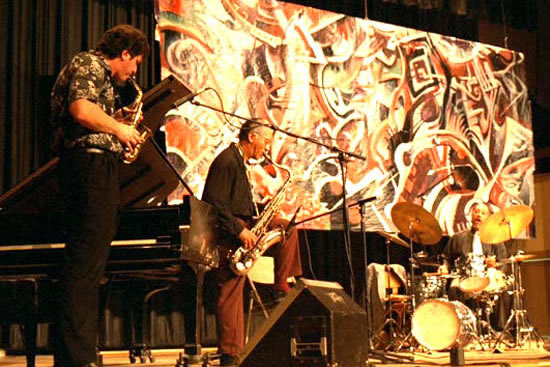
Pianist Joel Futterman was originally a Chicagoan, but he’s been a Virginia guy for a long time now. His roots are in the Windy City’s AACM (the Association for the Advancement of Creative Musicians), and it certainly shows, though the immediate influence that impresses through his improvisational attack would be Cecil Taylor. The biggest noticeable difference between Futterman and many of the other Taylor-ite players on the scene is that he feels less like an exponent of a conservatory environment and more rooted in a classic jazzic “live-music” tradition: the club/rehearsal space as sound lab. This isn’t to infer that Futterman’s playing isn’t academically challenging (and rewarding), it just feels more descended from the hotspot that produced Taylor’s masterpiece NEFERTITI, THE BEAUTIFUL ONE HAS COME than the perhaps safer shelter of the accelerated learning atmosphere that’s aided the work of Anthony Braxton and the late Bill Dixon. I’m not proposing that the academy is inferior to the club stage (especially since there isn’t a player that ranks higher for me personally than Brax), I’m just observing. Futterman’s great gush is very much in the grand stream of “excellence through performance”, which is where the AACM influence really comes into focus. Having a founding AACM member to join the proceedings on SOUTHERN EXTREME gets those fine roots showing even more. Alvin Fielder is one of the lynchpin names in the history of the ‘60s Chicago avant-garde movement. He played on SOUND, Roscoe Mitchell’s essential Delmark release and then disappeared from the recording scene for a couple decades, moving to Mississippi and working as a pharmacist. In the ‘80s he reappeared through the indie-label jazz renaissance, hooking up with Futterman and others and thankfully insuring that his legacy would be something other than another lost name. Fielder is one of many underappreciated guys from the original avant-wave that learned and played extensively in an “inside” context” before satisfying the urge to head into fresh territory. He’s quite an expert on the subtleties of assorted modern jazz masters that proceeded and inspired him in the drum seat, and the deep effect that his knowledge and influence of history has on his playing makes him a fine partner not only for Futterman, but especially saxophonist Edward “Kidd” Jordan, a New Orleans legend whose profile has risen over the last few decades due to his deep connections with some long standing greats like William Parker, Hamid Drake and the late Fred Anderson. Jordan’s recorded pedigree is notable for its R&B sessions, including backing the great Professor Longhair, so it should be no surprise that his playing is infused with a sharp bluesy edge that could surely be described as Coltranian. Certainly Jordan was touched by the influence of John, and that certainty is quite pronounced at times in his work on SOUTHERN EXTREME, but it’ll probably be a bit more useful to describe his playing on this disc as remindful of the late Taylor collaborator Jimmy Lyons. Some may consider that a stretch since Lyons played alto and Jordan, a multi-instrumentalist, sticks to tenor on this date. A few of Futterman’s earliest recordings included work with Lyons (stuff I REALLY want to hear), so I’ll admit to that knowledge possibly influencing the above comparison. But only a little bit. Because there are long passages on this live recording that boil like a smaller group version of Taylor’s amazing UNIT STRUCTURES. There are also extended spots that don’t sound like that at all, including the end of track two, where Jordan works himself into a scorching lower-register frenzy that collides with Futterman, who appears to be channeling McCoy Tyner under the influence of trucker speed. When the pianist really connects with Fielder’s percussive abilities he can briefly summon a similarity to the great Muhal Richard Abrams (more Chicago), and furthermore occasionally tosses out ideas that seem inspired by players as diverse as Paul Bley, Andrew Hill and even Jaki Byard. He has a wide ranging conversational strength in his fingertips, but doesn’t stop there, also blowing a couple of fine horns, namely the soprano sax and Indian wood flute, and when he steps away from the keyboard to flex his lungs the sparks do indeed fly. The segments where wood flute and drums mingle and stretch out are a bit like falling through a time-hole to find Don Cherry and Ed Blackwell playing on a Copenhagen street corner for the sheer love of it on a cool overcast day in 1970 (or thereabouts). And the fine saxophone tussles with Jordan are some of the disc’s highlights.


In comparison to the late Richard Grossman or John Blum, Futterman’s done a whole lot of recording, appearing on over sixty releases. In spite of his prolific output, he remains terribly underappreciated as a top-rank post-Taylor improviser as vital to the continuing progress of the music as Marilyn Crispell, Matthew Shipp, or Myra Melford. Where Grossman’s neglect is comparable to the master pianist Herbie Nichols and Blum’s relative lack of opportunity thus far feels similar to the early portion of fellow piano great Horace Tapscott’s career (this of course is subject to change), Futterman’s lack of recognition seems to stem in part from his geographic circumstances, and the artist that I can’t seem to shake in relation to his work isn’t a pianist but a writer. Objectivist poet Lorine Niedecker spent the majority of her life in rural Wisconsin, and the largely posthumous interest in her outstanding work has revealed that her lifestyle was inextricably linked to her creativity. It seems incorrect to opine that the factors necessary for artists like Niedecker and Futterman to flourish also works against their best interests somehow. One surefire obstacle for creative minds is recognizing the environment that best suits their endeavors, and the notion that artists thrive on the often erratic pulse of the urban milieu is true for many, but obviously not for all. Joel Futterman is proof of that, as are Jordan and Fielder. If the trio on SOUTHERN EXTREME suffers a lack of recognition, the fault lies not with them or their outstanding work but with their potential audience’s lack of diligence. Seek and ye shall find, you know?


Along the river
      wild sunflowers
over my head
       the dead
who gave me life
      give me this
our relative the air
      floods
our rich friend
      silt
          -Lorine Niedecker

Monday, August 9, 2010

The BYG/Actuel Series Part Four: Frank Wright- ONE FOR JOHN (Actuel 36)


For a guy that sort of hovers in a purgatory between obscure and “bubbling under”, the late tenor sax man Rev. Frank Wright has a fairly large number of recordings in his discography, both as a leader and sideman. His inclusion in the annals of the ESP Disk and the Actuel rosters sort of insures he’ll never suffer the lack of recognition that afflicts such names as Smiley Winters or Marc Levin, but a boost in the guy’s general notoriety would be a welcome turn of events. In the grand scheme of Wright’s recorded work, ONE FOR JOHN lands almost two years after a criminally unreleased Sunny Murray session for Columbia (SPIRITUAL INFINITY, with Clifford Thornton, Arthur Jones, Dave Burrell and possibly others) and shortly before UHURU NA UMOJA, his contribution to the French label America’s spate of avant jazz releases. JOHN is noteworthy as presenting the recording debut of a slightly shifting unit of ferocious free invention that flourished under Wright’s leadership, a crew that included alto giant Noah Howard, sublime pianist Bobby Few, incendiary drummer Muhammad Ali and bassist extraordinaire Alan Silva (post-bop drum vet Art Taylor also connected with Wright during this period, a fact that when bookended with Philly Joe Jones’ contemporaneous run-in with Archie Shepp [and the long, fascinating careers of Max Roach and Kenny “Klook” Clarke] lends credence to the theory that the most vital and longstanding element of bebop wasn’t reeds but rhythm). This one and done bomb drop for Actuel features Howard, Few and Ali along with Wright, so it’s more about heavy lung abstraction than rhythmic pummel.


French print ad for Selmer saxophones featuring Wright
(who probably didn't get paid)

Not that Wright’s overall artistic thrust varied all that much. He was clearly, at least as a leader, always expanding upon the core advancements of Coltrane and Ayler, and this has led some to dismiss him as a second tier player. Bullshit to that. The sensibility that denigrates Wright is essentially no different than that which disparages or belittles Sonny Stitt as eternally in the shadow of Charlie Parker. Much ado is often made, and deservedly so, over the innovators, but far less hoopla is given to what I’ll describe as the “extenders”, those players who grasp innovation often before critics and the general public and work with it to mold those new ideas into an established and accepted progression. Wright’s commentary upon Coltrane’s genius was more distanced than that of his wife Alice or Pharaoh Sanders, both key contributors to ‘Trane’s later exploratory period, and ONE FOR JOHN quickly reveals a sonic atmosphere that’s more concerned with euphoria of pure force. Where Wright’s first two ESP records can be viewed as direct responses to Ayler, SPIRITUAL UNITY inspiring THE FRANK WRIGHT TRIO and the larger bands of Ayler’s Impulse! period begetting YOUR PRAYER, they share with ONE FOR JOHN’s exploratory ‘Trane-ism’s a bold density and urgency that helps to place their leader’s sound in historical context: Wright, along with his cohort Howard, Charles Tyler, Arthur Doyle, late bloomer Charles Gayle and Test’s Daniel Carter and Sabir Mateen are all offspring of J.C./Ayler at their most energetically searching, a collective bubbling cauldron of distinct personalities, “extenders” all, dedicated to applying varying levels of toughness and abstraction to this shared approach. The commercial possibilities of this sound was something significantly less than great, so it’s no surprise that the vast majority of those names never got close to a major label recording studio. The main fallout from this circumstance is the faulty perception that the work of Ayler and late Coltrane is very specific and mainly relevant to the rocky social landscape of the 1960s instead of being recognized as the beginning of a wide-open style that still throbs forcefully in the here and now like a vein in the bicep of a greased-up weightlifter.The last few decades have seen a nice increase in acceptance for the overall thrust of free/avant/ecstatic jazz, with recent developments including a deep reevaluation of that most reviled of all jazz decades, the 1970s. And in my opinion the ‘70s were Frank Wright’s best period, for it found him engaged in the beautifully rewarding extended dialogue with the above mentioned core band, a relationship that proved so fertile it necessitated the forming of the artist run label Center of the World to document the development of their activities.
ONE FOR JOHN, recorded on 12/5/69, finds that core group already in an advanced state of mind. Side A’s title piece opens with a particularly inspired passage of well controlled simmering beauty that quickly and naturally erupts into full on furiousness of breath. Wright’s stamina, along with his unwavering dedication to this sonic ideal, remains impressive, as does his ability to get into a sympathetic zone with alto-ist Howard. It’s risky when two players this powerful lend their lungs to the same session, for exuberant intentions can often unfortunately lead to non-communicative overstepping and the drowning-out of the creative spark. Instead, here, the mind meld is fertile and extends to their dialogue with the piano and drums.


Noah Howard

Muhammad Ali is the brother of the late Rashied Ali, who is probably best known as Coltrane’s last drummer. Where Rashied’s long legacy gets a small but sustained boost due to that formative early relationship, his bro is unfortunately far less known. Which is a bit of a raw deal, for in addition to basically developing into Wright’s go-to sticksman he not only contributed in a very key fashion to Alan Shorter’s enigmatic Verve recording session that resulted in the ORGASM LP but also beat the skins on Noah Howard’s essential blast THE BLACK ARK and played on a handful of hot early ‘70s Archie Shepp blowouts. He’s correctly categorized as an “energy” player, though closer in style to his brother than to Sunny Murray or Milford Graves. If there is a tangible difference in delivery, I’d say that Rashied is a heavier hitter and Muhammad’s more occupied with a wider path of urgent finesse. At least on this recording.


Muhammad Ali

Wright’s long association with Bobby Few is notable in a period where many free players were following Ornette’s example and eschewing keyboards. Not to flog one idea at the expense of the whole, but this further emphasizes the depth of influence of Coltrane on Wright’s music. McCoy Tyner, followed by Alice, filled the piano seat on ‘Trane’s most outside work, and some listeners consider the inclusion of this instrument to be a grounding factor on those recordings, keeping most of them from truly exploding into orbit. I wonder if those ears would say the same (if ears could talk what tales they’d tell) about Few’s playing here, which is at times quite explicit in its connection to Tyner’s rising and cascading block chords. Hailing from Cleveland where he grew up (and played) with Ayler, Few is a versatile improviser similar in style to Dave Burrell and Don Pullen, all three sharing a sensibility rooted in tradition yet always actively searching. A distinct personal signature is prevalent in everything I’ve heard from Few however, and his hooks to jazz history just might be the deepest; his long association with the late Steve Lacy lends credence to this idea. The Tyner-esque style on display here is indicative of the tribute nature of the recording (this is the one BYG/Actuel release that really feels descended from the Bob Thiele/Impulse! tendency toward albums as statements of “props”) and while surely referential is still a fine example of this pianist’s complex and warmly rewarding style.


Bobby Few

Possibly the most impressive aspect of “One For John” is the sonic distance it covers. That short opening passage feels almost like an homage to the intro to MEDITATIONS, there’s a collective purge that’s not all that far from the white-hot ouch of THE OLATUNJI CONCERT, group vocal chants erupt like a more druggily wigged-out OM outtake and with around a minute left the group winds down into a gorgeous bit of edgy tranquility that harkens all the way back to “Alabama”. Geez. You’d be quite right in thinking that’s a hard act to follow, but side two pulls a mean feat with “China”, another side long piece that combines a traditional Asian motif with slowly building levels of improvisational oomph, Ali in particular getting seriously busy all over his kit. Both Wright and Howard attain high degrees of expression, albeit in a more subdued manner. It becomes apparent that this track is essentially about curiosity and the value of cultural exchange. Few’s recurring flurries of the Chinese theme, still a bit Tyner-like, do a fine job of elevating the overall discourse to a level that’s legitimate (sincere) as a fusion of musical styles and time-tested for pure non-scholarly listening. It’s really not far from the plateaus of cultural investigation and integration achieved by the great Don Cherry (much more on him later). And there’s more chanting, even more bent and loose than on side A. Yes, it’s the sort of sound that’ll make purists scowl, and if Richard Nixon had heard it back then, he might’ve reconsidered that trip to the PRC.


History can be a harsh mistress. While the tide of acceptance for post-Coltrane free jazz has thankfully started to turn more toward the positive, there’s still a long way to go, at least in this writer’s opinion, before players like Frank Wright (and the members of his band) get the credit they deserve. ONE FOR JOHN is exemplary documentation of a group of prime underdogs. Hear it and howl.

Friday, July 23, 2010

"Always - Love Over Gold" - WHY DID YOU MAKE ME HUMAN? cassette compilation (Mississippi Records)


The continuing saga of a modest little record store in Portland, Oregon and the consistent stream of audio goodness that bears their imprint/mark of quality is one of the best and least expected fruits of being a music fan in the here and now. WHY DID YOU MAKE ME HUMAN? is volume 43 in Mississippi Records’ homemade compilation tape series, and it presents a fine selection of “Doo-Wop, R & B and early Rock” (as scrawled on the packaging), much of it (at least to these ears) sweetly obscure. The ultimate objective of these cassettes (and the MP3s of their contents that are currently traversing the internet’s reliable circuitry) is quality and not rarity however, so the track-list does include some well known names: Bo Diddley’s riotous and celebratory call and response groove-mining (“Africa Speaks”), Ike & Tina Turner’s molten hip-swinging ferocity (“I Idolize You”), The Shirelles’ tough and sweet gal-group largeness (“Doomsday”), The Coasters’ typically zonked and wise-assed R & B (“Little Egypt”) and Sam Cooke’s eternally gorgeous soul rendering (“Nobody Knows the Trouble I’ve Seen”) all make superb appearances. There are also a slew of names that are noteworthy if far less canonical, and that’s where some of this comp’s finest tracks are located. Garnet Mimms and the Enchanters are best known for the formidable hit “Cry Baby” (later covered by Janis Joplin), but “A Quiet Place” should’ve been just as big. It lands squarely between late period vocal group richness and the then (1964) burgeoning Cooke-inspired soul construction, and it contrasts well with the blunt gush of The Falcons’ (who hit big with “You’re So Fine” in 1959) “I Got a Feeling”, which uses a roughly similar blueprint toward a goal that’s far more concerned with raw stomping and shouting. The Ad-libs are best known for “The Boy From New York City”, but their non-hit 1966 A-side “Human” (which queries this compilation’s title) is an amazing piece of A cappella Doo-Wop that’s cumulative effect is just jaw-dropping. The Edsels’ of “Rama Lama Ding Dong” fame conjure a nice bit of vocal group loopiness with “I Was Born in Mexico”, and Barbara George, best known for “I Know (You Don’t Love Me No More)” (#1 R & B/#3 Pop in ’61) fronts a slightly eccentric but inviting slice of vintage New Orleans junk. Considering the quality of all of the above, it’s still the obscurities that carry this gem up the stairs to the level of exceptional. The Twistin’ Kings were actually Motown’s legendary house band aka The Funk Brothers, and “Congo Twist (Part 2)” is a very curious and uncommonly inspired attempt at dance craze cash in, radiating very much like a piano led soul-jazz session that’s mutinied by a rogue gang of hired percussionists, the scalawags derailing and rerouting the atmosphere into territory very much about strong coffee and lush exotica. Quite beyond Chubby Checker, baby. But The Delcos’ might just steal this whole show with “Arabia”, which is a whole lot like a rougher, less streamlined version of The Four Seasons contractually obliging a cameo in some nameless rough and tumble exploito-teen cinema. I kind of imagine the scene a little like this: A bunch of absconding harem girls stow away on a cruise ship and accidentally drink copious amounts of a kooky scientists’ powerful love-elixir. They proceed to invade the ships swinging and unsuspecting discotheque, where Valli and Co are holding court with a particularly smoking band. Rhythmic mayhem ensues. If “Arabia” is destined to be my personal tiptop of the cuts offered here, there is still plenty more fine quality stuff located amongst the 23 tracks, and while most of it leans toward vocal group eloquence either A cappella (The Casanovas, The Hudsons) or with accompaniment (The Jive Bombers, The Revells), it also has a nice helping of additional R & B in store (Tarheel Slim & Little Ann, Pearl Jones). But it’s the two truly spiffy Rockabilly excursions that really stand out (but make total sense) in this milieu. The Musical Linn Twins “Indian Rock” is dripping with that spastic hiccupping frenzy as perfected by crazy Caucasians in the second half of the ‘50s and Benny Joy’s warped excursion into sauced lounge weirdness is a direct antecedent to one of Tav Falco’s many facets. The entirety of this cassette is an ideal example of wise, inspired assemblage, and as such is so much more than just cool. It’s loaded from end to end and back again with pure life affirmation, the stuff that serves like a hand-me-down hickory stick to beat off the bugaboos, scourges and downers of modern life. And while the actual cassette copies of this have probably all found loving homes, I’ll again stress that MP3s are out there for the finding. Playing them might lead you to momentarily mistake yr IPod for a transistor radio, and cool THAT most certainly is.


Monday, July 12, 2010

The planet just got a little less interesting


RIP Harvey Pekar

Ten from the '90s Part Six (1995): The Blue Humans- INCANDESCENCE CD (Shock)


INCANDESCENCE was released in 1995 on writer and Skullflower guitarist Stefan Jaworzyn’s Shock label, and it documents a particularly noteworthy and vital trio formation of guitarist Rudolph Grey’s post-No Wave/improv-rock outfit, featuring legendary and late jazz drummer Beaver Harris and longstanding skronk-noise-agitator Jim Sauter from New York’s notorious behemoth sax/guitar trio Borbetomagus, recorded live at CBGB in an opening slot for Sonic Youth in 1988. Music recorded in the ‘80s and released in the ‘90s to be (hopefully) savored until the end of all time. Blue Humans (along with Grey’s solo work) has been generally uncelebrated within the wide-open range of the post-’77 underground, even though he’s collaborated with a bunch of major names, outsider jazz giant Arthur Doyle and top-notch experimentalist Alan Licht among them. If Grey’s name rings a bell for many it’s in relation to his exceptional oral biography of sui generis American filmmaker Edward D. Wood Jr. And yeah, that’s one whopper of a book. Grey’s strength as a purveyor of molten improvisational scorch is a whole other basket of steaming bagels, though. Without explicit debts, Blue Humans launch from the same pad that hosted the ecstatic eruptions of late era-John Coltrane. But where lots of artists more deeply connected to jazz tradition became (maybe at times too) concerned with relating /continuing the spiritual element of ‘Tranes’ late sound, Pharaoh Sanders springing to mind first and foremost, Grey’s various groups start with the glorious sonic extremity inherent to LIVE IN SEATTLE or OM and jump with calibrated intensity into a new territory that falls between out-(noise) rock and unapologetically full-on improvisational scorch without ever feeling like a studied attempt at fusion style grafting, ultimately registering as far more organic and intuitive than either Last Exit or the unjustly neglected SST act Universal Congress Of (as great as both of those bands certainly were, and more on UCO later). Of course, Grey’s No Wave roots are a big part of the picture. His late ‘70s band Red Transistor is one of the key lost groups of the genre (one essential 7” posthumously released on Thurston Moore’s Ecstatic Peace! label), and Blue Humans can be looked upon as the template for the sort of aggressive and extended non-commercialism that No Wave really should have developed into. This very brief CD is evidence of the quite frequent gestures toward unbridled creativity that occurred during this era of supposed horrid conformity (the ‘80s only sucked for people who didn’t look or couldn’t find hep sounds), and I feel safe in surmising that at least one person that unknowingly stumbled in front of the exquisite explosiveness of this trio had their life permanently altered for the better. Sauter’s delivery here is looser and more identifiably jazz-like than his deliberately pummeling attack in Borbetomagus and Harris’ drumming throws aside any explicit ties to jazz tradition, instead opting for an explosive and rock-aligned forward motion (still abstract as all hell) that shows how deeply simpatico he is with Grey’s sensibility. That sensibility, in something close to a nutshell, is a free flowing yet thick and abrasive mass of sound surely influenced by but ultimately not classifiable as jazz. The music here, even with its roots in Coltrane (and Albert Ayler), owes far more to Jimi Hendrix at his most sonically extreme. Most casual listeners might miss this since Hendrix was nearly always somehow connected to song forms and Grey most assuredly is stridently the opposite, his work often feeling instead like one of Jimi’s typically great solos turned inside out and reshaped into something seemingly new yet secretly familiar, or possibly like a brief segment of The Experience at their most outré being looped, examined and expanded like a mind-bendingly beautiful Technicolor balloon. There are certainly still ties to the assaultive core sensibility of No Wave and also to free jazz, but Blue Humans were simply born of the former and borrowed from the latter. And just like it would be a huge fallacy to categorize AXIS: BOLD AS LOVE as a blues record, to call INCANDESCENCE late period No Wave or contempo free jazz is just as largely off the mark. Instead, this document is a core example of one of the rarest of forms: Free Rock. Now, one thing INCANDESCENCE does share with free jazz is the harsh fact that it is best experienced in the live context. To quote the great master Eric Dolphy: “When you hear music, after it's over, it's gone, in the air. You can never capture it again”. The recordings of improvisational, cathartically abstract expression have always been attempts to capture the incendiary essence of this wide-ranging and inexhaustible form, and even the greatest examples have ultimately failed to grasp the sheer life-altering power of witnessing the sweat roll from the brow of a player while standing in the midst of a cloud of collective creative abandon. INCANDESCENCE does a damn fine job trying to harness the force of the fervor, though. It’ll never match being there, but it can make being wherever the hell you are infinitely more interesting. And that’s the whole point, I think.


Grey with sax master Arthur Doyle and Beaver Harris

Wordy, unruly and dissonant: Saccharine Trust- PAGAN ICONS LP (SST 006)


Saccharine Trust’s first album is probably destined to be ever-slept on. It’s certainly identifiable as punk rock circa 1981, though there are either too many or not enough odd, quirky, arty elements integrated into the brief running time of PAGAN ICONS (I consider it an LP, some call it an EP, I think we’re both right) to work up the posthumous froth of a fan base. For many, they will be considered too weird to fit the now codified definition of what punk rock is supposed to sound like. But for others, the Trust will be too committed to the rock tradition, even at this early point, to really qualify under their terms as groundbreaking or vital. They weren’t an “anti”-group like Flipper in form or The Nig-Heist in content, and while assuredly lyrically thought provoking also lacked the aggressive antagonism inherent to many of their peers (label mates Black Flag for one example). Folks could and have called Jack Brewer’s words pretentious and his voice obnoxious, but rest assured I’d never be that uncouth. Brewer’s real function at this early stage is to serve as an effective vocal counterweight to guitarist Joe Baiza’s already distinctive style. Syllables and chords intertwine into a heaving, throttling atonalistic mass that when aided by the functional but worthy rhythm section of Earl Liberty (bass) and Bob Holtzman (drums) forms a vicious and dark whole. Brewer’s throat is so loose and slippery that it essentially eschews the sorta big group sing-alongs that have aided a lot of now canonical punk action, plus the lyrics avoid the kind of chanting brevity or blatant sloganeering that was quite frequent by this point. “I Am Right” is a tightly wound and well executed exception (while subversively serving as a smart taunt toward self-righteousness, punk and otherwise), featuring a group-growled chorus melded to some tightly coiled chug and clang (it was later covered very well by Sonic Youth), and “We Don’t Need Freedom” does edge up against the caustic protest punk that was starting to gain traction in the dawn of the hardcore era, though the thorny ponderousness of the subject matter is much larger and interesting than the so often simplistic political platitudes expressed by a stinky busload of punk “radicals”. This true non-conformist quality is quite an important aspect of their sound and identifies Saccharine Trust not as outsiders searching for the safety of a marginalized peer group (which is what much of the punk movement [any movement for that matter] actually was, and there is not a bit of shame in that) but instead as committed iconoclasts stoked by the thrilling tension and release (i.e. the power) of musical expression. Of course the Trust did find their hail fellows in the SST/New Alliance scene, where they became an integral piece of that network’s puzzling jigsaw. This fine record zips by in a flash of amped up density, with the five minutes of its closing cut “A Human Certainty” making it quite clear that Baiza and Brewer were heading outward from any kind of orthodoxy. Joe wails through a snarling mess of string mulch while simultaneously presiding over a stressed groove, and Jack steps up and matches him with the bruised and bombastic testifying of a wounded soul. This is the track that appeared on THE BLASTING CONCEPT compilation LP and served as my introduction to Saccharine Trust. ICONS fell into my lap almost immediately after that, and at first “A Human Certainty” stuck out like an aching digit from the other seven tracks on the record. 1-7 were hyper-spazzy out-punk, ragged and surly and comely, but 8 felt to me like a sweaty and unstable deconstruction of something I was much more familiar with at my then young age, that being blues based hard rock. This was in no way a boneheaded punk-era piss take, however. It was instead a signifier of deeper rock knowledge that lined these guys up with not only their SST label mates Minutemen and St. Vitus, but also Cali-contemporaries like Dream Syndicate, X and Flesheaters. This sense of history helped Saccharine Trust avoid even a fleeting flirt with faceless generics, and they continued to evolve, underappreciated but unbowed. These days, PAGAN ICONS truly feels like a well formed whole. Its energy and intelligence are undiminished, and if you’re at all interested in the SST saga, this isn’t a footnote, it’s an essential component.

Ten from the '90s Part Five (1993): Unrest- PERFECT TEETH CD (Teen Beat/4AD)


Unrest’s development from smart and arty ‘80s post-HC upstarts into arguably the best guitar-pop trio of the ‘90s was a fascinating thing to hear as it happened. I can’t brag that I was there from the very beginning mind you, but I wasn’t that far behind, doing mail-order from Mark E. Robinson’s Teen Beat label when a large portion of that imprint’s discography was homemade cassette releases. And in my opinion there is a plurality of approaches into the vast worthiness of the band’s legacy: maybe the easiest way is to engage with their existence in two parts. The first found Robinson and drummer Phil Krauth interacting with a progression of third members (Tim Moran, Chris Thomson, Dave Park, Justin Chearno) in a sustained attempt at romancing a mind-bogglingly diverse assemblage of influences into something roughly approximating a focused aesthetic. That they were so successful at this unruly endeavor gets more impressive as time slouches forward. UK prog, Kiss covers, Kenneth Anger, shards of DC-post hardcore, choppy acoustic wrangling, unusual but surefooted instrumental passages, sincere post-punk appropriation and flashes of unadulterated pop brilliance all combined to somehow sound downright logical. Any of the band’s early recordings showcase this sonic coup to fine effect, though MALCOLM X PARK is probably the best example. The culmination of this first part saw the band undergo a subtle refinement that avoided downplaying their wide ranging nature, with KUSTOM KARNAL BLAXPLOITATION evidencing this shift. And that was cool, but where do you go from there? In Unrest’s case, you move on to the second part of their lifespan, often called the “Bridget Cross-era”. Cross had already made some serious waves as a member of Velocity Girl, contributing in a very key manner to that DC-area group’s outstanding debut 7” before bailing and hooking up with Robinson and Krauth in 1990. Her contribution to Unrest was immediately felt as they kicked out a couple of classic short players, “Yes She Is My Skinhead Girl” and “Cherry Cherry”. Listening to both it was plainly clear that further refinement was taking place. Specifically, deep attention was now being paid to the post-punk and guitar pop elements in the band’s arsenal, and they quickly attained an overt yet non-slavish Anglo-ist minimalism that was equal parts arty and catchy. At times insanely catchy. IMPERIAL F.F.R.R. is often thought of as the go-to release for this era of the band, since it solidified them as a main attraction of the ‘90s indie heyday (Spin Magazine articles and all that). And it is a masterful record, but as much as I’m smitten with that one (and smitten I most assuredly am) I rank their final album PERFECT TEETH as both my sentimental favorite (by a nose) and this incarnation of Unrest’s qualitative high note. It’s the release that hits the perfect synthesis of their late fixations and is also a monument to how deep study of musical precedent can meld with imaginative inspiration to reward the listener with a profoundly personal collective voice. It opens with a nice passage of guitar and vocal fragility from Bridget and Mark (“Angel I’ll Walk You Home”) before exploding into the precise pop heaviness of “Cath Carroll”. You may recognize that name as belonging to a certain Factory Records artist of notable cult renown (she was in Miaow, one of the best late ‘80s Factory groups). Deliberate hommage was a major element in the Unrest (and Teen Beat) attack, often visually (that’s Cath’s striking image gracing PERFECT TEETH’s cover above). They titled another tune “Winona Ryder”, penned “Isabel” in tribute to painter Isabel Bishop and named an early cassette LISA CAROL FREMONT (identify the reference and make this middle-aged auteurist happy). This practice surely gives off a nice post-Godardian whiff, something they share with fellow DC resident Ian Svenonius. The song celebrating this particular Brit-pop muse is just brimming with elements that basically define late-period Unrest; guitars hyperactive and chiming (with occasional helpings of judicious distortion), vocals soaring and joyous (when they weren’t magnetically melancholic), drumming complex and forceful (yet wildly, indefatigably direct in a manner that’s kinda post-Motorik). The tune gallops, it freefalls, it explodes, it repeats. And repeats. Sweet and glorious. From there the record moves into Mark’s mid-tempo jangle comfort zone (“So Sick”), finds Bridget conjuring a very UK rainy day-ish spirited mopery (“Light Command”), lands on one of Mark’s alternate-universe karaoke belters (“Soon It Is Going To Rain”), and sees Phil sing (and drum) a pretty and picturesque love ditty, the kind of tune that’d sound flat-out euphoric on headphones from an airplane seat while traveling to reengage the warm embrace of a lover long missed (“West Coast Love Affair”). Yeah, there is also some Tommy Tutone if he recorded for Sarah Records tomfoolery from Mark (“Six Layer Cake”), and Bridget’s closer has the sort of bold bass playing and airy downtrodden vox that screams out Rough Trade circa 1980 (“Stylistic Ampersand”). The centerpiece of the whole disc though is “Make Out Club”, which sounds like some dastardly rouge cooked down the choppy jangle-rifics of the early Wedding Present, sucked it up in a big-assed cartoon syringe and shot it into a throbbing mainline that leads to a furiously beating heart muscle energized not by blood (no way) but by the myriad and eternal beauties of love (sorry Scientists). If you’ve ever passionately kissed someone in a field on a blanket in late spring until it felt like you had just exchanged tongues, you’ll understand the greatness of this song. If you haven’t, it’ll make you want to. Please proceed.