Wednesday, May 26, 2010

The Auteur Files #6: Gerd Oswald's SCREAMING MIMI (1958)


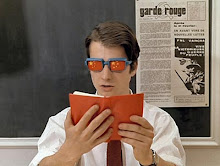
A few years ago, before cancelling my cable, I caught this 1958 film on Turner Classic Movies channel. Its director Gerd Oswald is a not particularly renowned figure who holds a special place for fans of classic TV (he directed a bunch of OUTER LIMITS episodes) and a certain small pocket of directorially focused and historically inclined film-nuts, most of them probably guided by the great Andrew Sarris, who wrote a wonderful tribute to him in his book THE AMERICAN CINEMA: DIRECTORS AND DIRECTIONS 1929-1968. That resource, which was pretty much ground-zero for English language auteurist film writing as well as a guide-source for movie-buff directors like Scorsese and Tarantino, was broken down into themed sections where Oswald fell under the group labeled as "Expressive Esoterica", and it was this corral to which I was attracted like a moth to an uncovered light bulb. Roughly half of this bunch toiled in the thankless landscape of the B-movie, a constant thread in the history of American film that wasn't really killed off until episodic television thoroughly entrenched itself as the way most people entertained themselves (the Grindhouse-era is the sometimes berserk and often sordid icing on this decades long cake), only to be resurrected in an inferior fashion with the largely undistinguished shelf-filling straight-to-video crap that appeared in the '80s "home-theatre"-period. Oswald was certainly a B director (the two exceptions to this were a film that featured Bob fucking Hope and a later '60s cash-in on the Bond craze called AGENT FOR H.A.R.M., two movies that Sarris calls "pre-doomed"), having to consistently deal with five to seven day shooting schedules and not particularly inspiring materials.


One of the great works of film scholarship

One of the first detectable qualities of MIMI is that its script is no great shakes. It's not "bad" (at least not in a groan or guffaw inspiring sense), but it is rather undistinguished in how it services the story. Oh yeah, the story. It's about a hubba-hubba blonde dancer named Virginia and as the film opens she gets attacked by a knife wielding psycho while taking an outdoor shower. The killer gets subdued by her shotgun toting relative (importantly, a sculptor) but Virginia is understadably traumatized and ends up in a sanitarium. While there, her doctor develops an attraction to her and his feelings take a left turn on the way to love and land smack dab in the territory of unhealthy and controlling obsession. Next thing we know, she's out of the hospital and working in a night club under the name Yolanda. A newspaper reporter falls into the story, and he's curious about this dancer's aloof personality and her possessive manager (yes, the doctor mentioned above). Then Yolanda finds herself attacked by another unknown manic with a knife, gets out of the hospital, engages in a brief tryst with the reporter, and starts acting more and more strange. Add in to the story these small sculptures of a stressed-out woman with flailing arms (I'll stop here for the spoiler averse), and you've got the basics for a no-reputation '50s-era suspense flick with some serious potential. The opening scene shows that at least some of that potential is going to be cashed in. It has a suitably rugged sensibility that's appropriate for a movie where the female lead gets attacked in the first few minutes by a man with a knife covered with the fresh blood of her dog (killed off-screen, natch). Additionally, this set up is also conceived with the dual intention of hooking the audience and withholding the fact that the pivotal character is played by a woman who wasn't cast for her acting abilities. Anita Ekberg was a European looker who is probably best remembered for appearing in Fellini's LA DOLCE VITA, but to be frank, she wasn't cast in that art-house staple for her thespian qualities, either.


It's in this movie's next scenes, which are full of crisp visuals and tight cutting, that Ekberg's deficiencies are gradually exposed. To expand and be fair, most of the acting is pretty bland, though Philip Carey as the reporter is solid and Harry Towne does achieve a mild level of Peter Lorre-ish strangeness. The movie's economy seems designed to create enough momentum to fend off viewers dwelling upon a flatly delivered line or a bland dialogue exchange. BAM, she sure is traumatized. BAM, that doctor sure likes her. BAM, she's getting better. BAM, Dr. Green is kind of a strange cat, and he's breaking at least one professional oath by messing around with his patient. BAM, she's out of the hospital, and dancing in a burlesque house under a different name. What's up with that? I didn't have my stopwatch handy, but all of this felt like it went down in under ten minutes. Along the way we get some nice camera movement and one notable little moment of Ekberg swaying around barefoot to some music that serves to establish that she's approaching some semblance of surface normalcy while simply upping the sexy quotient (sexy barefoot chicks being a staple of movies made under the production code. I find this to be one of the quirkier little elements of hommage in the cinema of obvious foot-man Quentin Tarantino). Next up was one of the more fractured scenes in the film, the extended establishment of the night-club where Virginia/Yolanda has landed a job. There are some seriously conflicting things going on: the club's band is played by Red Norvo's trio, and they lay down some nice '50s-era mainstream (not a putdown) jazz. It sounds cool, yet it feels a little off the mark to have a jazz group led by a double-mallet vibe player as the house band at an exotic dance club. Not exactly bump and grind material. But this really seems to feed into the atmosphere of this mythical joint. It's like a battle between shots that play up the "risqué" attributes of the place, and others that possess a blunt corniness (goofy dancing waiters, joke’s stale as a decade old bag of croutons).


It appears the intended effect is to land squarely between hipness and hokum. In the process, it becomes sort of an "unreal" location, not concerned with any kind of accuracy (at least to my perceived experience of what a dive like this, where scantily clad women dance "artfully" for the almost exclusive enjoyment of men [men who nearly all wear hats], circa 1950s America, should "really" "be"), instead existing as a motley mixture of elements that don't seem very compatible (the production code certainly played a part in this, and it could’ve also been designed by Oswald himself as a way to not offend some of the potentially fragile mindsets that could hypothetically inhabit theatre seats). I'm no stickler for realism, so I haven't the slightest beef with what's detailed above. Others might resort to mocking laughter or derision. Our personal mileage may vary, as they say.


As the scene unspools, the character of club owner and MC played by Gypsy Rose Lee is introduced. She delivers a not at all funny routine for the customers, and is obviously intended to add spice to the story, existing as a hard-as-nails, tough talking bird who just so happens to share her apartment with a young brunette with overt qualities of bohemianism, a pure hominahominahomina hottie who never utters a line but is almost always at Gypsy's side (even sitting beside her during a card game with the boys). I can't help but think that this girl exists to clue in the "knowing" to Gypsy's sexual preferences. There is one "red-herring" moment with this boho missy where she gives a meaningful head-turn as if she knows something to be revealed later, but all that adds up to is a hill of beans.


Dressed in black and digs records: My kind of gal

Shortly after Gypsy's introduction, we learn that Ekberg can't dance any better than she can act, which doesn't really seem so odd for an exotic dancer, but does create some dissonance when characters deliver subsequent lines about how great she is. Through this whole scene, the camerawork is rather nice, reinforcing the efficient assurance of the film up to this juncture. From a visual/thematic standpoint, things just get better in the next scene, which takes place in Yolanda's dressing room. In a word: mirrors. Characters have the opportunity to really see themselves, but nobody uses it. This theme is amplified by subsequent developments in the movie. We also get introduced to Devil, Yolanda's annoying as shit Great Dane. There is this wonderfully oddball reverse shot of a barking Devil that seems like it’s coming from another room entirely; it doesn't "fit" in the smooth manner that is the nearly all-encompassing standard for film's last few decades or so. Most will think this a positive development, but I for one love these brief flashes of shoe-string eccentrics. They’re like utilitarian hiccups, the tangible flare-ups that are sparked by the use of a more meager pallet.
But the true test of strong direction with little or no money is how complicated scenes are executed. The crowd scene here, the moment in the story where Yolanda gets stabbed by a mysterious, unseen serial killer, is certainly complex. It's set up to withhold essential information; we never see her get stabbed, the scene opens after the fact. When this is done, the complexities move away from showing the act convincingly, and head in a thornier direction, an area that's the opposite of the natural "less-is-more" tendencies of low-budget filmmakers. For a crowd scene that essentially functions to inform the viewer of what they've missed, you need to add characters, in this case bystanders and emergency personnel, who shape the scene. This means more shots, more continuity and more difficulties. Oswald does a fantastic job with this scene, and includes a bit of what I think is the movie's big underlying theme, for good measure. The ostensible good guy in the scheme of things is the reporter Bill Sweeney. He's at the scene, flanked by a cop with a pistol, and he's attempting to get the wounded Yolanda from the bottom of a basement stairwell. The only problem is Devil, who's in full protect mode, barking wildly. At one point, Oswald cuts to a close-up of Sweeney's face telling the cop to "shoot him, he's mad!" The look on his mug is an unflattering mix of coldness and menace. They do manage to get her out of the stairwell without offing Devil (he's needed for further story developments), and as the movie proceeds, Dr. Green gets more and more possessive, Yolanda becomes more and more disturbed, and she and Sweeney get down to some lovey-dovey business. The aforementioned underlying theme, delivered with a tasty ambiguity that's aided by the detached camera and cutting, is the suffering of Virginia/Yolanda under a group of male characters that inflict her with violence, selfishness, non-physical abusiveness, and a general inability to understand or care that the best thing for this particular woman at this specific time would be to get as far away from this fucked-up and foul group of heels as possible (in a nutshell: MALE OBSESSION. Where would the movies be without it?). Her brief affair with Sweeney is the icing on the cake. After a magnificently shot apartment scene that utilizes darkness and bursts of blinking light from outside the window, it becomes clear that Sweeney wants her to run off with him, even though her life is a borderline shambles that she can't remember large portions of. Oh, she was easy to convince. This is, until Dr. Green did some convincing of his own. From here the film heads with due speed to a tidy but in no way happy ending (nobody gets the girl). The story takes some far-fetched turns, but the unlikelihood is preferable to triteness.


My overall impression was that Oswald took the uninspiring materials he was handed and really made something worthwhile from it. The theme outlined above is penciled in (or "smuggled in", as Scorsese likes to say) so that some foggy nogoodnik in a wrinkled raincoat taking in a ten cent double bill in '58 could simply watch in obliviousness (a.k.a. what the studio wanted). Meanwhile, the no-flash mise-en-scene breathes life into the proceedings in much the same fashion.
The blunt delivery of movies like this, short sweet and self-effacing little "entertainments", at least from a surface glance, is a big part of their value. They are almost never included in the sporadic round-ups of "greatest films" or "best ever" lists, but are just as valuable as many canonical masterpieces. The perspective of the masterpiece is pretty much inappropriate for films like SCREAMING MIMI, anyway. Masterpieces are basically all-encompassing works that so often scream out that they are important and demand attention, that make clear that their existence has had a profound impact on the course of whatever form of art they inhabit (which is not exactly what the word masterpiece means [a piece that shows mastery, basically], but culture has taken this particular term and ran with it in the exact opposite direction from the word genius, which these days gets applied to chefs and football coaches). I'm cool with that: having my ass handed to me by Duchamp in a gallery to the point where I'm unconscious of strangers standing beside me is one hell of a feeling. But I'm just as clued in to a smaller scale scene, where I'm looking at (or hearing, or reading) a succession of less weighty productivity, all the while getting a little bit of impact from each example until at some point I'm just clobbered with the reality that a whole lot of so-called modest work has added up to a sum of something quietly unique and powerful. This is the domain of the pulp novelist, the minor poet, the garage band, and certainly the lowly "action-film" director circa 1958. That's where Gerd Oswald is at, plugging away in anonymity in a genre of his art form that got no respect while it was happening, only to find himself retroactively assessed as a small but significant part of a real golden age.


Gerd Oswald

Credit where it's due: most of the above screenshots were taken from the nifty beatniky-inspired blog Like...Dreamsville. Check it out: http://likedreamsville.blogspot.com/

Thursday, May 20, 2010

3 quick ones


The wealth of post-war electric blues can at times be a bit much to fathom. That’s why some folks elect to stay with the established classics, such as the stuff on the Chess, Trumpet and Aladdin labels, for just three instances. And that’s not an unwise attitude to take if yr tastes are diverse and yr time is valuable. But it doesn’t paint the whole picture. The compilation COOL PLAYING BLUES CHACAGO STYLE does indeed shed light upon and deepen the pool that casts the refection of ‘50s amplified blues, consisting of sides cut for the Parrot label in the middle portion of that decade. Most of this disc was unissued at the time of recording, but I suspect that had more to with the economics involved and not the quality of the sounds. However, if you’re rigid in yr disdain of horn sections as an unnecessary intrusion into the wild transference of energy that was the electrification of the blues, you might want to skip this one. That’s not my bag, but I do tend to prefer my blues raw and unfettered from the tendencies of streamlining, so this disc wasn’t a personal mindblower. It does go down well enough though, the best of the bunch belonging to Curtis Jones, whose use of horns feels natural (possibly the result of a working band) and not grafted on in an attempt to increase commercial appeal. Jody Williams has a nice uptown B.B. King-ish feel, L.C. McKinley’s tracks seem to hearken back to the booming echo-laden sound of the Chess Brothers’ Aristocrat releases (where guitars, pianos and horns often blended in a nicely rudimentary fashion), and on one tune tenor sax player Nature Boy Brown’s Muddy Water’s-like vocals create an appealing clash with his band’s favored blend of jazzy-R & B (his other two tracks are instrumentals). But yes, this is still a very hornified affair. And as such it lacks the impact of being slapped on the pate by the primal scorch of say, early Elmore James. But that’s alright. And the Jo Jo Adams’ cuts apparently feature arrangements by Sonny Blount, aka Sun Ra. WHOA!!!


Because I am what some consider a stick in the mud, I prefer early Cure to almost any other type of Cure. SEVENTEEN SECONDS isn’t the band’s oldest stuff, but it is the beginning of what I (and others) consider the group’s most fertile period. Never as doomy and depressing as some folks made them out to be (particularly in contrast with any ‘80s Swans, for just one example), they were staking out territory that combined pop, post-punk, and studied atmospherics in a stridently non-smiling way that was markedly different from the more late-night horror-movie infused aesthetic of fellow U.K.-ers Bauhaus. Oh well, the press still tagged The Cure as gothic. But that’s because they were fucking lazy. I’ll confess that I never started really listening to this band in earnest until my late 20s (though they were in semi-constant rotation in my high school years at parties and during car rides); before that, they always seemed too refined for me, especially in contrast to the brilliance of Joy Division, who nailed me to the wall the first time I heard them. I can intuit a lot of Joy Div in this record (particularly in the placement of the bass guitar in the schema of the band’s sound), more so than on any post-MOVEMENT New Order release in fact, but I can also hear a band attempting to bring its own collective identity to the table. And yes, refinement. The Cure were surely post-punk, but they weren’t raw or antagonistic. Accessibility was part of the band’s M.O. from the start (I mean seriously, give me an example of a more catchy woe-is-me mope-fest than “Boys Don’t Cry”), and this album commences a trio of records that combine that approachable sensibility with a seriousness of intent that refutes their reputation as just college radio hit-makers. This is a fine LP that at its best finds them proffering a catchy, multi-layered and deceptively edgy plod. Play this between Siouxsie and the Banshees’ ONCE UPON A TIME: THE SINGLES and Bauhaus’ IN A FLAT FIELD (a couple of classics, in retrospect) and you’ll have the soundtrack to at least a half dozen nights of my late teenage life. Nice to know I can appreciate it more now than I did then.


SUN ARK, Sun Araw’s newish 7’’ on the Not Not Fun label is a fine spectacle. “Bump Up (High Step)” is an extended tour of a blissed-out zone that feels equally indebted to low-fi bubblegum dub and tinny, street corner psychedelia. It’s a sweet blend of expansiveness and repetition, fuzzy and druggy, but with an irresistible (some might say nagging) pulse that never deviates from start to finish. Layers of gonky organ junk proliferate as the track motivates into the eternal consciousness, insuring that the sonic whole builds in intensity, but the track never really shakes its feel as hypothetical soundtrack music for a video game that’s object is to save the world while simultaneously getting thoroughly and unapologetically stoned. Sound(s) like fun(?) If this reads to you like some sort of retro trip - on one hand kinda, but on the other most emphatically NO. Grace Slick will hate it, but Phil Lesh will likely understand. Side two, “Live Mind”, is much more heavily drenched in dub syrup, but there is just as much wheedling and woozy organ, substantial levels of blunted boom-chacka guitar progressions and a slick fabric of cyclical rhythmic bursts. Vocal textures arrive, though they wisely avoid the limitations of language. It’s no surprise that a flute momentarily emerges from the mix. Like much of the current underground, Sun Araw is fairly prolific, and it’s clear that the man behind the title (Magic Lantern member Cameron Stallones) is quite welcoming of what many perceive as archaic technology in both the overall aural whoosh of his project and also in the manner of documentation, since a sizable portion of that output has been released on cassette. Mighty keen, I say. This baby is a vinyl single however, a limited edition of 500, and most likely already sold out. MP3s do exist, and if you are well stroked by the sounds of Panda Bear, High Places or label-mates Ducktails, you should seek Sun Araw out, bask in the rewards, and then tip yr cap in the vicinity of Augustus Pablo and Albert Hoffman for helping to set this delicious mess into motion.


Saturday, May 8, 2010

Ten from the '90s Part Two (1991): Love Child- OKAY? CD (Homestead)


It’s interesting to consider the bands/artists that get anointed with immortality and those that suffer the fate of being forgotten (if they were indeed ever known). To wit, 1991. Of all the bands in my personal heavy rotation that year, it was Pavement that has most impacted history. And that’s cool. PERFECT SOUND FOREVER was/is a flat out beauty of a 10 inch EP. The “Summer Babe” 7" was a stone gas as well. But two groups that were beating out Stockton's finest in my personal sweepstakes of the constant spin were Thinking Fellers Union Local 282, a bent and comely post-avant-garage group from San Fran that will no doubt eventually get their own post in this space, and Love Child, a complex New York indie-trio that I felt at the time were poised to rise to the top of a bursting bullpen of bands (though I probably played SEBADOH III more than any other record that year, but everybody loves that one, right? Right?). Thinking Fellers have a deep discography and are pretty entrenched in the lore of post ’77 US art-damage, but Love Child has been sorta kicked to the curb of history, or more to the point they are a footnote in the twisted geography of Alan Licht’s snaky list of recordings. In this regard, they suffer next to Run On, a Matador act that were kinda looked upon (by me, anyway) as an indie-supergroup (for the record, Rick Brown ex-Fish & Roses and Les Batteries, Sue Garner of the Shams and Licht of, well, Love Child, and also very fine solo releases and his shit-hot participation in Ed Wood-biographer Rudolph Grey’s mammoth no wave/free jazz project Blue Humans). One reason I thought Love Child were all set to conquer the scene (so to speak) was due to the way they were such a swell collusion of seemingly irreconcilable influences, convulsed in a specifically Noo Yawk way. Let’s run down the list: an approach to stripped-down sonics that was similar to the at-that-point very much in vogue K records’ sound, which was justly amplified by the bands’ multi-instrumental attitude (Never mind that Licht titled a solo release CALVIN JOHNSON HAS RUINED ROCK FOR AN ENTIRE GENERATION). Male sung lyrics that at times come off like a passive aggressive Jonathan Richman and at other moments lash out from the hypothetical psyche of a love-wounded schmeedle. Much of the proceedings are related to post-power pop happenings to varying degrees. Female vocals courtesy of the much missed Rebecca Odes generally detail lovey-dovey goings on in a grandly smart and detached manner (Oh so sweet). Licht’s guitar playing (soloing) depicts an alternate universe where Eddie Van Halen is actually Thurston Moore. I even hear echoes of post-Ubu Cleveland and a Frankensteinian sewing job of early Television and early Feelies. How east coast. In a sense Love Child was a perfect band for 1991, a period where the indie scene had reached a boiling point, Nirvana and to a lesser extent Pavement tearing the roof off the sucker. But Love Child was in no way a schizophrenic band. Nah, they seemed totally simpatico, with the necessary frictions and individualistic tendencies. They were riding a blazed trail into wide open territory, just one piece of a nationwide under-the-radar grid. Another reason I thought Love Child would succeed in contrast to (for example) the great but quite obscure Royal Trux (who inexplicably [to me] ended up on a major label and lasted into the 21st century) related to the trio’s pop sensibility, which at this point was more explicit then that of Unrest or for that matter Pavement. Ultimately, you never know how things are going to shake out. OKAY? really shook the peaches from my proverbial tree for a few years and has been in semi-frequent rotation over the last twelve months or so since I copped a download to replace my beat-to-shit vinyl. I never located the follow up LP WITCHCRAFT, though I’d love to hear it since it’s rumored to be in a more Yo La Tengo direction (It featured new member Brendan O’Malley replacing Will Baum, who left to head out west. He formed the band 9 Iron. Never heard them). I do own the debut 7” on Trash Flow and the Moondog covers 7” on Forced Exposure. Both are dandy. But I’ll let you in on a secret. If some enterprising and cutting edge label (say Merge, who’re getting a rep for righteous indie collections/reissues, Honor Role and Dino Jr. and Volcano Suns and Destroyer to name four) decided to compile the entire output of Love Child into a jam packed 2CD set, I don’t think I could resist picking it up, largely because they were such an aesthetically solid and purely rewarding band. They are always at the top of my coulda-shoulda been contenders list, a group that was clearly tailor made for my mindset (then and now), so any motion in the contemporary marketplace toward justifying their too brief existence would seem to require a reciprocal gesture on my part. The least I could do, essentially. What’s that? My favorite tracks? I’ll type this slowly, so nobody misses the point. Every fucking one. OKAY?’s landscape ranges wildly from start to finish, but every second is essential. Until somebody with the wherewithal to make waves wakes up and smells the caffeinated breeze, I guess it’s up to me to light a candle for these three. If you stumble upon them and find yrself similarly impacted, perhaps you might do the same.


Alan Licht playing No Fun Fest NYC
(any idea how hard it is to find a pic of Love Child online?)

The BYG/Actuel Series Part Three: Kenneth Terroade - LOVE REJOICE (Actuel 23)


Jamaican born UK resident Kenneth Terroade recorded just this one album as a leader and was a part of only a handful of sessions under the direction of others, the majority belonging to free-drumming master Sunny Murray; three Actuel dates (we’ll get to them later) and a fourth, BIG CHIEF, originally released by the French Pathe label and recently reissued by the excellent Massachusetts label Eremite (I’ve previously covered BIG CHIEF elsewhere in the guts of this blog). Along with Actuel sessions by Alan Silva, Claude Delcloo and Dave Burrell, Terroade is also on a very enticing LP (kindly reinstated to availability by Downtown Music Gallery) by South African expat-drummer Selwyn Lissack, a date that just happens to feature another legendary lost guy of freedom, Ric Colbeck. Other than playing flute on Dr. John The Night Tripper’s SUN, MOON & HERBS from 1971 (and rumors of other rock sessions), that appears to be it for Terroade. I actually have that record by the Dr. on the shelf and recall that it’s a good time, though not as hot as his first few (Clapton’s on it, what’d ya’ expect?). I just might pull that one out for a spin, though I’ve been locked into LOVE REJOICE all damn day and it’s not even close to wearing out its welcome.
Terroade plays both flute and tenor sax, and while I almost always prefer sax to flute (I’m just that kinda guy) I’m thankful for his abilities as a flautist, partially due to his sound (it’s good, reaching for urgency over prettiness) but mainly because his dual horn status probably helped to increase the man’s meager number of discographical spots. It’s a stone drag that he didn’t have more opportunity to head sessions, because based on the evidence of his sole shot he was well suited for the role. Before LOVE REJOICE is even slapped upon the platter it’s clear that this will be a unique listen. The instrumental makeup is notable for the inclusion of two bass players and a bevy of multi-horn action, bass clarinet most notably. And the names involved really stand out. South African expat Ronnie Beer, a cohort of the late Chris McGregor, plays tenor, alto and flute. Evan Chandley, a member of Cohelmec Ensemble (who’s 1971 LP HIPPOTIGRIS ZEBRA ZEBRA is a superfine and ultra rare slab of zonked French jazz) plays bass clarinet and flute (we’re up to three flutes, if you’re counting. Yes, parts of this do sound a bit like a fife and drum corps showed up to jam after gobbling a sheet of prime blotter. That’s very nice, yes). Wily Frenchman Francois Tusques, leader of the hard to find though top heavy with names INTERCOMMUNAL MUSIC on Shandar (amongst other important recordings), plays keys. The quite prolific Bob (or Beb, or Bab, or Bernard) Guerin plays bass, as does Earl Freeman, a vet of numerous very heavy Archie Sheep groups of the same period and two vital Noah Howard ‘70s dates PATTERNS/MESSAGE TO SOUTH AFRICA (combined and reissued by Eremite, BTW). Claude Delcloo, a reliable part of the Actuel story, rounds out the group playing drums.
The result of getting all these guys into one room is two side long improvisations, both excellent and distinct. “Blessing” wastes no time getting right down to business. By the one minute mark the horns have taken off and Delcloo is fervently attacking his kit, Tusques passionately accenting while the basses rumble from the bottom. From there the intensity and density ebbs and flows, with players dropping out momentarily, and there are hints of late-Coltrane and early Impulse!-era Sanders, something vaguely remindful of Ayler circa LOVE CRY (a certain ache in the melody) and a more prominent line of influence to Don Cherry’s embrace of trad global folk. The rhythmical triangle really succeeds in keeping the proceedings at a constant simmer, and with one or both of the bassists using a bow through the majority of the piece the sonic range is expanded even further. At a few points, bowed string combines with lung heave to produce an air of bluesy lament. Delcloo’s aggressive tactic never falters by overstepping or breaking down the communicative flow, and Tusques’ steady keyboard clatter provides both necessary momentum and additional coloration. What a fine nineteen minutes.
The same can be said for side two, though there are some key differences, foremost being the pace of the music. “Love Rejoice” begins as a slow gnaw that builds and releases tension throughout, allowing for periods of sustained and harried horn junk and some quite attractive engagement between the two bassists and Delcloo. Long passages develop dirge like qualities, and the feeling of New Orleans is palpable in the Paris night. There’s a sound, I think it’s coming from the bass, that’s like someone’s precocious kid bouncing around the studio with an electric pogo-stick. Boing! Flutes arrive and flutter about. Slowly there is a shift, a rising of the intensity, the music attaining a maelstrom-like force. Everyone’s in with both feet, going for broke. They hit the sweet spot and then expertly rein it back, winding it down. Amazing. And while it’s a bit of a craw-sticker to see LOVE REJOICE and players as strong as Terroade and his band treated so shabbily by history, any ill feelings are easily remedied by simply playing the music again. That’s why they recorded it, you know? And after its beauties have unspooled into the air the sheer number of ears that hear it matters far less than those instances where the evolution of improvisational dialogue (what Oliver Nelson called the “abstract truth”) grabs a listener’s attention and won’t let go. Kenneth Terroade, welcome to my personal canon.


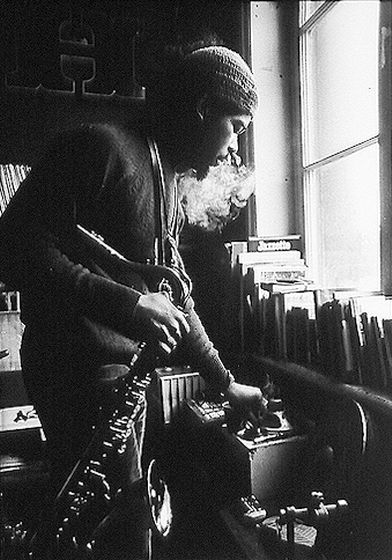
photo of Kenneth Terroade by Valerie Wilmer

Spotlight on Scientist Rock: Minutemen's THE PUNCH LINE (SST 004)


By this late date, I’ve become so familiar with the music of the Minutemen that it's almost part of my DNA. I can still recall quite vividly the first time I played THE PUNCH LINE, dropping needle to vinyl in my basement bedroom and preparing to flail my flabby frame to whatever my modest speakers spat out. This was a common ritual in those anything-but-halcyon high school days; however this occasion culminated with a different result. By the end of side one, I wasn’t all sweaty and puffy but was rather standing completely still, inspecting the album jacket in my hands like it was a piece of Mayan pottery that I'd inexplicably found under my bed during an all too infrequent cleaning session. Instead of flipping the record over, I replayed the first side again, and then a third time. It was a memorable afternoon, to say the least. At that point, I'd heard maybe a dozen or so punk records and a handful of homemade comps from friends where the music of assorted bands basically blended all together like the ingredients in a well-prepared fruit salad. Yum. When something stuck out, I elected to investigate further. First, I scored a copy of the justifiably legendary THE BLASTING CONCEPT compilation LP (SST 13), the contents of which felt like the sonic equivalent of being wailed on by a bunch of thuggish rouges, only to then be helped up, dusted off, and sent home with a playful ass slap. This led me directly to THE PUNCH LINE. One quality that still excites me about the record is how goddamned up-to-the-moment it sounds, specifically because the band's music was so extremely personal and, dare I say it, original. The "Ohh" word is best avoided as a rule when writing/talking about music (because there will almost always be someone ready to pounce and decry claims of originality with scenarios of influence, sometimes overstated and occasionally IMO imagined, though I’m getting submerged in a whole other bucket of guppies), but in this instance I feel it's acceptable to let it slip, mostly due to how it connects with the example of bassist Mike Watt's professed love of Modernist writers like Joyce and Faulkner.


The whole broad scope of Modernism (and 20th Century art in general) was flat-out ass-kicked by old man Ezra's challenge to "Make it new", and the still utterly unique music of these Pedro proles confirms to my ears that they really understood how to pull off that difficult task. In a nutshell, the only way to really, effectively make it new is to soak up and learn from the whole vast avalanche of worthwhile antecedents, and then after appropriate consideration distilling it into a potent brew that can make the receiver feel drunk (but not too drunk) with the liberating possibilities afforded by the freshness of this particular path. History so often repeats itself because too many hambones haven’t done their homework.
If all this sounds somewhat hyperbolic and worshipful, please allow me clarify. Regarding worship; if the story of this band is unfamiliar to you, I'll state that they were not a not a group that were knelt down to, at least not in the bright light of day. They were modest, positive, encouraging guys who in no way attempted to elevate themselves over their fan base, and were in fact vocally uncomfortable with the idea of musician as deity. If any band can be said to have brought the true essence of the punk rock ideal hurling into the indie-rock era and beyond, it was Boon Watt and Hurley. A book about the whole indie-rock explosion was thoughtfully titled from one of Minutemen's blunt lyrics: "Our band could be your life", a direct, level-headed mantra that sits in sharp contrast with some of the "Mascis is God" (new new Claptonism) or "Sonic Youth are geniuses" (new new Beatleism) remarks that I heard in smoky dorm-rooms and during car rides, so I hope you absorb the point that my verbiage is less designed for pedestal placing and is intended instead like the enthusiastic kudos you'd give to family or close friends when you discover that they've managed some particularly righteous feat. As for hyperbolic, I'll surrender guilty as charged, since the success and appeal of Minutemen is intrinsically linked to a workmanlike, kinda ordinary, no-big deal anti-swagger. Get in the studio, get onto tape, get outta there and get heard, and get back to being dudes. Indeed a large friction does exist between the reality of this band and my attempts to give them their due within the context of art and history and the struggle of moving onward (forward!) in the intertwining lives we're handed (i.e. SHIT THAT MATTERS), but if you just (re)consider that basement bedroom remembrance and how it's still hanging on tight after over twenty years of existence (fuggin’ nostalgia, it’ll get you every time), I hope that friction isn't difficult to swallow.


In one sense, I’m a bit disappointed that THE PUNCH LINE is no longer available as a standalone work, being currently in print as part of POST MERSH VOL. 1, the first of three collections that do an important job of showcasing the majority of the band’s pre DOUBLE NICKELS ON THE DIME output (though the greatest Minutemen comp will probably always be the gargantuan MY FIRST BELLS cassette (SST 32), an exhaustive road-trip readymade that smartly pulled together nearly everything these guy’s recorded pre-NICKELS and that I somehow stupidly and sadly allowed to slip through my fingers. I blame it on the format: convenient enough to fit in yr shirt pocket, but far easier to lose. It’s probably under the passenger side seat of a grey Chevy Chevette in some skanky junkyard at this very moment. Blah). Minutemen’s original releases are very distinct. While their sound was in constant flux they were also strict and thoughtful documentarians of their music and no-nonsense operators in the studio, the result being LPs and EPs that when lined up and played in something resembling chronological sequence present a thread of artistic progress that’s the equal of any rock band ever. And if you think THAT is hyperbole I simply ask you to shine a light on their betters. That said I don’t want to carp too loudly over how digitization can distort the beauty of a band’s evolution. Who’s to say that my approach to their sound is any more worthy than a sixteen year old skate rat pumping the band on IPod shuffle, anyway? Still, my passion for historical clarity burns.


THE PUNCH LINE is very much a punk rock record, eighteen songs in roughly fifteen minutes spinning at 45 RPM, and the overall hefty brevity is comparable to other get-it-over-and-done-with punk slabs from the same time period such as Circle Jerks’ GROUP SEX and Angry Samoans’ BACK FROM SAMOA (all three from Cali, I’ll add). The weight and shape of the sonics are quite different, of course, since Minutemen were squeezing out compact shards of what’s essentially a brutal and hyper punk/funk that continues to stand apart due to its solid minimalist tendencies, its sheer urgency, and its ultimate lack of egoist flash. They didn’t sound like anybody else, then or now, but this feat was achieved, as detailed above, through the absorption and consideration of precedent and the inspiration of their contemporaries. For instance, the music’s hooky minimalism took cues from the UK art-punk of Wire and marched in solidarity into the 1980s alongside fellow Californians Urinals (who’s “Ack Ack Ack” was covered by the ‘men). Certainly urgency and the avoidance of show-off moves aren’t uncommon traits in punk rock, but on this LP these qualities combine with the stridently political lyrical focus to attain a rare power. Where the words of so many punk bands are their least admirable quality (particularly as the ‘80s marched on), they were integral to what Minutemen were doing. They could say more with one song title than some bands could with an entire lyrical arsenal. THE PUNCH LINE shows them plumbing into the Beat-style word-smithing that later came to dominate their sound (moving away from the tyranny of the rhyme, but not forgetting that they were writing lyrics for instance), but at this early point they were still quite happy to embrace an edgy and well-considered didacticism, and you can feel as the record roars that the trio were fiercely proud to be political (a quality they never lost, in fact). And the ingrained influence of countless hours of pre-punk hard-rock listening (Blue Oyster Cult being the example the band most often championed) provides the record with both an amazing instrumental dexterity (attained through constant practice) and an unfailing balance between tight and loose, which for my ears is crucial due to the funk angle of the music (I’ll confess that when funk gets too tight it almost always loses me). Yet the dominance of punk in the total stew insures that they never succumb to hard rock’s excesses.


The idiosyncratic (though never obscure) nature of the Minutemen sound has gained them a strong following in the long term, but back in the ‘80s it caused many to hold the band at arm’s length: I often heard it spoken that they weren’t appropriately “punk” or “heavy” enough. I thought that sorta talk was crazy (natch), and I’m glad that hearing it has become less frequent than sightings of DRI muscle shirts. Faux Pas! The second hand vinyl of THE PUNCH LINE can’t be too hard to find or expensive when found, so if I’ve stirred yr interest, please don’t hesitate. It’s a very specific part of the Minutemen picture, and I contend that grappling with it alone will bring a sweet reward.

Ten from the 90's Part 1 (1990): Daniel Johnston- 1990 CD (Shimmy Disc)


It seems a bit odd in retrospect, but 1990 was the first gospel recording to enter the hallowed confines of my record collection back in the year of its release. What’s even odder is how, even though the record far from resembles a traditional gospel album, it took me over a decade to recognize it for what it clearly was. This largely speaks to my (former?) knuckle-headedness and lack of maturity, but it also (just a little bit) points to how aberrant was the concept of spiritual music in the scene that then embraced, with varying degrees of ironic distance, Johnston’s work. There was such a range of appreciation from the guy’s fans (along with naysayers who harrumphed that his popularity was just one big hipster put-on, though happily this has largely subsided), from borderline exploitative (curiosity seekers) on one side to naively adulatory (“outsider genius”) on the other. In the days before Cobain donned a HI HOW ARE YOU? T-shirt there was much debate over Johnston’s underground popularity. One odious line of thinking accused his musician collaborators and the wealth of his fans of using Daniel for credibility and cool-points. Time has proven this to be nonsense, of course (IMHO there were undoubtedly higher percentages of phonies professing to love Sonic Youth during this same period, but that’s another story). 1990 has moments of sheer beauty, but it’s also a troubled, rough, and at times difficult record to listen to, and I can sorta see it from this distance as a goad to those who were suspicious of the Johnston phenomenon. The original LP release featured eleven songs, six produced at Mark Kramer’s Noise New York studio, four live and one non-Kramer recording of a Beatles’ song. Six of the tracks are overtly spiritual in content, a couple more are ambiguously so. An additional few touch on the familiar Johnston themes of love and pain. But the whole damn thing feels like the testifying of a tortured man desperately in need of salvation. The studio cuts work best, stripping Daniel’s music of the tape hiss and “amateur” status that previously adorned so much of his work and in turn adjusting/sharpening the focus. It enriches the acapella opener “Devil Town”, making it sound huge where on a home-tape it would likely be quaint. And the studio really becomes an additional instrument on “Spirit World Rising”, where moments of intense quiet and the resonating of guitar strings combine most excellently with the booming yet adenoidal echo of the voice. Both “Held the Hand” and “Lord Give Me Hope” benefit mightily from the crisp studio atmosphere and how it not only captures the mood of injured desperation but also the later song’s sharp shifts in dynamics. Johnston’s piano playing displays incredible musicality (though he’s no virtuoso), even when the instrument sounds out-of-tune and possibly broken: “Got To Get You Into My Life” becomes deluged in cascades of rumbling low notes and the song is cagily transformed from The Beatles’ ode to sexual yearning into one of religious need. But it’s the pristine rendering of “Some Things Last a Long Time” that provides the album’s highlight. A haunting tune of love and loss, it’s one of Kramer’s strongest productions and really shows how adept Johnston is at interpreting other’s material (words are by Jad Fair). The live tracks all pass muster at differing levels, though “Don’t Play Cards with Satan” and “Funeral Home” both sound superior on the Mike McGonigal compiled long OOP Atavistic Video MOUTHFUL OF SWEAT. And “Funeral Home”, recorded live at Jersey record store Pier Platters (RIP), gets us back to the opprobrium of the naysayers. As a lazily strumming Johnston encourages a sing-along, it’s difficult to swallow the laughter of some attendees, which definitely feels aimed “at” the performer not “with” him, because the player clearly ain’t laughing. This contrasts sharply with “Careless Soul”, an acapella cover of a fire and brimstone gospel chestnut where the crowd is so quiet you can hear a pin drop between the anguished, emotionally distraught verses (I can positively feel the tears on his cheeks) and the dissonance between one believer and a room full of probable cynics is thick as George Steele’s neck. Yes, I’m inferring some of this, but only because on more than one occasion I witnessed folks become uncomfortable with “Careless Soul” (as well as other parts of 1990). Once a house guest asked me if the song was “some kind of fucking joke”. Um, no. The joke is on you I’m afraid. What’s also interesting is how I feel quite different about Daniel’s getting into the emotional deep weeds on MOUTHFUL’s organ drenched version of “Don’t Play Cards with Satan”. I can clearly see the tears on that clip, but in this case my heart swells up with empathy (instead of concern) since he’s being taped not in a club but in a house and is clearly amongst friends. I’ve felt for a while that the inclusion of “Careless Soul”/”Funeral Home” on 1990 was an attempt to delineate between the listeners who truly accepted and embraced the full range of Daniel’s artistry and personality from those who perceived it as some sort of yuk-it-up eccentric fun-fest (I can’t help but view the lingering notoriety of the late Wesley Willis through this lens. If this makes me a killjoy, I’m sorry to leave that impression. I’m really a fun loving person. Honest injun. Equal to a barrel of monkeys, in fact). I think Kramer (who ran Shimmy Disc, still does I think) largely succeeded in separating the lovers from the fakers, so to speak, and he surely had a helping hand from the advocacy of Kurt: three years later, Daniel would release another studio album, this time on a major label (Atlantic), the far more fine-tuned and stable FUN, with production from longtime friend and Butthole Surfer-member Paul Leary. Its title was accurate and fitting, but it was also more than just that. It deserves a separate post for ample discussion. These days, Johnston’s songs have been covered by dozens, he’s collaborated with just as many, his art’s been bound in books and displayed in New York galleries, and he’s the subject of a great, loving documentary. Success is surely sweet, particularly when it’s so hard fought. 1990 is an unflinching portrait of the trouble along the way, but it’s also a fine study of the work’s severe quality and the sincere beauty of the man. As such, it’s one to cherish.


photo by Michael Macioce

Sunday, April 11, 2010

Some Sunday night listening


TENOR CONCLAVE is essentially the story of four classic horn-men, all of them now representing something distinct in jazz history. Mobley is a fine example of just how deep the mainstream was in the years 1955-65, a guy whose discography is as substantial as any essentially straight ahead player from the era on any instrument, including trumpeter Donald Byrd. Like Byrd, Mobley’s best stuff was released by Blue Note, but he spread himself out all over the place, most notably Prestige, of which this session is just one part. He acquits himself in typically fine fashion. Al Cohn came out of Woody Herman’s band with fellow players Stan Getz, Serge Chaloff, and this recording’s Zoot Sims, but seems to have fallen into the shadow of all of his cohorts in that band with the exception of Chaloff. This might not seem like a big deal, but Cohn co-lead a major quintet with Sims in the second half on the 1950s that really brought home the bacon as far as post-bop from post-Hermanites was concerned. Sims just happened to be more prominent on recordings over a long period of time, the result being that his name and rep has grown over the decades, with Cohn developing into something approximating a player’s player. No matter. When he’s cooking, Cohn is as good (great) as Getz at his non-samba best. Or Sims, since he’s one of the blowers involved in this recording. Zoot has become a justifiably canonical player, forceful yet restrained, smooth but tough, swinging and smart. At the point of this record his sound was really the embodiment of a cross country road trip in a gas-guzzling convertible; large and powerful and engaging and stealthily cerebral. That leaves ‘Trane, and we know just how large an effect he had on the course of 20th Century music. But hell, here it’s early yet. We’re not even at BLUE TRAIN. Coltrane was at this moment a fiery young player that had understandably attracted the attention of Miles Davis. And on this date, he was just one amongst four in a group then named The Prestige All-Stars. Befitting that title, the rhythm section is appropriately solid: Red Garland on keys, Paul Chambers on bass and Art Taylor on drums. They lay down a foundation deep and warm for the four horn line, and the result is a quartet of tracks that possess a brilliance that is amplified by an inescapably offhand quality, a no-big-deal everyday greatness. All in a day’s work, you know?


Spending time listening to Coltrane can lead you into all sorts of unexpected areas, particularly in his early and late periods. One of the sweetest avenues a young John C traversed was recording with tubist Ray Draper’s Quintet. Now the tuba has surely never been the first (or fifth) horn people think of when modern jazz is the subject, but Draper’s group was anything but a novelty. It was a sincere and rather successful (in a lower case sense lacking in exclamation points) attempt to widen the sonic spectrum of post-bop. This is straight ahead jazz with an edge and an avant-garde approach not in the post-Coleman/Taylor sense, but rather in how directly it was engaged in opening up the instrumental sphere of a then commercially thriving medium. This record shares similar intent with Steve Lacy’s debut recording for Prestige SOPRANO SAX, since both featured instruments that were quite foreign to the modern jazz milieu of the period. Altos, tenors and trumpets ruled the roost, and while Lacy successfully cracked that supremacy to have a long career detailed in earnest elsewhere on this blog, Draper, to be frank, didn’t. And that’s a damn shame. For on NEW JAZZ 8228 the 17 year old tuba upstart sounds assured and passionate. While his axe of choice lacks the expressive range of Coltrane’s, Draper never falters by attempting to push matters. He colors, he comments, he accents, he leads. And when he solos, it is with the smarts and taste of a guy wise beyond his years. Like any in the pocket post-bop session of the era, this record rests on the total strength of the group’s ability, and the rhythm section stands tall even if their names aren’t those that normally fall off tongues engaged in ‘50s jazz-gab. Pianist Gil Coggins was an associate of Miles and Sonny Rollins, bassist Spanky DeBrest worked with Monk and drummer Larry Richie was an alumnus of Jackie McLean. All three are splendid on this record, and Coltrane is limber and focused in his role as the more emotive horn. Along the way, he trades moments with Draper and Coggins with sly tenacity, and then lays out on the album’s brief closing track, a piece well intended as a parting showcase for the record’s leader. Anybody who wants to get a true handle on just how wide ranging and rewardingly deep was the post-bop scene of the period should take a handful of listens to this baby. And then stick it in a stack of successive plays with TENOR CONCLAVE, the aforementioned Lacy disc, perhaps Rollins’ TENOR MADNESS (with the wonderful opening double team with Coltrane) and maybe Davis’ ROUND ABOUT MIDNIGHT. What I think you’ll hear is that NEW JAZZ 8228 is anything but an eccentric aside, an oddball one-off. It has a strong vital pulse of pure jazz invention, and it deserves to be something significantly larger than a footnote.

Saturday, March 27, 2010

A Portrait of Buster and Beckett as sweetly aging men.


Go on, Steamboat Bill.....

SST Records + Canadian punk = The Subhumans' NO WISHES, NO PRAYERS (SST 18)


Right from the beginning, Canada's punk scene was a diverse and interesting one. The Subhumans are a vital part of that history. Their story starts in 1978 with the top notch DEATH TO THE SICKOIDS 7 inch, and the band, along with their British Columbian peers D.O.A., were one of the best examples of impassioned, unhyphenated punk rock energy to burst into the first half of the '80s. For the most part, punk is a genre best presented on the brief and sturdy vessel that is the 7 inch single. Long playing records very often expose the lack of ideas or focus which so many bands working with the slippery simplicity of punk have lingering underneath their admirable ability to conjure up a handful of great songs. Of course, there are enough extant exceptions to ultimately make this thought a general idea and not a rigid rule. Many great punk bands never managed to come anywhere close to the tightrope walk of recklessness and discipline that's needed to pull off the achievement that's a successful full length record, but the ones that did are deserving of high regard. The Subhumans, with their SST record NO WISHES, NO PRAYERS, land squarely in this upper echelon. What's most impressive about this record is how the music, essentially an extension of the melodic Brit-punk sound of the late '70s (going so far as to include a nifty cover of the Menace classic "Screwed Up"), is reverent to its source without sounding tired or irrelevant. By 1983, British Columbia was home to both the hyper speed weirdisms of The Neos and the "jazzy" progressions of Nomeansno, so the very straightforward approach that The Subhumans offered up was at risk of sounding antiqueish. That may seem like an overzealous statement, but five years, in musical terms, is a long time (To illustrate, consider this: A band, in 1969, that sounds like The Beatles in '64. Catch my drift?). That this record still sounds energetic and necessary a full flipping decade into the millennium after it was recorded leads me to the conclusion that it must have sounded positively cathartic in the year of its release. How sweet it would've been to have experienced it firsthand in a raggedy room full of bodies going bonkers with sweat and adrenalin and an obligatory police helicopter circling above the mayhem. The Subhumans were an exceptional blend of speed, snot, seriousness, fun, chops, and distortion, and even though they lack the idiosyncrasies of The Stains or The Dicks, that's no reason to slight them. I tip my cap.

The saga of a punk rockin' Texas drag queen and his snotty bandmates: Thoughts on The Dicks' KILL FROM THE HEART (SST 17)


Unlike the Stains, lots of things went right for The Dicks, one of the most bizarre and incendiary punk bands to ever get captured on magnetic tape. For one thing, they are actually well served by their recordings, which is something many "legendary" punk bands can't claim. Second, The Dicks have retained relevance as a recording unit that non-punk obsessives actually care about in the here-and-now. And last, they stand as a shining example of a successful union of extreme leftist politics and a sound that was anything but by-the-numbers punk motion. I'd easily rate them as one of the best political-punk bands on a world-wide scale, mostly because underneath the flamboyance and confrontation, much of The Dicks' message was one of common sense. Issues of class, racial injustice, and police brutality were the common focus of their songs. When they took on broad subjects like war, the lyrics avoided speculative angles like nuclear annihilation and conspiratorial machinations and instead dealt with plain facts like how the poor were being used again as a pawn to serve rich nation's agendas. The Dicks were more interested in spewing out jagged, bluesy, occasionally funky, and reliably rock solid music and adding lyrical content that seemed like a bastard descendant of folk-protest staples like pre-electric Dylan and early Phil Ochs. Gary Floyd is one of punk's most striking and musically deft vocalists, a huge gay man from a state that's notorious for its close-mindedness, a guy who looked around him and definitely disliked what he saw, his distaste inspiring him to join up with some fellow oddballs (the late Glen Taylor, Buxf Parrot, and Pat Deason, for the record) and make some righteous noise. It's a bummer that KILL FROM THE HEART, the band's Spot produced entry in the SST discography is only partially represented on CD or legal download. The Alternative Tentacles compilation 1980-1986 is a nice attempt to gather tracks from the band into some kind of representative "best of", but I have a hard time getting fully behind a comp of Dicks material the doesn't include the extended caustic funkisms of "Dicks Can't Swim". I think a whopping double disc set would capture everything these lovely wackos ever put to vinyl, and a band of this stature shouldn't have to settle for anything less. If enough people bug Biafra, maybe it'll come to pass.

The Auteur Files #5: Some old notes on Tarkovsky's STALKER

The text below was saved to my hard drive shortly after watching Andrei Tarkovsky's 1979 masterpiece at The National Gallery of Art back in 2007. As an intial insight into the work of this Russian giant, I think my writing falls somewhere in the ballpark of just adequate. Additional viewings would certainly aid in enriching my perspective into this director's unique and sprawling genius. Get cracking, right?

One of the most impressive things about the film is how it proposes a story of the fantastic in such an open, direct way. That is, Tarkovsky presents his images with two of the basics of film form; camera movement and long takes. There is no slight of hand, no reliance on special effects, or rapid fire editing to help ease the skeptical into suspending disbelief. Instead, the camera documents the proceedings in a restrained (yet at times quite beautiful) manner. Certainly Tarkovsky's approach is an aesthetic one, yet it also feels like a matter of ethics. There is honesty in how the film progresses, as if the filmmaker is saying- 'I'm simply going to tell you a story. You can choose to believe in it or not. No smoke and mirrors'.
Long takes and slow pacing of narrative very often go hand in hand, but here the pacing seems to especially infuse the long takes with much of their power. Adding to this is the often subtle, occasionally intense camera movements (in particular the deliberate back and forth that provides the viewer with sustained moments with the three characters heads while they travel on the railcar). Often these movements seem to exist to provide a sense of perspective, of space and surroundings. Other times they seem more overt in their intention to infuse beauty into a landscape that's stricken with desolation, emptiness, and despair. There is mastery in how these three elements- pacing, long takes, and camera movement- are combined. The assurance with which the story unfolds is quite striking.


The scene in the bar that indicates the return of the three men is quite important. Without the presence of the dog, it would be difficult initially to tell if they had actually ever left for the Zone. But they did go, and in the resulting dialogue between the men and the Stalker's wife, there hangs a feeling that little or nothing has changed, that in spite of the surreal atmosphere and science-fictive events the men experienced on their journey, they were still the men they were before. There is no longer any doubt about the trip to the zone; they were there and felt all of its strangeness and pressures. But the return is quite melancholy, and in the subsequent scenes it's hard to shake off the lingering impression that in this particular cinematic world, engagement with the fantastic may be thrilling (and taxing), but doesn't give much of lasting value to the character's lives. The Stalker's despondency over the perceived futility of the trip only heightens this feeling.
The last scene of the film, upon consideration, is simultaneously mysterious and a very direct (re)statement of the filmmaker's position in relation to his characters and also to the mystical, the unexplainable, the paranormal. While the film is a story of the three men, an extended examination of their difficulties, shortcomings, and ultimately their failures, its ending exists as an artist's statement about human potential and the power of things that are beyond our comprehension. The Stalker's daughter, a girl who cannot walk, can move things with her mind. Her unnatural ability, her haunting presence (which to me seems to be infused, upon reflection, with an almost unnerving purity), and her solitude in this last scene appears to ultimately vindicate humankind from the neurosis, the coldness, and the misery which was such an intrinsic part of the film. Tarkovsky is emphatically saying that the aforementioned maladies are not a foregone conclusion, nor are they terminal. Furthermore, his ending is a passionate defense of belief, of what human beings can hypothetically achieve when they are not burdened by the emotional baggage and difficulties of communication which are so frequent in the modern world. Instead of a reactionary response to the harshness of modernity, in the end Tarkovsky posits that human beings are capable of overcoming their current malaise and can move forward, can triumphantly evolve to a new plateau of knowledge and capability


The innocence and alien-ness of one child shows what we can, what we should, hope and strive for.

Tuesday, March 9, 2010

Some more SST stuff: Stains.


The real worth of some things only becomes apparent over time. This is the case with the sole 45 rpm LP by East-LA's Stains. The record was recorded in '81 but wasn't released until '83. This two year gap certainly contributed to the initial non-reaction that the band received. By the end of the decade, the record was scarce (I tried to find it in some sort of half-assed fashion based on the strength of the song included on SST comp A BLASTING CONCEPT), and the few occasions I asked people about the band they either shrugged their shoulders or thought I was talking about Texas/San Fran outfit M.D.C., who went by the same name early. The record was missing in action, which is a shame in retrospect, because the peculiar and energetic blend of punk and metal that The Stains burp out would have sat very nicely with many of the "crossover" types that populated my particular neck of the 'burbs in the late '80s. Sadly, there just weren't enough copies of this record pressed to cook up a posthumous fan-base so soon. Some more years needed to pass, a couple of bootlegs needed to be released, and the internet had to be invented for this band to really get the appreciation they always deserved. These days, the record goes for big bucks, and the band is revered by many as the should've-been-contenders they definitely were. The icing on this reversal of fortune would be a well designed, strongly mastered reissue, preferably with the two demos (one recorded prior to the LP, one shortly after) that I've heard talk about (these demos are supposedly bootlegged, but they've never graced my ears. They could easily suck, particularly the post-LP recording, but it'd be nice to know for sure). It doesn't look like this is about to happen, so if you want the scoop on the band I suggest navigating the web. The whole record is out there in MP3 land, and short of a deluxe reissue, that's as good a place to hear this throbbing, heaving, spitting mess as any. Vocalist Rudy Navarro sounds wonderfully screwed-up and pissed-off, and the wailing strangeness of Robert Becerra's guitar is drizzled all over the place, helping the band eschew the sameness that was just starting to plague the punk scene during the decade. The rhythm section may not be up to the standards of Watt/Hurley, Dukowski/ROBO, or Lombardo/Stevenson, but it's not far behind. As with many SST recordings from the label's early period, producer Spot is the secret weapon. If these guys had been stuck in a room with some knob-twiddler who didn't know punk rock from pancakes, I'm pretty certain that this record wouldn't be the sought after item it is today. Shit, it's nice to think that something went right for these cats.

The BYG/Actuel Series, Part The First: Paul Bley - RAMBLIN' (Actuel 13)

This is the first in a hopefully eventually complete series of posts devoted to the discography of the amazing French avant-garde jazz/out-rock label BYG/Actuel. As befitting the unruly and disruptive nature of that roster’s collective of searching souls, I’m going to tackle this endeavor not in chronological fashion, but instead with a non-liner approach that I hope will provide an appealing and accurate historical landscape in which to appreciate this massive and still thrilling group of recordings. We start with Actuel 13, Paul Bley’s RAMBLIN'.

I’m not the first to say it, but Paul Bley is a prolific dude. Jazz pianists are often noted for their aptitude at clogging bins with a seemingly endless stream of releases, often with slight variance of personnel, and in addition for zealously examining/interpreting standards in the also seemingly endless pursuit of perfection in the elevation of form as content. Thing is, Bley is quite familiar with both of those modes of operation (thank you very much), but he’s also had other (bigger) (tastier) fish to fry. And quite frankly, I find myself stumped that the guy isn’t held in higher importance when the subject turns to jazz history. Bley’s playing life has spanned well over half a century and includes work with Charlie Parker, Lester Young, Ben Webster, Charles Mingus, Sonny Rollins, Coleman Hawkins, Ornette Coleman, Jimmy Giuffre and a slew of lesser known but equally important figures from what can be roughly categorized as the free/avant era. He was a member of the Jazz Composers Guild, a group that kick started the legendary October Revolution in Jazz back in 1964, along with his then wife Carla, Bill Dixon, Cecil Taylor, Archie Shepp and Sun Ra (amongst others).


The Jazz Compsers Guild

Possibly because he is a pianist that seems to prefer working in trios with advanced yet essentially accessible rhythm sections, Bley has indeed chalked up quite a discography, particularly post 1980, when European labels started getting their hooks into him, sending his list of credits into the stratosphere. All that said, the man still has a (relatively) tidy number of essential recordings, quite a few from the earlier days of his career, and RAMBLIN’ from 1966 is part of that group. In the heavy ranks of the BYG/Actuel roster, a group that includes some of the most uncompromising sets of wailing freedom to ever see commercial release, this slab is often given short shrift by (over)demanding power mongers. But Bley’s never been a scorcher, so slighting him on that count basically lacks a component of insight into just what makes the guy’s music resonate so mightily. RAMBLIN’ does a great job of aural portraiture, showing the pianist subtly straining against an essentially traditional melodic framework in his own playing while interacting with a very lively pair of rhythmic improvisers in bassist Mark Levinson and drummer Barry Altschul. The collective stew can shift from meditative to rollicking to angular to dense in a short span, with the level of percussive/rhythmic abstraction calibrated so that the music never totally loses its loose handle on piano trio classicism. And yet the level of intuitive interplay can be simply striking: on “Both”, the album’s thorny and complex first track, Bley maneuvers shrewdly between tough clusters of notes and periods of relative calm and (perceived) inactivity, leaving his fellow players to gradually build a slow-burn rhythmic back-and-forth that culminates in an explosive percussive display from Altschul. It’s a powerful opening, serving well as a statement of principles for the notably varied sounds that lay ahead. It was composed by Annette Peacock, his partner at the time of this recording, as was the following cut “Albert’s Love Theme”, which provides an extended foray into the minimal sensibility that Bley would expand upon at length in parts of his ‘70s discography.


Paul Bley and Gary Peacock

Certainly sparse, “Albert’s” still holds moments of insistent movement, moments that later efforts sometimes lacked, not necessarily to their detriment. Plus, the cut features some of the most un-brushlike brush work that I’ve ever enjoyed, and Levinson’s bass playing sounds like a giant rubber band being plucked by a love-drunk satyr. Sexy. Carla Bley’s wonderful tune “Ida Lupino” is also given a brilliant examination, the music hovering between a dark tension and an unruly prettiness. If, like their US counterpart ESP Disk, Actuel had elected to release 45 RPM singles, then “Ida” would have been a perfect candidate for the honor. And hell, they could’ve stuffed the diamond-tough classic-trio hyperactivity of the LP’s title track (an Ornette piece) onto the flip side for good measure. Its jagged momentum is quite enticing. “Touching”, another Peacock composition, features a return to spacious, contemplative playing, and the idea really seems to be the opposite of trad-motion. At times the sound just sort of hangs in place, as thick as cold peanut butter. This might bother some ears, but I like the hazy aural density that it conjures just fine. The pianist’s own tune “Mazatalon” closes out the record, with Bley’s thorny up-tempo melodic sense weaving through Levinson and Altschul’s typically strong rhythmic fabric. So, in something reminiscent of a nutshell, RAMBLIN’ is a record of peaks and valleys, with much time devoted to developing fresh variations on classic point A to B movement coupled with excursions into a studied but less familiar minimal approach. These ups and downs come together to form a fine whole. There are still many other sides to the multi-faceted work of this top-flight improviser left for examination, his pair for ESP Disk, numerous ECM releases and the Improvising Artists work in particular, but I feel secure in my prediction that this record, an expansive, disciplined and ultimately concise document of fine rewards, will rank as one of his best.