Sunday, April 11, 2010

Some Sunday night listening


TENOR CONCLAVE is essentially the story of four classic horn-men, all of them now representing something distinct in jazz history. Mobley is a fine example of just how deep the mainstream was in the years 1955-65, a guy whose discography is as substantial as any essentially straight ahead player from the era on any instrument, including trumpeter Donald Byrd. Like Byrd, Mobley’s best stuff was released by Blue Note, but he spread himself out all over the place, most notably Prestige, of which this session is just one part. He acquits himself in typically fine fashion. Al Cohn came out of Woody Herman’s band with fellow players Stan Getz, Serge Chaloff, and this recording’s Zoot Sims, but seems to have fallen into the shadow of all of his cohorts in that band with the exception of Chaloff. This might not seem like a big deal, but Cohn co-lead a major quintet with Sims in the second half on the 1950s that really brought home the bacon as far as post-bop from post-Hermanites was concerned. Sims just happened to be more prominent on recordings over a long period of time, the result being that his name and rep has grown over the decades, with Cohn developing into something approximating a player’s player. No matter. When he’s cooking, Cohn is as good (great) as Getz at his non-samba best. Or Sims, since he’s one of the blowers involved in this recording. Zoot has become a justifiably canonical player, forceful yet restrained, smooth but tough, swinging and smart. At the point of this record his sound was really the embodiment of a cross country road trip in a gas-guzzling convertible; large and powerful and engaging and stealthily cerebral. That leaves ‘Trane, and we know just how large an effect he had on the course of 20th Century music. But hell, here it’s early yet. We’re not even at BLUE TRAIN. Coltrane was at this moment a fiery young player that had understandably attracted the attention of Miles Davis. And on this date, he was just one amongst four in a group then named The Prestige All-Stars. Befitting that title, the rhythm section is appropriately solid: Red Garland on keys, Paul Chambers on bass and Art Taylor on drums. They lay down a foundation deep and warm for the four horn line, and the result is a quartet of tracks that possess a brilliance that is amplified by an inescapably offhand quality, a no-big-deal everyday greatness. All in a day’s work, you know?


Spending time listening to Coltrane can lead you into all sorts of unexpected areas, particularly in his early and late periods. One of the sweetest avenues a young John C traversed was recording with tubist Ray Draper’s Quintet. Now the tuba has surely never been the first (or fifth) horn people think of when modern jazz is the subject, but Draper’s group was anything but a novelty. It was a sincere and rather successful (in a lower case sense lacking in exclamation points) attempt to widen the sonic spectrum of post-bop. This is straight ahead jazz with an edge and an avant-garde approach not in the post-Coleman/Taylor sense, but rather in how directly it was engaged in opening up the instrumental sphere of a then commercially thriving medium. This record shares similar intent with Steve Lacy’s debut recording for Prestige SOPRANO SAX, since both featured instruments that were quite foreign to the modern jazz milieu of the period. Altos, tenors and trumpets ruled the roost, and while Lacy successfully cracked that supremacy to have a long career detailed in earnest elsewhere on this blog, Draper, to be frank, didn’t. And that’s a damn shame. For on NEW JAZZ 8228 the 17 year old tuba upstart sounds assured and passionate. While his axe of choice lacks the expressive range of Coltrane’s, Draper never falters by attempting to push matters. He colors, he comments, he accents, he leads. And when he solos, it is with the smarts and taste of a guy wise beyond his years. Like any in the pocket post-bop session of the era, this record rests on the total strength of the group’s ability, and the rhythm section stands tall even if their names aren’t those that normally fall off tongues engaged in ‘50s jazz-gab. Pianist Gil Coggins was an associate of Miles and Sonny Rollins, bassist Spanky DeBrest worked with Monk and drummer Larry Richie was an alumnus of Jackie McLean. All three are splendid on this record, and Coltrane is limber and focused in his role as the more emotive horn. Along the way, he trades moments with Draper and Coggins with sly tenacity, and then lays out on the album’s brief closing track, a piece well intended as a parting showcase for the record’s leader. Anybody who wants to get a true handle on just how wide ranging and rewardingly deep was the post-bop scene of the period should take a handful of listens to this baby. And then stick it in a stack of successive plays with TENOR CONCLAVE, the aforementioned Lacy disc, perhaps Rollins’ TENOR MADNESS (with the wonderful opening double team with Coltrane) and maybe Davis’ ROUND ABOUT MIDNIGHT. What I think you’ll hear is that NEW JAZZ 8228 is anything but an eccentric aside, an oddball one-off. It has a strong vital pulse of pure jazz invention, and it deserves to be something significantly larger than a footnote.

Saturday, March 27, 2010

A Portrait of Buster and Beckett as sweetly aging men.


Go on, Steamboat Bill.....

SST Records + Canadian punk = The Subhumans' NO WISHES, NO PRAYERS (SST 18)


Right from the beginning, Canada's punk scene was a diverse and interesting one. The Subhumans are a vital part of that history. Their story starts in 1978 with the top notch DEATH TO THE SICKOIDS 7 inch, and the band, along with their British Columbian peers D.O.A., were one of the best examples of impassioned, unhyphenated punk rock energy to burst into the first half of the '80s. For the most part, punk is a genre best presented on the brief and sturdy vessel that is the 7 inch single. Long playing records very often expose the lack of ideas or focus which so many bands working with the slippery simplicity of punk have lingering underneath their admirable ability to conjure up a handful of great songs. Of course, there are enough extant exceptions to ultimately make this thought a general idea and not a rigid rule. Many great punk bands never managed to come anywhere close to the tightrope walk of recklessness and discipline that's needed to pull off the achievement that's a successful full length record, but the ones that did are deserving of high regard. The Subhumans, with their SST record NO WISHES, NO PRAYERS, land squarely in this upper echelon. What's most impressive about this record is how the music, essentially an extension of the melodic Brit-punk sound of the late '70s (going so far as to include a nifty cover of the Menace classic "Screwed Up"), is reverent to its source without sounding tired or irrelevant. By 1983, British Columbia was home to both the hyper speed weirdisms of The Neos and the "jazzy" progressions of Nomeansno, so the very straightforward approach that The Subhumans offered up was at risk of sounding antiqueish. That may seem like an overzealous statement, but five years, in musical terms, is a long time (To illustrate, consider this: A band, in 1969, that sounds like The Beatles in '64. Catch my drift?). That this record still sounds energetic and necessary a full flipping decade into the millennium after it was recorded leads me to the conclusion that it must have sounded positively cathartic in the year of its release. How sweet it would've been to have experienced it firsthand in a raggedy room full of bodies going bonkers with sweat and adrenalin and an obligatory police helicopter circling above the mayhem. The Subhumans were an exceptional blend of speed, snot, seriousness, fun, chops, and distortion, and even though they lack the idiosyncrasies of The Stains or The Dicks, that's no reason to slight them. I tip my cap.

The saga of a punk rockin' Texas drag queen and his snotty bandmates: Thoughts on The Dicks' KILL FROM THE HEART (SST 17)


Unlike the Stains, lots of things went right for The Dicks, one of the most bizarre and incendiary punk bands to ever get captured on magnetic tape. For one thing, they are actually well served by their recordings, which is something many "legendary" punk bands can't claim. Second, The Dicks have retained relevance as a recording unit that non-punk obsessives actually care about in the here-and-now. And last, they stand as a shining example of a successful union of extreme leftist politics and a sound that was anything but by-the-numbers punk motion. I'd easily rate them as one of the best political-punk bands on a world-wide scale, mostly because underneath the flamboyance and confrontation, much of The Dicks' message was one of common sense. Issues of class, racial injustice, and police brutality were the common focus of their songs. When they took on broad subjects like war, the lyrics avoided speculative angles like nuclear annihilation and conspiratorial machinations and instead dealt with plain facts like how the poor were being used again as a pawn to serve rich nation's agendas. The Dicks were more interested in spewing out jagged, bluesy, occasionally funky, and reliably rock solid music and adding lyrical content that seemed like a bastard descendant of folk-protest staples like pre-electric Dylan and early Phil Ochs. Gary Floyd is one of punk's most striking and musically deft vocalists, a huge gay man from a state that's notorious for its close-mindedness, a guy who looked around him and definitely disliked what he saw, his distaste inspiring him to join up with some fellow oddballs (the late Glen Taylor, Buxf Parrot, and Pat Deason, for the record) and make some righteous noise. It's a bummer that KILL FROM THE HEART, the band's Spot produced entry in the SST discography is only partially represented on CD or legal download. The Alternative Tentacles compilation 1980-1986 is a nice attempt to gather tracks from the band into some kind of representative "best of", but I have a hard time getting fully behind a comp of Dicks material the doesn't include the extended caustic funkisms of "Dicks Can't Swim". I think a whopping double disc set would capture everything these lovely wackos ever put to vinyl, and a band of this stature shouldn't have to settle for anything less. If enough people bug Biafra, maybe it'll come to pass.

The Auteur Files #5: Some old notes on Tarkovsky's STALKER

The text below was saved to my hard drive shortly after watching Andrei Tarkovsky's 1979 masterpiece at The National Gallery of Art back in 2007. As an intial insight into the work of this Russian giant, I think my writing falls somewhere in the ballpark of just adequate. Additional viewings would certainly aid in enriching my perspective into this director's unique and sprawling genius. Get cracking, right?

One of the most impressive things about the film is how it proposes a story of the fantastic in such an open, direct way. That is, Tarkovsky presents his images with two of the basics of film form; camera movement and long takes. There is no slight of hand, no reliance on special effects, or rapid fire editing to help ease the skeptical into suspending disbelief. Instead, the camera documents the proceedings in a restrained (yet at times quite beautiful) manner. Certainly Tarkovsky's approach is an aesthetic one, yet it also feels like a matter of ethics. There is honesty in how the film progresses, as if the filmmaker is saying- 'I'm simply going to tell you a story. You can choose to believe in it or not. No smoke and mirrors'.
Long takes and slow pacing of narrative very often go hand in hand, but here the pacing seems to especially infuse the long takes with much of their power. Adding to this is the often subtle, occasionally intense camera movements (in particular the deliberate back and forth that provides the viewer with sustained moments with the three characters heads while they travel on the railcar). Often these movements seem to exist to provide a sense of perspective, of space and surroundings. Other times they seem more overt in their intention to infuse beauty into a landscape that's stricken with desolation, emptiness, and despair. There is mastery in how these three elements- pacing, long takes, and camera movement- are combined. The assurance with which the story unfolds is quite striking.


The scene in the bar that indicates the return of the three men is quite important. Without the presence of the dog, it would be difficult initially to tell if they had actually ever left for the Zone. But they did go, and in the resulting dialogue between the men and the Stalker's wife, there hangs a feeling that little or nothing has changed, that in spite of the surreal atmosphere and science-fictive events the men experienced on their journey, they were still the men they were before. There is no longer any doubt about the trip to the zone; they were there and felt all of its strangeness and pressures. But the return is quite melancholy, and in the subsequent scenes it's hard to shake off the lingering impression that in this particular cinematic world, engagement with the fantastic may be thrilling (and taxing), but doesn't give much of lasting value to the character's lives. The Stalker's despondency over the perceived futility of the trip only heightens this feeling.
The last scene of the film, upon consideration, is simultaneously mysterious and a very direct (re)statement of the filmmaker's position in relation to his characters and also to the mystical, the unexplainable, the paranormal. While the film is a story of the three men, an extended examination of their difficulties, shortcomings, and ultimately their failures, its ending exists as an artist's statement about human potential and the power of things that are beyond our comprehension. The Stalker's daughter, a girl who cannot walk, can move things with her mind. Her unnatural ability, her haunting presence (which to me seems to be infused, upon reflection, with an almost unnerving purity), and her solitude in this last scene appears to ultimately vindicate humankind from the neurosis, the coldness, and the misery which was such an intrinsic part of the film. Tarkovsky is emphatically saying that the aforementioned maladies are not a foregone conclusion, nor are they terminal. Furthermore, his ending is a passionate defense of belief, of what human beings can hypothetically achieve when they are not burdened by the emotional baggage and difficulties of communication which are so frequent in the modern world. Instead of a reactionary response to the harshness of modernity, in the end Tarkovsky posits that human beings are capable of overcoming their current malaise and can move forward, can triumphantly evolve to a new plateau of knowledge and capability


The innocence and alien-ness of one child shows what we can, what we should, hope and strive for.

Tuesday, March 9, 2010

Some more SST stuff: Stains.


The real worth of some things only becomes apparent over time. This is the case with the sole 45 rpm LP by East-LA's Stains. The record was recorded in '81 but wasn't released until '83. This two year gap certainly contributed to the initial non-reaction that the band received. By the end of the decade, the record was scarce (I tried to find it in some sort of half-assed fashion based on the strength of the song included on SST comp A BLASTING CONCEPT), and the few occasions I asked people about the band they either shrugged their shoulders or thought I was talking about Texas/San Fran outfit M.D.C., who went by the same name early. The record was missing in action, which is a shame in retrospect, because the peculiar and energetic blend of punk and metal that The Stains burp out would have sat very nicely with many of the "crossover" types that populated my particular neck of the 'burbs in the late '80s. Sadly, there just weren't enough copies of this record pressed to cook up a posthumous fan-base so soon. Some more years needed to pass, a couple of bootlegs needed to be released, and the internet had to be invented for this band to really get the appreciation they always deserved. These days, the record goes for big bucks, and the band is revered by many as the should've-been-contenders they definitely were. The icing on this reversal of fortune would be a well designed, strongly mastered reissue, preferably with the two demos (one recorded prior to the LP, one shortly after) that I've heard talk about (these demos are supposedly bootlegged, but they've never graced my ears. They could easily suck, particularly the post-LP recording, but it'd be nice to know for sure). It doesn't look like this is about to happen, so if you want the scoop on the band I suggest navigating the web. The whole record is out there in MP3 land, and short of a deluxe reissue, that's as good a place to hear this throbbing, heaving, spitting mess as any. Vocalist Rudy Navarro sounds wonderfully screwed-up and pissed-off, and the wailing strangeness of Robert Becerra's guitar is drizzled all over the place, helping the band eschew the sameness that was just starting to plague the punk scene during the decade. The rhythm section may not be up to the standards of Watt/Hurley, Dukowski/ROBO, or Lombardo/Stevenson, but it's not far behind. As with many SST recordings from the label's early period, producer Spot is the secret weapon. If these guys had been stuck in a room with some knob-twiddler who didn't know punk rock from pancakes, I'm pretty certain that this record wouldn't be the sought after item it is today. Shit, it's nice to think that something went right for these cats.

The BYG/Actuel Series, Part The First: Paul Bley - RAMBLIN' (Actuel 13)

This is the first in a hopefully eventually complete series of posts devoted to the discography of the amazing French avant-garde jazz/out-rock label BYG/Actuel. As befitting the unruly and disruptive nature of that roster’s collective of searching souls, I’m going to tackle this endeavor not in chronological fashion, but instead with a non-liner approach that I hope will provide an appealing and accurate historical landscape in which to appreciate this massive and still thrilling group of recordings. We start with Actuel 13, Paul Bley’s RAMBLIN'.

I’m not the first to say it, but Paul Bley is a prolific dude. Jazz pianists are often noted for their aptitude at clogging bins with a seemingly endless stream of releases, often with slight variance of personnel, and in addition for zealously examining/interpreting standards in the also seemingly endless pursuit of perfection in the elevation of form as content. Thing is, Bley is quite familiar with both of those modes of operation (thank you very much), but he’s also had other (bigger) (tastier) fish to fry. And quite frankly, I find myself stumped that the guy isn’t held in higher importance when the subject turns to jazz history. Bley’s playing life has spanned well over half a century and includes work with Charlie Parker, Lester Young, Ben Webster, Charles Mingus, Sonny Rollins, Coleman Hawkins, Ornette Coleman, Jimmy Giuffre and a slew of lesser known but equally important figures from what can be roughly categorized as the free/avant era. He was a member of the Jazz Composers Guild, a group that kick started the legendary October Revolution in Jazz back in 1964, along with his then wife Carla, Bill Dixon, Cecil Taylor, Archie Shepp and Sun Ra (amongst others).


The Jazz Compsers Guild

Possibly because he is a pianist that seems to prefer working in trios with advanced yet essentially accessible rhythm sections, Bley has indeed chalked up quite a discography, particularly post 1980, when European labels started getting their hooks into him, sending his list of credits into the stratosphere. All that said, the man still has a (relatively) tidy number of essential recordings, quite a few from the earlier days of his career, and RAMBLIN’ from 1966 is part of that group. In the heavy ranks of the BYG/Actuel roster, a group that includes some of the most uncompromising sets of wailing freedom to ever see commercial release, this slab is often given short shrift by (over)demanding power mongers. But Bley’s never been a scorcher, so slighting him on that count basically lacks a component of insight into just what makes the guy’s music resonate so mightily. RAMBLIN’ does a great job of aural portraiture, showing the pianist subtly straining against an essentially traditional melodic framework in his own playing while interacting with a very lively pair of rhythmic improvisers in bassist Mark Levinson and drummer Barry Altschul. The collective stew can shift from meditative to rollicking to angular to dense in a short span, with the level of percussive/rhythmic abstraction calibrated so that the music never totally loses its loose handle on piano trio classicism. And yet the level of intuitive interplay can be simply striking: on “Both”, the album’s thorny and complex first track, Bley maneuvers shrewdly between tough clusters of notes and periods of relative calm and (perceived) inactivity, leaving his fellow players to gradually build a slow-burn rhythmic back-and-forth that culminates in an explosive percussive display from Altschul. It’s a powerful opening, serving well as a statement of principles for the notably varied sounds that lay ahead. It was composed by Annette Peacock, his partner at the time of this recording, as was the following cut “Albert’s Love Theme”, which provides an extended foray into the minimal sensibility that Bley would expand upon at length in parts of his ‘70s discography.


Paul Bley and Gary Peacock

Certainly sparse, “Albert’s” still holds moments of insistent movement, moments that later efforts sometimes lacked, not necessarily to their detriment. Plus, the cut features some of the most un-brushlike brush work that I’ve ever enjoyed, and Levinson’s bass playing sounds like a giant rubber band being plucked by a love-drunk satyr. Sexy. Carla Bley’s wonderful tune “Ida Lupino” is also given a brilliant examination, the music hovering between a dark tension and an unruly prettiness. If, like their US counterpart ESP Disk, Actuel had elected to release 45 RPM singles, then “Ida” would have been a perfect candidate for the honor. And hell, they could’ve stuffed the diamond-tough classic-trio hyperactivity of the LP’s title track (an Ornette piece) onto the flip side for good measure. Its jagged momentum is quite enticing. “Touching”, another Peacock composition, features a return to spacious, contemplative playing, and the idea really seems to be the opposite of trad-motion. At times the sound just sort of hangs in place, as thick as cold peanut butter. This might bother some ears, but I like the hazy aural density that it conjures just fine. The pianist’s own tune “Mazatalon” closes out the record, with Bley’s thorny up-tempo melodic sense weaving through Levinson and Altschul’s typically strong rhythmic fabric. So, in something reminiscent of a nutshell, RAMBLIN’ is a record of peaks and valleys, with much time devoted to developing fresh variations on classic point A to B movement coupled with excursions into a studied but less familiar minimal approach. These ups and downs come together to form a fine whole. There are still many other sides to the multi-faceted work of this top-flight improviser left for examination, his pair for ESP Disk, numerous ECM releases and the Improvising Artists work in particular, but I feel secure in my prediction that this record, an expansive, disciplined and ultimately concise document of fine rewards, will rank as one of his best.

Thursday, February 25, 2010

tagged by the horse and the hare


The rules of this tag are:
1. Open your 1st Photo folder.
2. Scroll to the 10th photo.
3. Post the photo and the story behind it.
4. Tag 5 or more people.

Hmmm. The specifics of how I came to possess this particular silent film intertitle screen capture escape me at present. I have no earthy idea what film it's from, and I'm not at all sure which blog (if indeed that's where I found it) hosted this image. I'll just state that I'm a fan of strong sentences, and this one must've struck me then because it still strikes me now. You know, if I passed by a tombstone in a graveyard that held the above statement in chiseled permanence, I know I'd stop and give the departed a few moments of my time. Because on some days I can most certainly relate.

early '80's California punk and SST records: thoughts from someone who frankly wasn't there, man.


I'm in the process of slowly working through some of my old writings with the intention of eventually placing most of it under the happy banner of this here blog. I'm sometimes subtly/sometimes substantially tweaking these earlier pieces, knocking out a clunky turn of phrase or adapting the text to the open-ended free-for-all approach that defines this small blip in the cyber-realm. If you are one of the three people that were previously familiar with these new/old postings, I'm sorry for the redundancy. Continue to watch this space for fresh posts. 'kay?

1977 is a landmark year in the history of rock music, for it announced to the world at large the arrival of a striped-down approach to the form that had been brewing under the surface for a good while previous: inspired by The Stooges, '60's garage bands, and even rockabilly and Chuck Berry, it was a raw, fresh approach, a return to basic principles, a slap in the face to rock-star aesthetics and show-off technical proficiency. Obviously, I'm talking about punk rock. But flash forward to the dawn of the '80s, and a look at the punk "scene" finds it floundering in a variety of directions. Many of the great bands that defined the '70s punk rock sound had broken up, others had either watered down their sound to find commercial acceptance (the "new wave" phenomena) or moved into more complex or abstract territory (post-punk or experimental music), and some were playing in the same style with less interesting results. For a variety of reasons, pure punk rock never caught on commercially in the USA, and this fact had major impact on what was happening in numerous regional music scenes around the country. The effect this had on Southern California, one of the strongest locales in the history of early American punk, was huge. Some took the new wave route, with probably the most commercially successful example being The Go-Gos (yes, they were a punk band in the beginning, though there is sadly no recorded evidence of this, their early days existing as a part of Cali punk lore). Many bands broke up, in some cases with individuals simply disappearing into a mist of anonymity, others like Darby Crash and Black Randy dying young, and a few like X and the post-Dils band Rank and File adjusting and adapting with varying levels of success to a more traditional rock sound. By the start of the Reagan decade punk rock was in bad shape. Shunned by the major record labels, perceived by the public at large as yesterday's fad, and carried on by bands who were either inferior to the classic sounds of the initial impulse or were soldiering forward with diminishing levels of chutzpah, it was obvious that something needed to happen to reignite and refocus the whole shebang. And it did. For some it was the renewed energy and focus of what came to be known as hardcore. For others, it was the varied and less genre specific sounds that were later described as indie-rock. But interestingly, one "scene" can lay claim to being an essential influence on both of these developments. That's SST records.


The label's inaugural blast was released in 1978, the NERVOUS BREAKDOWN 7 inch, and compared to other examples of punk that were extant at the time, it's a major step beyond (sonically, only The Dils and The Middle Class come anywhere near the antagonistic blitz of SST's first release. I should add that Germs, at this point, were still more notable for being barely able to hold their sound together, and for the sheer spectacle of their live shows. 1979 saw the release of their GI album, which frankly does give NERVOUS BREAKDOWN a run for its money in the extreme sonic pandemonium sweepstakes, though the Flag still take the honors by a nose). 1980 saw the band continuing the template (the challenge?) they laid out on that first platter, and it was this year that saw them gathering momentum and documenting the harsh, angry, brutally direct sound that was so influential to so many kids all over the country, kids who were vital in developing the early hardcore scene. In fact, Black Flag were so important to the hardcore explosion that was ready to detonate that they are often themselves called a hardcore band. Personally, I think this a mistake, an example of inclusion due in this case to the wicked mania of their sound, a sound that was so distinct from the often goofy non-conformist fun of their predecessors, and also the band's image or presentation, which was notably subversive (owning a Black Flag record, even in the late '80s, had the same feel that owning Burroughs novels did. It felt dangerous and liberating for a young mind). No, I'll always consider Black Flag to be a punk band, though I'll add that their brand of punk in the FIRST FOUR YEARS-era is really the perfect example of the genre at its most extreme: get any more "out there" and suddenly you've become something else. And that something else is really what hardcore was in its earliest days. Still intrinsically tied to punk, hardcore was, at its beginnings, an undeniable step in a new direction. Fueled by youth, adrenalin, rage, and a helplessness inspired by the culture of the time, hardcore at its best was a music that could send the listener reeling with its intensity. This sound served for many as a clarion call, and for others it was like a line in the sand; it was like 1977 all over again, except this time many of these snotty-nosed instigators (those who were still around) were now on the receiving end of this take it or leave it hostility. It would have been easy for Black Flag to just get swept up in the tide, tailoring their sound to this new scene, and receiving the hosannas of these new hardcore brigades on tour after tour across the country. But Flag leader Greg Ginn, through his label, had other fish to fry. If hardcore is eternally indebted to the Flag, indie-rock is unimaginable without SST. Look no further that the labels early stable of bands: Minutemen, Husker Du, Meat Puppets, and to a lesser extent Flag themselves were all beacons in the decade long march of indie-rock to its eventual explosion into worldwide consciousness via the Pacific Northwest and all the sweet hell that ensued throughout the '90s (indie-rock Mk. II).


Considering that these four bands were there at the beginning, sticking out like sore thumbs in an increasing sea of mediocrity and generics, maturing and redefining their sounds, influencing and frustrating their fellow travelers, using the inspiration and friction of the closeness of the SST "family" to create such timeless art, it becomes easy to declare that SST Records was the most important label of the '80s. The Minutemen grew from their spastic, individualist punk beginnings into the best rock trio since The Jimi Hendrix Experience. Meat Puppets kept refining what they were until they arrived at a wonderfully approachable twist on psychedelia. Husker Du subtly adjusted the noisy assault of their early sound to influence a horde of bands, and the loud/soft dynamics of The Pixies and the underappreciated early achievements of indie long-runners Superchunk are intrinsically linked to Mould/Hart/Norton.


Black Flag continued to confound listeners and critics like the dysfunctional yet brilliant unit they were; there was no accepted line on this band. Many turned their backs on them and others would praise the band for a particular release only to be let down or perplexed by the next one. The all over the map, document everything tactic of Ginn easily lost them more fans than it gained, but this eclectic, dramatic evolution endeared them to a small but fervent few as the one American band to have come from the late '70s punk scene that not only retained their relevance, but actually increased it. And in addition, Saccharine Trust existed as an often ignored, yet defiant entity that sent countless fanzine scribes into spasms of purple prose that alternately attempted to get their readers to hippen the fuck up and to document for all time how clueless these readers were in comparison to these tireless writer/publishers.


Overkill and Wurm? They show just how unconcerned SST were with scene fashion and how invested they were with personal satisfaction, and regardless of how successful you or I feel those releases were, they exist as the fringe elements of a label that was nothing short of a goddamned juggernaut that ran rampant over the '80s and was as important to the history of rock music as Chess, Sun, Stax, or Dangerhouse. By the tail end of this decade, if you listened to hardcore, you probably thought that the majority of indie bands (who were still working without the comfortable catchall genre designation to lump them under) were, with a few possible exceptions, arty or pretentious. If you listened to Sonic Youth or Dinosaur Jr. or their confederates, you were quite likely to feel that the hardcore scene was nothing short of a near-total waste of time. I can just imagine Greg Ginn, one day around say 1987, after a grueling yet commonplace marathon practice session with his post-Flag group Gone, sitting down for a brief rest in the SST office. After lighting the fifth joint of the day, he looks over to his desk and sees two magazines. One is the latest issue of Maximum Rock 'N' Roll, where in the letters section Black Flag is dismissed by one of countless punk theorists as "sucking after 1981", and the other is the most recent Forced Exposure, which gives the critical smackdown to SST's new Das Damen LP. Greg smokes his joint in the silence save for the ringing in his ears and for a brief moment sits back and smiles with recognition at the sheer fucking catalyst he's been. Then he gets up, calls his dealer for another bag, places a full page ad for SWA in the next Option magazine, and "forgets" to send out past due royalty checks. Just a hypothetical snapshot of a moment in a day in the life of an unabashed weirdo punk.

Friday, February 19, 2010

five films considered


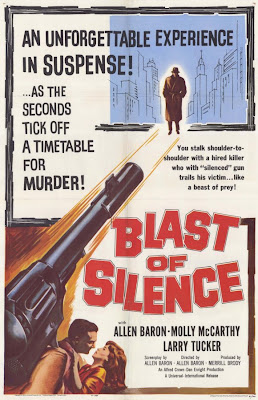
BLAST OF SILENCE (1961, Allen Baron) - The Criterion Collection continues to be a fantastic resource for things cinematic, particularly little orphan films like this one, a cult item from the tail-end of the original noir cycle that’s been talked about so highly and for so long it frankly had a large reputation to uphold, due mostly to my naturally raised expectations (a fate very similar in my personal trail of film discovery to Leonard Kastle’s classic one-shot THE HONEYMOON KILLERS). BLAST OF SILENCE is certainly a quirky film, featuring an interior narration that serves to amplify the solitude and disgust of the main character, a contract killer (played by the director) who goes coldly and deliberately about his business until the hands of noir fate start to gum up the works. But the unusual narration is hardly the only element of the film that stands out; the period flavor of New York City and certain landmarks (Harlem and the Apollo Theatre, the Village Gate nightclub, etc) is so thick that it virtually becomes another character, and the visuals lack the polish of even most B-grade Hollywood noir yet are smartly filmed and edited. Yes Martha, this is surely low budget stuff, and the acting often lacks the professionalism that helps to ground even modest studio filmmaking with a degree of perceived ‘normalcy’. That’s not to say the acting is ‘bad’. Most of the players had obviously acted before, and they are believable in their roles; it seems more likely that the non-polish on display had more to do with tight shooting and lack of retakes. One actor does stand out, though. Larry Tucker plays an obese, bearded hoodlum and achieves a formidable level of weirdness. The movie is worth watching for his performance alone, but it’s even better that Baron was able to integrate the actor’s energy into his mise en scene with such success. There is definitely some impressive raw inventiveness going on in BLAST OF SILENCE, particularly the nastiness of the violence, the anti-social nature of the hit man (and how his one attempt to reestablish contact with someone from his past throws his whole world out of balance), and an ending that uses its blunt inevitability as strength - i.e., you can see it coming a mile a way, but this knowingness of what’s going to happen adds a fine sum to the film’s total equation. Yeah, by the end, I was hooked. This is as fine a piece of left-field, no-sheen filmmaking as I’ve seen in quite a while. Now that I have actually watched it I guess Irving Lerner’s MURDER BY CONTRACT moves to the top of my most salivated over rare films noir list. And that one’s currently available. What an unlikely twist of good fortune.


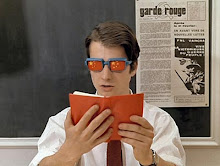
THEY LIVE (1988, John Carpenter) - This one has grown into a solid ‘cult’ item, and deservedly so. It’s hard to think of a better example of a smart movie (in both content and form) lurking in the folds of what so many perceived as just another silly action flick. Carpenter’s work is probably never going to be championed by high-brows (at least not in this country), but that’s their (our) loss. Of course, the director deliberately muddies the waters by working at extremes. On one hand, his ideas about consumerism and societal conditioning are blaringly clear, yet they are delivered through a genre piece that’s usually reserved for popcorn-movie escapism. He rather subversively casts pro-wrestler Roddy Piper as his lead actor, for crying out loud. What’s lastingly great about this movie is how the direction never sells the content short. On the contrary, by using the story device of the truth telling sunglasses, Carpenter is able to utilize formal elements to really push his themes to strong levels without weakening the story’s tight construction. So, he can make a BIG point without the viewer feeling like s/he’s been clubbed over the head. The sharp contrast between the rather conventional progression (in the Hawksian sense) of the film up to the moment where Piper puts on the sunglasses and how the narrative momentum is momentarily derailed while our protagonist gets smacked with the blunt black and white reality of subliminal mind control just screams to be experienced in a darkened movie theatre. From the point of this all important discovery the movie delves into some darkly comic playing around with genre tropes (particularly a fight scene that expertly flirts with parody and one of the hammiest lines of dialogue ever delivered) before boiling down to a fine riff/update on 50s-style sci-fi belief stretching and concluding in a rather abrupt, oddball ending. Yeah, it’s a humdinger. But again, the real strength in Carpenter’s work lies in its economical, concise construction: the image of a piece of cash currency holding the words ‘THIS IS YOUR GOD’ is just a visual grand-slam, for it says in a few seconds what Oliver Stone’s ‘Wall Street’ spent over two hours agonizing over (and paradoxically unwittingly glamorizing). Within Carpenter’s razor sharp oeuvre (up to around the end of the ‘80s, anyway), this is top four, easily.


NASHVILLE (1975, Robert Altman) - I’ll cop to not having watched all of this film until something like my fifth attempt, even though I really like many of Altman’s films quite a bit. This is over two and one half hours set in the city of the movie’s title that concerns characters that have some sort of relationship (either entrenched or peripheral) to the city’s country music scene. There is also a ‘third-party’ political campaign that features in the story, and the way this connects to the city’s music business and the characters that populate and surround it is a basic canvas that ends up growing into a wall sized mural by the film’s end. Altman can be smug and condescending at times, and the population of his ensemble cast unfortunately doesn’t hold anything resembling equal importance in the story. Unfortunately, much of the short shrift goes to women. Shelly Duvall’s character, an anorexic interloper from California, is essentially a mean-spirited joke that basically just requires her to walk around either in ‘wacky’ clothes or her underwear, and Geraldine Chaplin’s BBC reporter becomes increasingly hard on the nerves as she alternately stereotypes what she perceives as clueless simple folk and amateurishly philosophizes about what they ‘really’ signify. But the cynical 70’s Altman is never without bountiful rewards. The film doesn’t really have a plot; instead, it uses a gradual accumulation of group activity to impart essential information as to where the film is going and to explain the motivations and personalities of the characters. Along the way, actors who play the part of performers sing songs that they often wrote themselves (Karen Black’s being the most interesting/successful), and the rather strange vibe of the whole Hal Phillip Walker political campaign really settles into the general fabric of the film. How the presidential candidate is represented in the movie is a shrewd formal device. We never actually see him, but we sure as hell hear him, due to a megaphone wielding van that travels the city blaring out the man’s calm screeds of ‘populist’ dissatisfaction (that seems to obscure the ogre of grassroots fascism). Michael Murphy’s campaign manager does appear however, giving the lie to Walker’s platform, and in doing so balancing the sense of political apathy and resignation that is best represented by NASHVILLE’S gospel tinged denouement song ‘It Don’t Worry Me’. In the context of the movie, the song represents a snide commentary on the post-60s feel-good political defeatism that’s being propagated in the film by a folksy trio seemingly based (loosely) on Peter, Paul & Mary. As the true nature and motivation of Murphy’s character comes into focus, so does the thrust of Altman’s film. The idea that corruption infects everything it comes in contact with, causing either more corruption or deflated acceptance/lack of resistance is certainly representative of the 1970s mindset, both artistically and culturally. By the ending (which I won’t spoil if you haven’t seen it), Barbara Harris’ success-crazed character is on Nashville’s Parthenon steps (the concept of the city as ‘Little Athens’ is tellingly mentioned by a character) belting out the aforementioned tune, and every time she wails the song’s title what she’s really saying can be summed up as follows: “EVERYTHING (AND EVERYBODY) IS FUCKED. We might as well just sing about it (READ: sing ‘around’ it.)” Probably not the best movie to watch during an election year (particularly on those occasions where you’re faced with the lesser of something or other), it still rates as a flawed and sprawling masterpiece. Altman definitely bit off more than he could comfortably chew (at the Big Banquet of Cynicism), but I’ll take that over the work of filmmaker’s who seem reluctant to even nibble at the hors d’oeuvres table (at whatever ideological feast they find themselves attending), and in turn leave me famished for something in which to sink my teeth.


THE BAD NEWS BEARS (1976, Michael Ritchie) - So sports movies almost always suck. Bio-pics are about the only type of film that has a lower success rate in my personal estimation, and when bio-pics are done on sports figures, you can almost guarantee that the result will stink up the room (an exception would be Scorsese’s RAGING BULL, though it’s arguable if bio-pic is really the appropriate descriptor for that discomforting masterpiece). This movie isn’t a bio-pic, natch, but it does concern a little league baseball team, and it’s one of the first films that I can recall watching as a kid. I hadn’t thought much about it until recently, when I caught some of it on cable, and found myself pretty wrapped up in it, party due to sentimentality, but also because it’s sort of an aberration. The movie is not so much about sports. It’s really about the desire for winning growing into a disease, and also about the emotional and physical damage that kids and adults inflict on each other (and themselves). I found a cheap DVD of this for sale and impulsively bought it, curious as to how the whole film held up. I don’t regret spending those six bucks for a second. Now I must confess ignorance regarding the other films by this director, but reading about his 70’s work brought up a recurring theme: competition. Previous to this movie, he’d directed a duo of films with Robert Redford, one about skiing (DOWNHILL RACER) and one about presidential politics (THE CANDIDATE), then followed that up with a commercially unsuccessful feature about beauty pageants (SMILE) that has some critical admirers. I’d really like to see that one. But what does BEARS have other than nostalgia for my younger days? Quite a lot, actually: the movie is visually assured but modest, which fits the story. The outdoor scenes often have a sun drenched dustiness that’s appropriate. The vast majority of the movie takes place during the daytime and while my observation about that is rather blunt, I’ll make it anyway: Ritchie is determined to shed light on both the nature of his cast of characters and the environment they find themselves in. It makes perfect sense to place nearly all of the narrative in the sharp brightness of daylight, where the actions of the people and the harsh reality of the situation are on full display. There are also some very effective shots, successions of shots to put a fine point on it, of character’s observing, listening, and reacting to the words and actions of others. Walter Matthau’s alcoholic team manager is fascinating: in a less complex film he would be a flawed yet angelic character who takes a group of inept misfits under his wing and in the process warms the hearts of the audience while becoming a better person. Not here. Morris Buttermaker only takes the job because he’s getting paid (bottom-feeding opportunist) and proceeds to drive the hapless group of kids around while drunk, at one point passing out from sheer inebriation on the field during a practice. His dugout rants are the antithesis of feel-good audience manipulation, and again, the reaction shots of the kids are infused with a sharp passivity. They’ve heard it before, but now it’s coming from someone who’s supposed to be on their side. Due to the inclusion of two talented players, the Bears slowly improve and improbably but inevitably end up in the championship game, where Ritchie gets the opportunity to integrate his thematic and visual ideas with real success. The game unwinds slowly, giving the illusion of real time. This helps adequately situate the actions of the characters, particularly the two adults, Buttermaker and the opposing manager played by Vic Morrow. Morrow is surely the ‘bad guy’ in the film, but his success at winning is the only thing that really allows him to play that role effectively. Buttermaker is a loser, but he’s also a lout, and at one point he angrily showers the Bears’ female pitcher (played by Tatum O’Neal) with beer when she won’t stop trying to orchestrate some off-season activities between her and him and her mom (who happens to be Buttermaker’s ex-girlfriend). All she wants is some adult stability (some normalcy) in her life, and for her troubles she ends up with a noggin soaked with suds. Ritchie’s world isn’t one of heroes and villains. Instead, it’s loaded with winners and losers. Often they do the same things, but the blatant objectification of success (and how that bleeds over into how people treat others) gives the actions of the winners a distasteful effectiveness. His losers aren’t noble as much as they are lucky. They get the opportunity to learn some important things before the druggy rush of success somehow finds them and dulls the chance that they will navigate the progression to adulthood with some semblance of human decency intact. In THE BAD NEWS BEARS, the grown-ups are pretty much a lost cause. The hope for the future lies with the kids.


MY BLUEBERRY NIGHTS (2007, Wong Kar Wai) - critical reaction to this one was generally not good. Wong Kar Wai is a Chinese director based out of Hong Kong who had a boost of notoriety a few years back due to the fandom/advocacy of Tarantino, who released Wong’s CHUNGKING EXPRESS under his ‘QT Presents’ series. This is Wong’s first film based in the US, and it seems that most of the movie’s detractors have a problem with the application of the director’s slow, lush style to the American setting. For me however, this reality is what makes the film so interesting. The story: A woman (Norah Jones) has been dumped by her boyfriend. She meets a café owner in New York (Jude Law) and drowns her sorrows in his menu. Then she lights out for the road, ending up in Memphis where she works two jobs, diner work and bartending, in an attempt to save money. She meets an alcoholic cop and his estranged wife and is witness to their problems. She writes postcards to the café owner back in New York. Then she ends up out west, working in a casino, where she meets a callous gambling woman (Natalie Portman) who asks her for money. They end up traveling together for a while before parting, and the story concludes back at the café in New York. Wong tackles the American road movie genre without sacrificing what makes his films intrinsically his. He never ratchets up the momentum, elects to avoid the detailing of traveling to instead spend more time focusing on the atmosphere of her destinations, and gives meaning to objects (keys, food, plastic chips) that flies in the face of the more conventional ‘road movie’ signifiers (cars, pavement, radio). Most people seem to view the disjointed nature of the movie as a failure, probably due to the lack of any great insights on Wong’s part. Yes, he plays around with road movie tropes, but ultimately this is a love story. Love stories in the movies were old hat before talking films were perfected. But again, Wong screws around with the convention of the love story. For Jones’ character to actually, legitimately fall in love with Law’s character, she has to end up on the other side of the goddamned country. When they first meet, she’s hurt and preoccupied with the guy who’s just told her to get lost, and instead of filming a story about two nice people who eventually fall in love due to their proximity to each other (with misunderstandings, emotional pyrotechnics, and other hijinks in evidence), Wong instead wisely separates the two. Law’s character stays stationary in his café, which is just how it should be. He knows what he wants, but was smart enough to know better than to pursue any sort of deeper emotional interaction with her at the beginning of the film. She’s deep in the messiness of ‘On The Rebound’, and she quickly spirals out of New York and under the pretext of ‘working excessively to avoid thinking about her situation’ (which happens to be the exact opposite of ‘checking in to see what condition your condition is in’, har-dee-har-har), she actually absorbs clarity and emotional stability from the difficulties of others. All of this is filmed with a non-judgmental distance that I find refreshing. That might be the final blow that has heaped this film with such disfavor. One thing American movies do far to fucking much is present situations where the audience is intended to root for certain characters and disdain others, and in the process judging the former as worthy of admiration and praise and the later as deserving disdain or opprobrium (Where does Wong get off coming to this country and making some weird riff on road movies that instead reveals itself to be actually a love story but we actually don’t know that until the end and where’s the fun in that, especially when he doesn’t even have any bad guys?). This is not to say that his characters don’t change. Wong expertly shifts sympathy on the Memphis couple without ever sacrificing the film’s tone. And the gradual layering of Portman’s character is also well done. In conclusion, many have said that with this picture Wong had ‘lost it’, but I just can’t agree. What he did by making a movie in the USA wasn’t doling out more of the same. This film is unique in Wong’s oeuvre, and it’s also unique in the landscape of recent English language film. It’s not as great as Wong in full Asian mode, but I don’t think it’s intended to be. In its low-key aspiration, I think it succeeds mightily.

Thursday, February 11, 2010

The Auteur Files #4: Robert Siodmak's THE FILE ON THELMA JORDON

I typed this up a few years ago and was inspired to retool it a bit for posting since director Robert Siodmak has been getting some blog comment section action over the past week at Dave Kehr's site, and also a post devoted to him at Glenn Kenny's excellent blog SOME CAME RUNNING. This'll be just the tiniest squeak next to their collective roar, but I'm cool with a wide and varied sonic spectrum. Aren't you?


Robert Siodmak (pronounce it See Odd Mack) directed some truly classic films. THE KILLERS and CRISS CROSS both starred a young Burt Lancaster, and those two movies sit at the top of the heap of late 40’s noir, the former based on an Ernest Hemingway story. Siodmak had a relatively short period of prime productivity, about ten years (1943-53), and he’s considered a director who never excelled at another genre beside the mid-century’s quintessential American staple of gloomy, fatalistic black and white pessimism. This might be why the guy’s essentially forgotten. Unlike some noir filmmakers, Siodmak didn’t work on Poverty Row pictures with no-name or has-been actors: he made films with studio budget and muscle behind him, and in the late’40s the types of movies he directed could be compared in terms of contemporaneous significance to the work of guys like Billy Wilder and John Huston. In 1946 he directed three films, which is striking by today’s standards of productivity, but I bring it up because all three of them were nominated for Academy Awards. That doesn’t mean the films are any good of course, but it does make it seem even odder that his name isn’t better known. In contrast to Siodmak’s truncated career, Wilder and Huston both directed into the 70’s and 80s, making movies that ranged from comedies to literary adaptations. THE KILLERS is in the Criterion Collection in a nifty two disc edition with the 1964 (also classic) Don Siegel version, however, and currently Siodmak’s output can be accurately assessed as an ‘underground’ taste awaiting an overdue reemergence.
THE FILE ON THELMA JORDON is one of the more difficult Siodmak films to see, due to the fact that it has apparently never been released on VHS or DVD, at least in this country. Again, this is weird, due to Barbara Stanwyck playing the lead, and the plot’s rough similarity to Wilder’s DOUBLE INDEMNITY, where Stanwyck also starred. I sat down for a TCM showing and found that while the film isn’t as strong as either THE KILLERS or CRISS CROSS, it is a fine work that holds complexity, nuance, and quiet, assured visual flair.


This is early noir, so it doesn’t quite reach for the bleak inky blacks and doom laden scenarios that are attributed to many famous films of this style/cycle as it reached its conclusion at the close of the 1950s. Wendell Corey plays a district attorney who’s disillusioned with his marriage. He goes on a bit of a bender on his anniversary and finds himself involved with Stanwyck. She’s a woman with a shady past who is possibly using him as a dupe. There’s an aunt, some jewelry, a recently changed will, a dead aunt, an arrest, a trail where Corey presides as prosecuting attorney and clandestinely sabotages the whole proceeding, and a dude in a fedora lurking around in the shadows. What’s unusual is the film’s intersecting currents of familial breakdown. The DA’s marriage is, on the surface, being plagued by his wife’s intruding parents. This would seem to be an easy enough hurdle to cross. But it isn’t. Underneath is something deeper, something that avoids being made explicit. This failure of communication isn’t given large prominence in the story. No mention is made of the marital problems beyond the overbearing/meddlesome parents. Instead it’s allowed to lurk under the surface where it combines with another crisis of family on Stanwyck’s side of the story. Basically, the narrative hook of the film is the question of her involvement in her aunt’s murder. The very possibility of matricide, when in combination with Corey’s marital logjam, emphasizes the concept of family, and specifically betrayal within its boundaries, as the film’s underlying motif.This may not seem startling, but few films I’ve encountered in this genre are concerned with such a theme. That said the overt thrust of the story does revolve around the question of Stanwyck’s guilt and the drain that Corey’s life finds itself moving down as he surreptitiously aids her case from the side of the prosecution. Corey is nobody’s idea of a great actor (okay, maybe his mother’s), but his ‘adequate’ performance really does something to enhance his effectiveness as a patsy. As he pulls strings and gets deeper and deeper in the shit, his small town schmuckiness (L Fucking 7, man) just grows like a weed and feels pitch-perfect due to the absence of any large, brassy thespian gestures. What a poor sap.


Oh, you poor sucker


-
Stanwyck is great in the lead, which is to be expected. The first half of the movie moves at a more deliberate pace than most noir, and without her skill this could have posed a real problem. But her presence and ability assures that the story is never bland, and when combined with the tight yet expressive direction, the narrative arrives at an expertly filmed sequence where we discover that Thelma’s aunt is no longer among the living. Corey ends up there after the fact (splitting the scene just before others discover him), Stanwyck gets arrested for the murder, and from that point it’s inevitable: human carnage will pile up.
For me, the big payoff of watching this movie is the above sequence, specifically its complexity, the suspense it gathers, and the smoothness with which it’s delivered. There is so much happening in so many different directions, and yet it has such a seamless, easy quality that allows the mounting tension of the story to be the focal point rather than the difficulty of effectively and efficiently depicting the scenario. I really wish that THE FILE ON THELMA JORDON was readily available for plucking from video store shelves or through the mail via Netflix, so that the scenes I’m referring to could be easily accessed and the source of my pleasure better communicated. But alas, this is not the case. Siodmak’s work is perfect fodder for reissue though, and hopefully some company will grab this film (and other hard to see work by him from this period) and give it the release it deserves.
The rest of the film is also well done, holding steady to a suitably downbeat conclusion (I will give away nothing more). Siodmak is accomplished yet restrained, from a visual standpoint. Having strong material such as a complex and solid story/script, a star actress, an experienced supporting cast, and a big studio budget to work with can allow for a polished subtlety that might contribute to why Siodmak continues to be so underrated. Having so many tools at yr disposal helps to erase any desperation on the part of the director to really get the whole thing across and the invisibility of perceived ‘craftsmanship’ can result. If this is the case, that’s too bad, because I feel that Siodmak displays real artistry in this film. Noir is often defined by its extremes; the fringy gut-punches of anonymous conjurers who captured the subterranean malaise that crept up after WWII and spat it back out through movie projectors with strange, doomy darkness and contagious helplessness which makes abundantly clear that these movies were authored by unique, artistic personalities (Edgar G. Ulmer’s DETOUR and Joseph H. Lewis’s THE BIG COMBO spring immediately to mind). THE FILE ON THEMA JORDON isn’t infused with that type of urgency, its artfulness never grabbing the viewer by the collar and demanding significance. It’s never as dark or as bleakly futile as it could have been in some other director’s hands. But that’s what could have been. It’s much more satisfying to deal with the film that actually is. I just wish more people could see it, since it’s a fine piece of work. It is available for internet streaming or download from the Internet Archive, but I mention that hesitantly, since very often films found via that source are in shoddy condition or worse. Again, my viewing was courtesy of the TCM cable channel, so if you are interested in seeing this and forming yr own opinion, I say check yr local listings. Increased familiarity can only help to boost Siodmak’s reputation, and that would be a nice, much needed corrective. And, who knows, the established noir canon could deepen, as well. Wouldn’t that be a kick in the head?


Robert Siodmak

Sunday, January 31, 2010

more late night listening


Kraftwerk’s debut record finds the core duo of Ralf and Florian deep in the heart of Krautrock experimentation. Four extended cuts feature the brittle coldness and abrupt sonic detours which were part of that still fascinating ‘70s German art-rock movement’s aural palate. For those that love that Motorik beat as exemplified by Neu! and Kraftwerk’s later AUTOBAHN (and also absorbed rather smartly into the Stereolab sound), well you can find some of that here. The total sum of the record’s duration is a far more abstract proposition, however. I’d be okay with Radiohead playing some future Super Bowl Halftime show if only for the miniscule chance that they’d decide to pull a cultural fast one and cover this record’s “Ruckzuck”: it’s got a great beat and you can dance to it.


THE LIFE OF THE WORLD TO COME continues The Mountain Goats’ progression into the large, warm, unashamedly polished territory that is coming to define the 2nd or maybe 3rd “era” of John Darnielle’s work. As raw and startling as the early boombox stuff was (is), it’s really starting to feel that his more recent, more “pro” (sorry) albums are going to define this dude’s legacy for subsequent generations. But hell, he’s still got a long way to go. And the mutually beneficial relationship between the sound of Darnielle’s voice and the sturdy beauty of his lyrics continues: when he utters the line “I will do what you ask me to do/because of how I feel about you” in “Genesis 30:3” it gets me every time. As great a record about faith and humanity as I can think of right now.

Lowell Davidson’s sole recording, a 1965 trio date for ESP Disk featuring Gary Peacock on bass and the mighty Milford Graves on drums, is a major work in advanced piano studies. Davidson’s style is comparable to early ‘60s Cecil Taylor in its spikey determination to forge new paths, but his playing also rubs up against the great harmonists Monk and Herbie Nichols. There is higher density and moments of increased momentum on display in Davidson’s sound that when coupled with Peacock and Graves’s righteous refusal to even momentarily entertain the idea of falling into a trad piano trio accompanist role basically insures Davidson will never leave the margins of outsider jazz lore. Only recording one album doesn’t help matters either. Oh well. It’s there if you want it.

Can’t say that I’ve ever really been seduced by the sound of Sinatra. Sure, the stuff with Riddle is a major achievement, particularly when heard on a sweet hi-fi setup, but so much of the guy’s output inspires little else in me than the desire to chain smoke cigarettes and regress into outmoded social mores. Sorry. I kept hearing people speak highly of WATERTOWN however, often making comparisons to Scott Walker. And I’ve only listened to this a few times, but I feel it’s a good one. It may grow into a great one. It definitely has an open desire to engage a rock-era audience, though it never trips up and falls prey to ham-fisted attempts at being hep. There is a lushness and grandiosity that’ll certainly make fans of Walker and Serge Gainsbourg stand up stiff and salute. Did I mention it’s a concept album? No? Well, it is. An ambitious and, dare I say it, classy piece of work.


James Carr has been described at least once as the Syd Barrett of soul. “The Dark End of the Street” is his most famous tune, and while he was never considered a hit maker (seven of his singles made the R&B top 40, though), he’s justifiably legendary for the depth and range of his emotive abilities and for the focused uniqueness that defines his work for the Goldwax label. Carr excels in my ears at mid tempos, where he recalls the sturdiness of Otis Redding while never sounding even remotely like a rote copyist. The bands backing up Carr on THE COMPLETE GOLDWAX SINGLES are simply shit hot, landing in classic southern soul territory defined by Stax and Muscle Shoals, but with more modest recording circumstances lending the music a tougher, more garage-like feel. And frankly, there’s not a bad song in the bunch. Even a dangerous endeavor like covering the Bee Gee’s twee-pop nugget “To Love Somebody” succeeds. Every bit of James Carr’s retroactive status as a deep soul superstar is deserved.

Thursday, January 28, 2010

Late night listening


Pere Ubu’s THE MODERN DANCE is one of the strongest and strangest debut records to ever lose record company money, a wild, weird, and tough as nails mixture of punk and experimentalism that could only have been birthed in the dark days of 1970s Cleveland: a little chugging, some misshapen dub, blown out tire rubber on the side of the highway, broken glass and synthesizer shrapnel, and frontman David Thomas as Dadaist ringleader. As intellectual and idiosyncratic a piece of punk rock that ever was, yet fiercely proletarian. Ground level stuff, dig?


And THIS IS DESMOND DEKKAR is as soulful a slab of island ska as you are likely to find. Slinky grooving with just the right amount of backbone, this stuff (at least for me) sounds best on warm and breezy summer days while lounging half crocked (or half baked) in a lawn chair imagining those big fluffy clouds are really smoke signals from giant invisible Indians. They’re trying to tell us something.


Certain recordings possess a greatness that resists being adequately expressed with brevity of language. They really must be heard, soaked up in real time, allowed to impact the mind and body with the totality of the sound, the inexhaustible and irresistible nature of the creative impulse, and THEN if you write 50,000 words on the workaday brilliance, the genuine offhand mastery of Sam Cooke tearing down the house LIVE AT THE HARLEM SQUARE CLUB (just one night among many), you might get lucky and land somewhere close to the ballpark of doing the record some serious justice. Two figures tower behemoth-like over the creation of soul music: Ray Charles and Sam Cooke. If you need a primer in the genius of Soul Stirrer #1, this will hand yr ass to you but good.


SCORPIO is a vital document of free-jazz in the late-1960s expatriates in France style (BYG/Actuel division), featuring three horribly under-recorded guys: session leader Arthur Jones on fiery post-Shepp-ian sax, Bob Guerin doing a sweet and loose variation on Jimmy Garrison stylistics on bass and Claude Delcloo splashing and slapping and skittering in a slightly (Sunny) Murray-like manner on drums. The trio mingles and melds minds in a very attractive fashion, setting the search-mode to simmer instead of full boil. Small group free-jazz is most often still about communication (in contrast to large group excursions where the objective is collective catharsis and wall pinning mania). SCORPIO holds much warmth and thorny beauty in its two grooves.


Bert Jansch was one of the prime UK folkies of the 1960s. His playing and singing deftly mixed toughness and prettiness, weariness and smoothness, and it’s no wonder the guy remains so revered by those turned on by the starkness of acoustic guitar and a nude voice. These are the assured initial efforts of a major artist. If you dig pre-psyche Donovan and don’t know Jansch, then you’re missing a big piece of the puzzle.